Synthesis of Selaginpulvilin D by [2 + 2 + 2] CyclotrimerizationA Second-Generation Approach
Sundaravelu Nallappan, Lukas Rycek

TL;DR
Scientists improved the synthesis of a compound called selaginpulvilin D using a more efficient and practical method.
Contribution
The new synthesis uses a [2 + 2 + 2] cyclotrimerization to efficiently build the fluorene core of selaginpulvilin D.
Findings
The [2 + 2 + 2] cyclotrimerization now provides high-yield access to the fluorene core.
The new strategy avoids the need for a difficult-to-prepare intermediate.
The synthesis is more practical, efficient, and modular.
Abstract
We report a second-generation synthesis of selaginpulvilin D that addresses key limitations of our earlier route. An efficient early-stage [2 + 2 + 2] cyclotrimerization now provides high-yield access to the molecule’s fluorene core. Previously, this step was low-yielding and relied on a difficult-to-prepare aryldiyne intermediate. By introducing the arylalkyne moiety after the cyclotrimerization, the new strategy removes these issues and delivers a more practical, efficient, and modular pathway to selaginpulvilin D.
Genes, proteins, chemicals, diseases, species, mutations and cell lines named across the full text — each resolved to its canonical identifier and authoritative record.
Click any figure to enlarge with its caption.
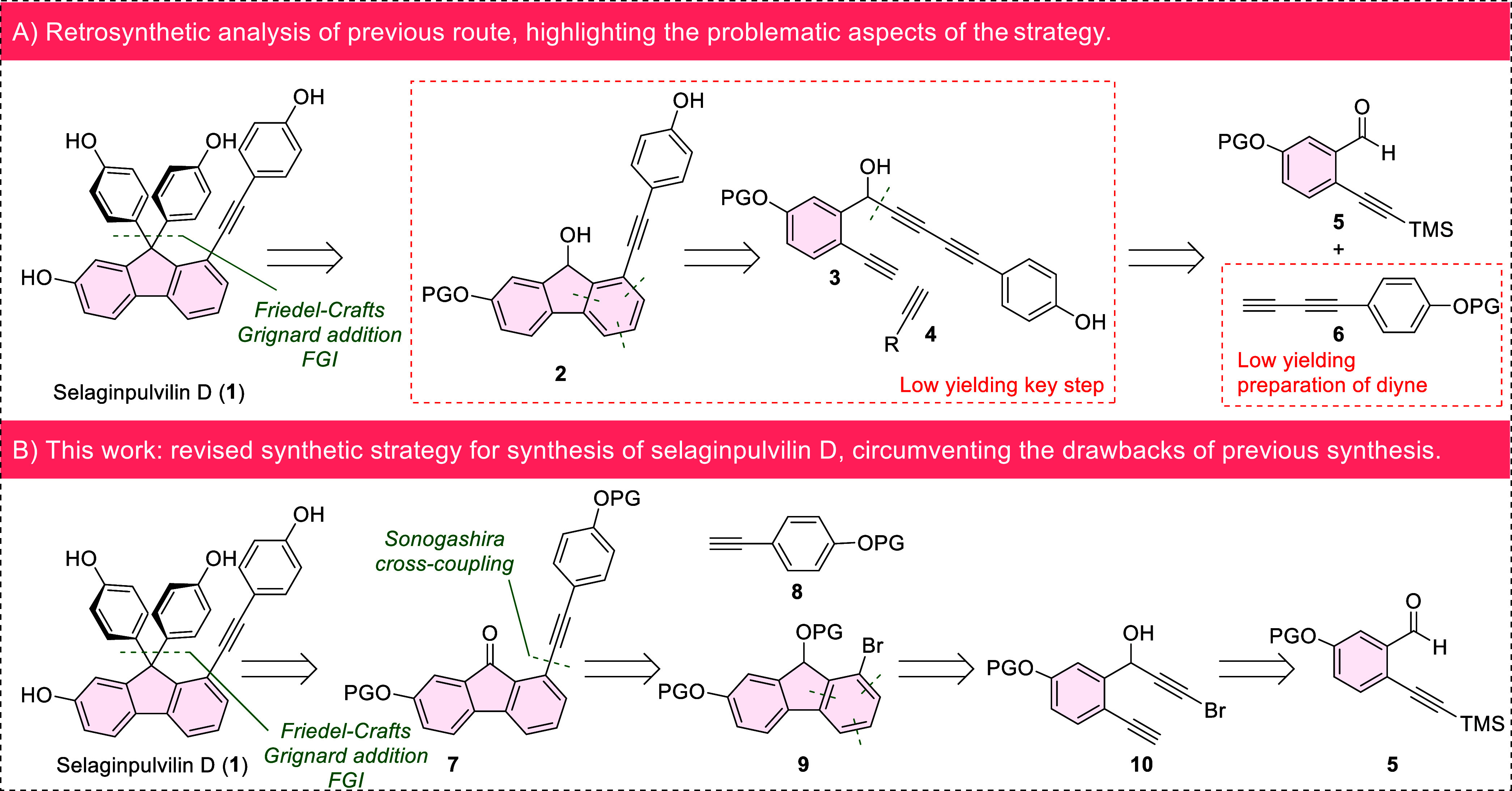 Figure 1
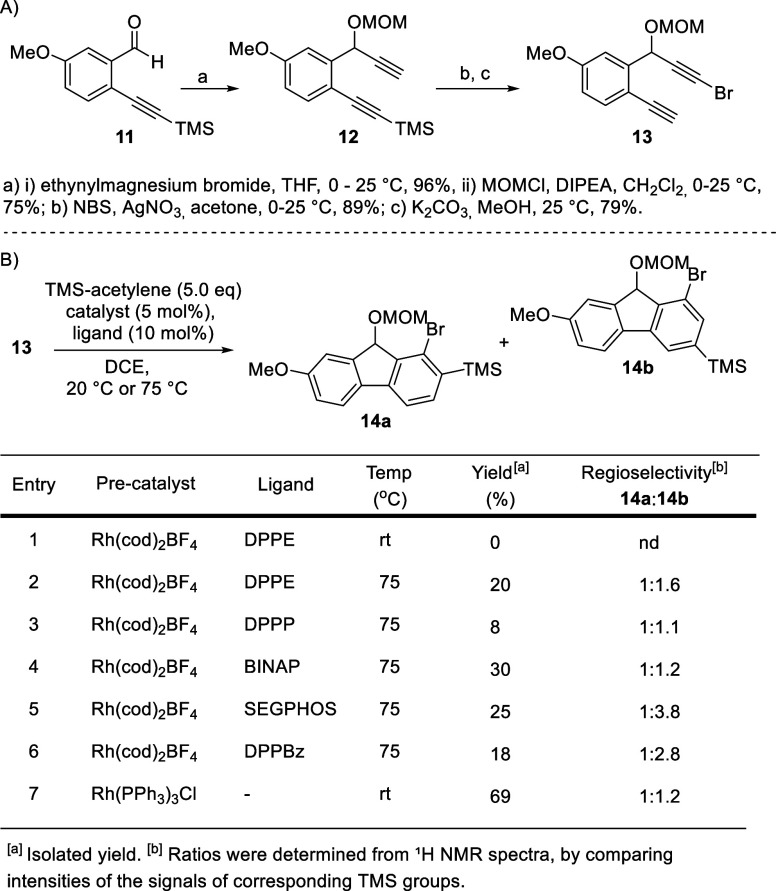 Figure 2
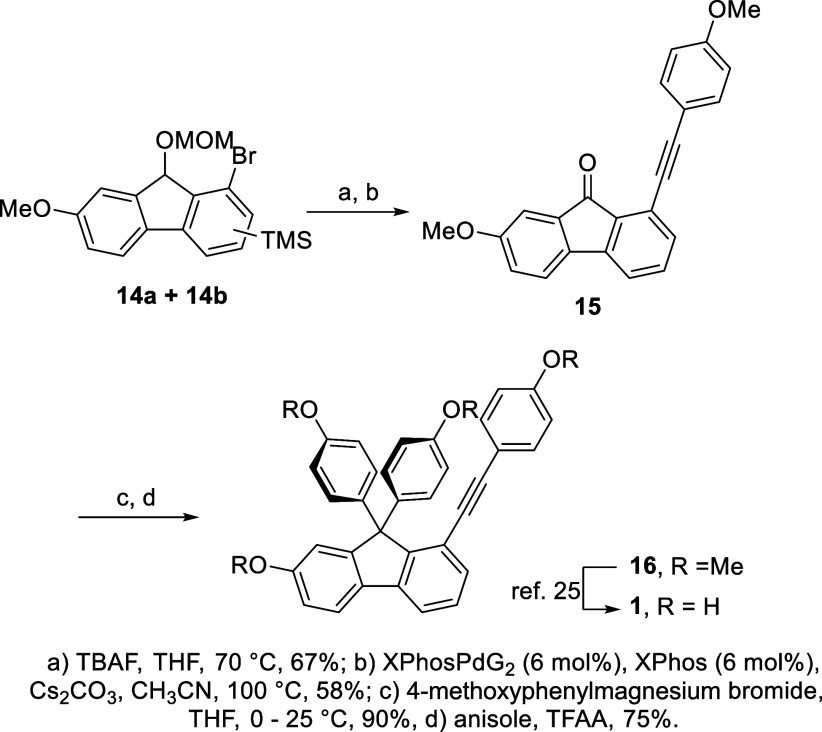 Figure 3
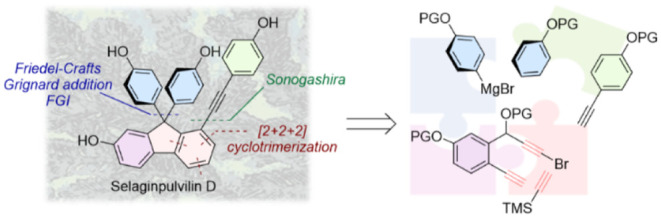 Figure 4
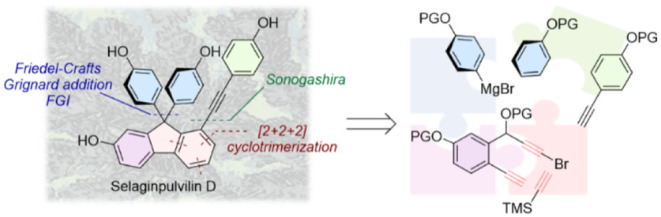 Figure 5
- —Univerzita Karlova v Praze10.13039/100007397
- —Univerzita Karlova v Praze10.13039/100007397
Peer Reviews
No public reviews on file for this paper yet. If you reviewed it on a platform where reviews are public (OpenReview, ICLR, NeurIPS, ICML), you can paste yours below so the community can read it here.
Videos
No videos yet. Explain this paper in a talk, walkthrough, or lecture? Add one.
Taxonomy
TopicsPhytochemical compounds biological activities · Cyclization and Aryne Chemistry · Biological Activity of Diterpenoids and Biflavonoids
Plants of the genus Selaginella are considered living fossils, having persisted on Earth for an estimated 400 million years.? The genus comprises over 700 species, many of which have been used in traditional folk medicine to treat a variety of conditions, including jaundice, gonorrhea, acute hepatitis, asthma, dysmenorrhea, and traumatic injuries. ?,? Extracts of these plants have shown various biological activities, such as anticancer, anti-inflammatory, antimicrobial, antioxidant, antiviral, and other in vitro and in vivo effects. ?−? ? Some species of the genus, particularly Selaginella pulvinata and Selaginella tamariscana, are rich sources of structurally diverse natural polyphenolsreferred to as selaginellaceae polyphenols. These include selaginellins,? selagibenzophenones, ?−? ? ? ? and selaginpulvilins, ?−? ? among others.? Notably, many of these compounds are unique to these species and have not been identified in any other plants. The structural peculiarity and biological activity of selaginellaceae polyphenols have attracted the attention of many researchers, including us. We have been engaged in the development of the synthesis of several natural products, including selagibenzophenones A and C. ?,? We also demonstrated that a compound previously isolated and described as selagibenzophenone B was incorrectly elucidated; in fact, the authors had isolated selagibenzophenone A.? We further developed the synthesis of selaginpulvilin X,? selaginpulvilin C, and selaginpulvilin D.? In addition, we developed the synthesis of unnatural derivatives of selagibenzophenone A and B and discovered their selective cytotoxic properties against prostate cancer cell lines. ?−? ?
Among the natural products, selaginpulvilins (such as selaginpulvilin D, Figure), isolated from Selaginella pulvinata, are especially remarkable for two reasons: their structurally unique fluorene-based frameworks, which attract the attention of synthetic chemists, and their promising biological activity, underscoring their potential importance in medicinal chemistry. Selaginpulvilins exhibited strong inhibitory activity against PDE4D2, with IC_50_ values as low as 0.11 μM. ?−? ?,? This potent activity may help explain the healing effect of Selaginella pulvinata.
Several syntheses were developed toward various selaginpulvilins, including strategies based on: (a) a tetradehydro Diels–Alder reaction of an enyne–diyne, ?,? (b) a hexadehydro Diels–Alder reaction of a tetrayne,? and (c) sequences comprising cross-coupling reactions and an intramolecular S_E_Ar reaction.? Moreover, we have recently disclosed a new synthesis of selaginpulviline C and D based on [2 + 2 + 2] cyclotrimerization of a substituted 1,3-diyne-yne 3 with alkynes 4 (Figure, A).? [2 + 2
- 2] cyclotrimerization is an efficient method for constructing aromatic and heteroaromatic compounds,? using various catalysts such as rhodium,? ruthenium,? cobalt,? nickel,? iron,? or others.? It has been successfully applied in the preparation of various natural products? or molecules with potential applications in material sciences.? The effectiveness of our modular approach in the synthesis of selaginpulvilin D was, however, compromised by a low yield of the key [2 + 2 + 2] cyclotrimerization step, particularly in the case of selaginpulvilin D. The desired fluorenol 2 was obtained in only 36%. Another problem that we encountered was the low-yielding preparation of diyne 6, which was obtained in three steps with a poor 27% yield.
Herein, we report a revised synthetic strategy for the formal total synthesis of selaginpulvilin D (1), based on a [2 + 2
- 2] cyclotrimerization of brominated diyne 10 (Figure, B). This approach enables the early construction of the substituted fluorene core in good yield. The arylalkyne moiety is introduced into the molecule after the key [2 + 2 + 2] cyclotrimerization via Sonogashira coupling of the bromide with arylacetylene 8, allowing us to circumvent the use of diyne 6. Subsequent transformations of fluorene 9 complete the formal synthesis of selaginpulvilin D while overcoming the main limitation of the previously reported route.
Synthesis began from alkyne 11,? which was treated with ethynylmagnesium bromide, and the resulting alcohol was, without further purification, protected with a MOM group to afford alkyne 12 in an overall 72% yield. Bromination of the terminal alkyne and basic methanolysis of the TMS group provided the key dialkyne 13 in 89% and 79% yield, respectively (Scheme, A).
Having obtained diyne 13, we carried out a [2 + 2
- 2] cyclotrimerization to construct the key structural motif of selaginpulvilin D (1), namely, the fluorene core. Based on our previous experience, ?,? we examined catalytic rhodium precatalyst Rh(COD)2_BF_4 in combination with various bidentate ligands, such as DPPE, DPPP, BINAP, SEGPHOS, and DPPBz. However, the reactions provided the desired fluorene in unsatisfactory yields, ranging between 8% and 30% (Scheme, Table 1, entries 1–6). We did not observe any significant or only slightly increased selectivity for regioisomer 14b (up to 1:3.8 for 14a:14b). To our delight, the yield increased to a good 69% when the reaction was carried out with Wilkinson’s catalyst at room temperature (Scheme, Table 1, entry 7). We obtained a mixture of two regioisomers, 14a and 14b, in the ratio of 1:1.2 (14a:14b). The low selectivity of the transformation does not pose a significant problem for the total synthesis, since both isomers can be converted into the natural product in subsequent steps.
To finalize the synthesis of 1, the mixture of regioisomers 14a and 14b was, in two steps, converted to fluorenone 15 (Scheme). First, treatment of 14a and 14b with TBAF resulted in the cleavage of the TMS group from the aromatic core and, to our delight, also in the deprotection of the MOM group, followed by spontaneous oxidation to fluorene. Further Sonogashira cross-coupling with 4-methoxyphenylacetylene, catalyzed by XPhosPdG2, furnished the formation of 15, which was obtained in 67% and 58% yields for the respective steps. Further introduction of two aromatic rings by means of a reaction with 4-methoxyphenylmagnesium bromide and a reaction with anisole led to the formation of the protected selaginpulvilin 16 in 90% and 75% yield, respectively. Deprotection of 16 was described previously; thus, the formal synthesis of the natural product was achieved.
In conclusion, we report a modular formal synthesis of selaginpulvilin D (1). The key fluorene core of the natural product was constructed via a partially intramolecular [2 + 2 + 2] cyclotrimerization between diyne 13 and trimethylsilyl acetylene, providing the desired fluorenol in 69% yield. This represents a significant improvement over that of our previous synthesis. The fluorenol was obtained as a mixture of two regioisomers; however, this does not affect the total synthesis, as TMS removal from both isomers yields the same product. The formal synthesis was completed by introducing the arylalkynyl moiety via Sonogashira cross-coupling using 4-methoxyphenylacetylene, which overcomes the low-yield issue encountered with aryldiyne 6 in the earlier route. Finally, two aromatic rings were installed at position 2 of the fluorene core to complete the formal total synthesis. Overall, the new strategy provides an efficient and improved route to selaginpulvilin D (1), addressing several limitations of our previous synthesis.
Supplementary Material
The reference list from the paper itself. Each links out to its DOI / PubMed record.
- 1Banks J. A.Selaginella and 400 Million Years of Separation Annu. Rev. Plant Biol.200960122323810.1146/annurev.arplant.59.032607.09285119575581 · doi ↗ · pubmed ↗
- 2Bailly C.The Traditional and Modern Uses of Selaginella Tamariscina (P.Beauv.) Spring, in Medicine and Cosmetic: Applications and Bioactive Ingredients J. Ethnopharmacol.202128011444410.1016/j.jep.2021.11444434302944 · doi ↗ · pubmed ↗
- 3Shi S.Zhou H.Zhang Y.Huang K.Hyphenated HSCCC–DPPH· for Rapid Preparative Isolation and Screening of Antioxidants from Selaginella Moellendorffii Chromatographia 2008683–417317810.1365/s 10337-008-0716-1 · doi ↗
- 4Adnan M.Siddiqui A. J.Jamal A.Hamadou W. S.Awadelkareem A. M.Sachidanandan M.Patel M.Evidence-Based Medicinal Potential and Possible Role of Selaginella in the Prevention of Modern Chronic Diseases: Ethnopharmacological and Ethnobotanical Perspective Rec. Nat. Prod.202115533035510.25135/rnp.222.20.11.1890 · doi ↗
- 5KřížkovskáB.Kumar R.ŘehořováK.Sýkora D.DobiasováS.KučerováD.Tan M. C.Linis V.Oyong G.Ruml T.Lipov J.ViktorováJ.Comparison of Chemical Composition and Biological Activities of Eight Selaginella Species Pharmaceuticals 20211411610.3390/ph 14010016 PMC 782344433375355 · doi ↗ · pubmed ↗
- 6Yin D.Li J.Lei X.Liu Y.Yang Z.Chen K.Antiviral Activity of Total Flavonoid Extracts from Selaginella Moellendorffii Hieron against Coxsackie Virus B 3 In Vitro and In Vivo Evidence-Based Complementary Altern. Med.2014201495081710.1155/2014/950817 PMC 405524024963331 · doi ↗ · pubmed ↗
- 7Zhang L.-P.Liang Y.-M.Wei X.-C.Cheng D.-L.A New Unusual Natural Pigment from Selaginella Sinensis and Its Noticeable Physicochemical Properties J. Org. Chem.200772103921392410.1021/jo 070117717439180 · doi ↗ · pubmed ↗
- 8Liu X.Tang G.-H.Weng H.-Z.Zhang J.-S.Xu Y.-K.Yin S.A New Selaginellin Derivative and a New Triarylbenzophenone Analog from the Whole Plant of Selaginella Pulvinata J. Asian Nat. Prod. Res.201820121123112810.1080/10286020.2017.137864628952358 · doi ↗ · pubmed ↗