Correction: Arriero-Cabañero et al. Transplantation of Predegenerated Peripheral Nerves after Complete Spinal Cord Transection in Rats: Effect of Neural Precursor Cells and Pharmacological Treatment with the Sulfoglycolipid Tol-51. Cells 2024, 13, 1324
Alejandro Arriero-Cabañero, Elisa García-Vences, Stephanie Sánchez-Torres, Sergio Aristizabal-Hernandez, Concepción García-Rama, Enrique Pérez-Rizo, Alfonso Fernández-Mayoralas, Israel Grijalva, Vinnitsa Buzoianu-Anguiano, Ernesto Doncel-Pérez, Jörg Mey

Abstract
Genes, proteins, chemicals, diseases, species, mutations and cell lines named across the full text — each resolved to its canonical identifier and authoritative record.
Click any figure to enlarge with its caption.
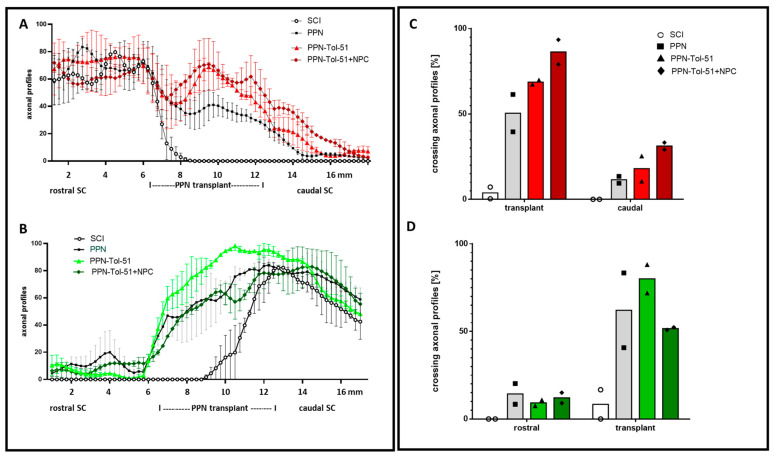 Figure 1
Peer Reviews
No public reviews on file for this paper yet. If you reviewed it on a platform where reviews are public (OpenReview, ICLR, NeurIPS, ICML), you can paste yours below so the community can read it here.
Videos
No videos yet. Explain this paper in a talk, walkthrough, or lecture? Add one.
Taxonomy
TopicsNerve injury and regeneration · Spinal Cord Injury Research · Neurogenesis and neuroplasticity mechanisms
In the original publication [1], there were errors in Table 1, Figure 5 and Section 3.1.
In Table 1, there was an error regarding the number of animals that were lost during the different phases of the experiments. The corrected Table 1 is below.
In Figure 5, the position of the PPN implant was not indicated correctly below the x-axis. The corrected Figure 5 is below:
In Section 3.1, there was an error in the last phrase of the first paragraph regarding the number of animals evaluated at the end of the study. The correct text is below:
To assess axonal regeneration reliably, we made complete spinal cord transections at thoracic level T9. This is a very severe lesion, but it is considered necessary to test spinal reconnection with combinatorial therapy of biomaterials, cell transplantation, and pharmacological agents [30,36,37]. Despite intensive postoperative care, this disease model is characterized by high mortality, specifically during the first month after SCI (Table 1). No animals were lost due to the surgery per se, and after transplantation, there was no indication of sickness behavior or rejection of the transplanted tissue. In the following weeks, eight rats had to be sacrificed due to humane endpoints (urinary infection and self-mutilation). At the designated end of the study, 27 animals were evaluated (Table 1, Figure 1).
The authors state that the scientific conclusions are unaffected. This correction was approved by the Academic Editor. The original publication has also been updated.
The reference list from the paper itself. Each links out to its DOI / PubMed record.
- 1Arriero-Cabañero A. García-Vences E. Sánchez-Torres S. Aristizabal-Hernandez S. García-Rama C. Pérez-Rizo E. Fernández-Mayoralas A. Grijalva I. Buzoianu-Anguiano V. Doncel-Pérez E. Transplantation of Predegenerated Peripheral Nerves after Complete Spinal Cord Transection in Rats: Effect of Neural Precursor Cells and Pharmacological Treatment with the Sulfoglycolipid Tol-51Cells 202413132410.3390/cells 1316132439195214 PMC 11352494 · doi ↗ · pubmed ↗