Seroprevalence and associated risk factors of Toxoplasma gondii among pregnant women in Ain Defla, northwest Algeria
Asma Dahmani, Asma Aiza, Safia Zenia

TL;DR
This study finds that 32% of pregnant women in Ain Defla, Algeria, are infected with Toxoplasma gondii, with rural living and certain dietary habits increasing the risk.
Contribution
The study provides new data on T. gondii seroprevalence and risk factors among pregnant women in Ain Defla, Algeria.
Findings
The overall seroprevalence of T. gondii infection was 32.03% among pregnant women.
Living in rural areas, eating raw vegetables, drinking tap water, and contact with soil were significant risk factors for infection.
Abstract
Toxoplasma gondii (T. gondii) is a serious public health issue, but limited data has been published to date on the seroprevalence of T. gondii infection in Algeria. The aim of this study was to determine the seroprevalence and associated risk factors of T.gondii infection among pregnant women in Ain Defla, northwest Algeria. Blood samples were collected from 300 pregnant women. Serum samples were analyzed to detect T. gondii antibodies (immunoglobulin M and immunoglobulin G) via the enzyme-linked immunosorbent assay (ELISA) technique. Risk factors associated with T.gondii infection was assessed through structured questionnaire. The overall seroprevalence of T.gondii infection was 32.03%. Seropositivity for IgG only was 22.78%, IgM only was 2.14% and cooccurrence of IgG/IgM was 7.12%. Pregnant women who lived in rural areas (OR= 1.739; 95%CI: 1.009–2.997; P=0.045), eat raw vegetables…
Genes, proteins, chemicals, diseases, species, mutations and cell lines named across the full text — each resolved to its canonical identifier and authoritative record.
Click any figure to enlarge with its caption.
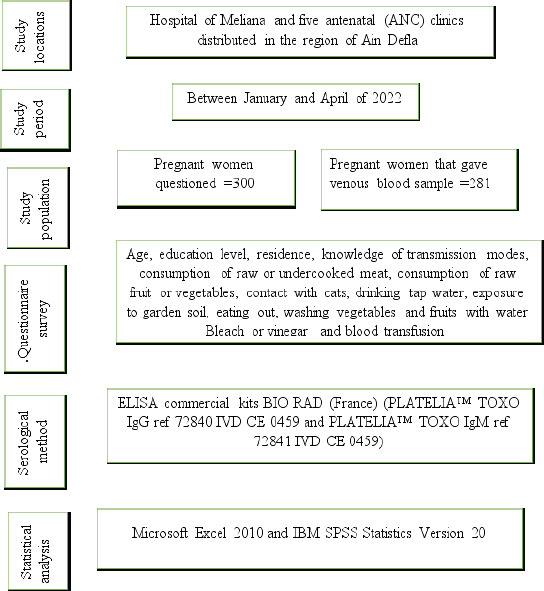 Figure 1
| ELISA | N | Number of women tested | ||||
|---|---|---|---|---|---|---|
| Positive | Negative | P-value | ||||
| test | No | % | No. | % | P<0.0001 Test de khi-deux | |
| IgG | 70 | 64 | 91.43% | 6 | 8.57% | |
| IgM | 70 | 6 | 8.57% | 64 | 91.452% | |
| IgG & IgM | 211 | 20 | 9.48% | 191 | 90.52% | |
| Variables | N | Seropositive | Seronegative | P | OR | CI 95% | ||
|---|---|---|---|---|---|---|---|---|
| n | % | n | % | |||||
|
| ||||||||
| < 30 years | 174 | 53 | 30.5 | 121 | 69.5 | 0.472 | 0.829 | 0.496 – 1.384 |
|
| ||||||||
| University | 130 | 38 | 29.23 | 92 | 70.76 | 0.351 | 0.786 | 0.474 – 1.304 |
|
| ||||||||
| Rural | 78 | 32 | 41.02 | 46 | 58.97 | 0.045 | 1.739 | 1.009 – 2.997 |
|
| ||||||||
| Yes | 198 | 62 | 31.31 | 136 | 68.68 | 0.691 | 0.895 | 0.519 – 1.545 |
|
| ||||||||
| Yes | 44 | 9 | 20.453 | 35 | 79.54 | 0.073 | 0.495 | 0.227 – 1.081 |
|
| ||||||||
| Yes | 142 | 60 | 42.252 | 82 | 57.74 | <0.001 | 2.659 | 1.575 – 4.488 |
|
| ||||||||
| Yes | 66 | 24 | 36,363 | 42 | 63.63 | 0.388 | 1.29 | 0.723 – 2.30 |
|
| ||||||||
| Yes | 108 | 54 | 50 | 54 | 50 | <0.001 | 3.806 | 2.248 – 6.442 |
|
| ||||||||
| Yes | 70 | 35 | 50 | 35 | 50 | <0.001 | 2.836 | 1.620 – 4.967 |
|
| ||||||||
| Yes | 7 | 4 | 57.143 | 3 | 42.85 | 0.216 | 2.915 | 0.638 – 13.307 |
|
| ||||||||
| Yes | 203 | 50 | 24.635 | 153 | 75.36 | <0.001 | 0.310 | 0.180 – 0.536 |
|
| ||||||||
| Yes | 173 | 48 | 27.74 | 125 | 72.25 | 0.051 | 0.603 | 0.362 – 1.005 |
| Observations | Forecasts | |||
|---|---|---|---|---|
| Results | Percent correct | |||
| Positive | Negative | |||
| Results | Positive | 35 | 55 | 38.9 |
| Negative | 27 | 164 | 85.9 | |
| Overall percentage | 70.8 | |||
Peer Reviews
No public reviews on file for this paper yet. If you reviewed it on a platform where reviews are public (OpenReview, ICLR, NeurIPS, ICML), you can paste yours below so the community can read it here.
Videos
No videos yet. Explain this paper in a talk, walkthrough, or lecture? Add one.
Taxonomy
TopicsToxoplasma gondii Research Studies
Introduction
Toxoplasmosis is considered as one of the main infectious agents during pregnancy1. It is mainly acquired by eating raw or undercooked meat that contains T. gondii tissue cysts, by ingesting oocysts shed by cats from soil, by drinking contaminated water, and by vertical transmission from mother to fetus through the placenta during pregnancy2,3,4,5. The tissue cyst-forming coccidium T. gondii is one of the more polyxenous parasites known to date. It has a facultatively heteroxenous life cycle and can probably infect all warm-blooded animals (mammals and birds) and humans6. Cats and other members of the Felidae are the definitive hosts of the parasite and shed the oocysts after they are infected. These oocysts contain infective sporozoites that can then cause human infection by fecal-oral transmission. Humans can also be exposed to bradyzoites, contained in tissue cysts of the intermediate hosts—particularly food animals—through consumption of improperly cooked meat and meat products or water7. The immunologic response to primary infection is followed by encystment of the parasite (latent toxoplasmosis), providing life-long immunity. Possible reactivation of latent infection in an increasingly immunosuppressed population, however, makes toxoplasmosis an important opportunistic infection8. Several factors are associated with Toxoplasma prevalence, including low socioeconomic status, owning cats, eating raw or uncooked meat, eating raw or unwashed vegetables or fruits9, having poor hand hygiene10,11 and contact with soil12,13.
However, to date, the relative effects of each of these factors have not been fully established, except for the fact that they vary from area to area. Although, when maternal infection is acquired during pregnancy, T. gondii can infect the fetus with variable severity. However, congenital infection during the first trimester can lead to more severe disease when it occurs14. The seroprevalence of T. gondii infection is extremely varied greatly among different countries6,15, among different geographical areas within one country6,16, and among different ethnic groups living in the same area6,15,16. In Europe seroprevalence of anti-T.gondii antibodies in pregnant women vary from 9% to 67%17,18 and in Asia 0.8% to 63.9% seroprevalence were reported19. On top of this in Africa different scholars were reported 18.5% to 92.5% seroprevalence20,21. However, Robinson et al.22 and Mocanu et al.23 noted a decrease of the trend of T.gondii seroprevalence in the last years as a result of implementing hygiene measures. In Algeria, few studies on the seroprevalence and potential risk factors associated with T.gondii infection in pregnant women have been performed. On the other hand, Algerian's humid, and rainy climate is changing and other environmental variables affect the emergence of potential pathogens. In light of these data, we performed a cross-sectional study to determine the prevalence of T. gondii infection in pregnant women living in Ain Defla region and the risk factors associated with the seropositivity of T. gondii.
Methods
Description of study area and targeted population
This cross-sectional study was conducted between January and April of 2022 in the hospital of Meliana and five antenatal (ANC) clinics distributed in the region of Ain Defla. The study population comprised of 300 pregnant women from 1st trimester to their 3rd trimester or at term,. These women visited the hospital and clinics for the purpose of ANC and they were selected by systematic random sampling. Permission for the study was taken from Directorate of Health. The samples were obtained of 281 pregnant women who met the inclusion criteria: to be a pregnant woman, to reside within or around the city of Ain Defla, to have renatal exams, to be aged between 20 and 40 years old, and to accept participating in the research. To select the sample, we used the simple random sampling method, with a systematic step size of around 4, from a total of 1,187 pregnant women attending our clinics. 300 were selected for the survey.
Questionnaire survey
Data regarding the associated risk factors were collected from all pregnant women during a face-to-face interview using a structured questionnaire by gathering sociodemographic data that included the participant's age, education level, residence, knowledge of transmission modes. In addition, behavioral and lifestyle information were also collected (e,g., consumption of raw or undercooked meat, consumption of raw fruit or vegetables, contact with cats, drinking tap water, exposure to garden soil, eating out, washing vegetables and fruits with water Bleach or vinegar and blood transfusion).
Serum samples and serological method
Approximately 5 mL sample of venous-blood was aseptically collected from each study participant by venipuncture into a tube. The tubes containing the blood were then labeled and kept it at 4°C before transport to the hostipal and clinical laboratories under suitable conditions. All blood samples were centrifuged at 3000 rpm for 5 minutes, and serum samples were collected and stored at −20°C until analysis. Serum samples were tested using ELISA commercial kits BIO RAD (France) (PLATELIA™ TOXO IgG ref 72840 IVD CE 0459 and PLATELIA™ TOXO IgM ref 72841 IVD CE 0459). We quantitatively evaluated the anti-T. gondii IgG antibodies while IgM specific antibodies were qualitatively detected. The steps to test the samples were done according to the manufacturer's instructions. T. gondii IgG antibody concentration levels were expressed as international units IU/mL, and a result equal to or greater than 9 IU/mL was considered positive for T. gondii and indicated past or chronic, latent infection. T. gondii IgG antibody concentration levels < 6 IU/mL were considered negative. The unit for T. gondii IgM results was index. The results of IgM antibodies with ≥ 1 index were considered positive for T. gondii and indicated a recently acquired infection. The results of IgM antibodies with < 0.80 index were considered negative for T. gondii.
Statistical analysis
For statistical analysis, univariate and multivariate analyses were performed using the software program Microsoft Excel 2010 and Statistical Data for Social Science (SPSS) 20 packages © IBM Copyright, IBM Corporation and its licensors 1989. 2011 IBM., USA. The univariate analysis was carried out to evaluate each independent variable for its unadjusted association with T.gondii infection. The Associations among the variables were assessed using crude odds ratios (ORs), and 95% confidence intervals (CIs) were calculated, and Chi-square analyses were performed. All independent variables associated with T.gondii infection at p < 20% threshold were included in a multivariate analysis using binary logistic regression to evaluate factors associated with T.gondii infection. For the comparison between the two serological tests, the degree of agreement (Cohn's Kappa) was calculated based on contingency tables containing date from both serum panels. Degree of agreement was interpreted as follows: ϰ ≤ 0.2 = slight, 0.21 ≤ ϰ ≤ 0.4 = fair, 0.41 ≤ ϰ ≤ 0.6 = moderate, 0.61 ≤ ϰ ≤ 0.8 = substantial, ϰ>0.8 = almost perfect, ϰ = 1 = perfect24.
Results
Comparison between IgG and IgM
Table 1 shows that 64 (91.43%) participants have positive IgG antibodies to T. gondii, indicating previous infection, and 6 (8.57%) have specific IgM antibodies to T. gondii, indicating acute infection. It also shows that 20 of the participants have both acute and chronic infection, indicated by the positive presence of IgM and IgG antibodies. Statistical analysis showed significant differences between them (p<0.0001). In addition, to study the agreement between the two techniques, we will use Cohn's Kappa measure of agreement. The value of the kappa index is 0.259 with 95% CI (0.21 - 0.40), the significance is p-value<0.0001. According to the interpretation of the index, the agreement between the two techniques is equitable.
Seroprevalence of T. gondii in pregnant women
Among 281 pregnant women serum studied, 90 (32.03%) were found to be seropositives. Seropositivity for Toxoplasma IgG only was highest (22.78%, 64/281) classified as latent or chronic infection. Seropositivity for Toxoplasma IgM only was 2.14% (6/281) classified as acute infections. while 7.12% (20/281) of samples had both acute and chronic infection which is indicated by the presence positive of both IgM and IgG antibodies.
Risk factors associated with T.gondii infection
Results of the seroprevalence of T.gondii according to the risk factors are shown in the following Table:
Multivariates analysis
We decided to continue the analysis using logistic regression, introducing into the model the variables linked to infection (serology) at the p < 20% threshold. The analysis was therefore not continued with the following five variables, which were eliminated at this stage of the bivariate analysis: age, education level, knowledge of transmission modes, contact with cats and blood transfusion. Only 7 variables were entered into the logistic regression model: Region, consumption of undercooked meat, consumption of raw vegetables, consumption of water other than tap water, contact with soil, meals at home and washing of vegetables and fruit with bleach or vinegar. The logistic regression used the input procedure. For each model step, the number of iterations was small (less than 5). The Hosmer-Lemeshow test (goodness-of-fit statistic) of the model (χ^2^ = 9.863, dl = 8; p = 0.275) shows that the model fit is adequate (the null hypothesis of a good fit is not rejected, p > 0.05). At the end of the multivariate analysis, the region variable was no longer linked to infection and was eliminated from the model. The final model retained the 5 variables. The variable region, with a p-value of 0.919, and the variable vegetable and fruit washing with bleach or other, with a p-value of 0.636, are not among the variables linked to T.gondii infection. It's surprising that these two important variables were eliminated at the end of the analysis. In fact, we can show that the variable region and the variable washing vegetables and fruit with bleach or vinegar are linked to the other variables. The statistical indicator of the overall significance of the model is the measure of association given by the chi-square test, which is worth = 57.529 with ddl=5 and a p-value <0.0001. We can conclude that overall, these 5 variables are significantly associated with T.gondii infection. The quality of this regression can be assessed by means of the coefficients of determination proposed by SPSS, namely: Cox & Snell R-two = 0.185 and Nagelkerke R-two=0.2592. This means that between 18.5% and 25.9% of the variability in the probability of being infected with T.gondii can be explained collectively by the 5 variables in the model.
Model accuracy
Table 3 shows a classification table resulting from the prediction model. The model has an accuracy of 71% with an error rate of 29%. It correctly predicts (35 + 164) cases and is wrong in (27+55) cases, giving a ratio of 71% (199/82).
According to these results, the relevant variables for predicting T. gondii infection are: consumption of undercooked meat, consumption of raw vegetables, consumption of water other than tap water, contact with soil, meals at home.
The equation of the logistic regression model is Logit (T.gondii infection)= -1.956 -1.237* consumption of undercooked meat(Yes)+0.653* consumption of raw vegetables(Yes)+0.933* consumption of water other than tap water(Yes) + 1.360* contact with soil(Yes)+0.763* meals at home(No)
Discussion
Overall seroprevalence of T. gondii In the present study the overall seroprevalence of T.gondii infection was close to the result of Silva-Díaz et al.25 from Peru, Ramsewak et al.26 from Trinidad and Tobago and Tavares et al.27 from Brazil who reported a seroprevalence of 35.8%, 39.3% and 43.5% respectively. However, it was lower than the 51.5 % seropositive rate reported for Morocco28, 75.7% for Ethiopia29, 80% for Cameroon30. In another hand, the present result was higher than the result reported by different studies in pregnant women from different countries; 20.2% from Sudan31, 12.2% from Rwanda32, 10 % in China 17 and 11% in Vietnam33. Seroprevalence of T. gondii infection varies by country, the area of a given country, and the population surveyed. Such variations may be due to the different contexts and impacts of various potential risk factors in these countries. The use of different serological methods and the difference in sensitivity may also be responsible for the divergences30.
Most infections were past or latent. The present results agree with those obtained in Cameroon by Ayeah et al.30, who found that majority of infections are often past infections (72.7%) with few cases of Toxoplasma-specific IgM (1.3%). In Iran, Babaie et al. 12 noted that the seroprevalence of Toxoplasma IgG antibodies in pregnant women was 34.4% while 18.8% out of IgG-positive women showed specific IgM antibodies. Furthermore, in meta-analysis published by Foroutan-Rad et al.34, the seroprevalence rate of latent and acute toxoplasmosis during pregnancy was calculated as 38% and 4%. According to Many and Koren35, the high seroprevalence of anti-T. gondii IgG may indicate that most women got infected possibly 6 to 12 months before pregnancy. IgM antibodies are the first class of antibodies detected after a primary Toxoplasma infection and they can persist a long time in the serum36. However, they also decline very rapidly than IgG antibodies and this is probably why most Toxoplasma infections detected are IgG.
Risk factors associated with T.gondii infection
Concerning the area of residence, Flatt and Shetty 10 have found similar results with the current study. However, Silva-Díaz et al.25 have found higher seroprevalences in urban areas. A significant number of rural residents, inadequate health literacy, and restricted accessibility to health care facilities. Observed result regarding habit of eating raw vegetables was in agreement with the study of Negero et al.29. Insufficient hygienic method for transportation and selling of vegetables together with the poor quality water for washing vegetables might have contributions for the contamination of vegetables by T.gondii oocysts. The contamination with T.gondii was more likely observed in those participants who consumed tap water. This indicates that contamination of tap water by T.gondii oocysts from felids feces indicate inadequate water management. This is in consistent with previous report of Negero et al.29 and Soltani et al.14. Soil contact was highly associated with the infection. This result agrees with different findings12,13 and oppose with some previous studies of 10,26,29. We found gardening and farm work as a risk factor because of the rural nature of a large proportion of Ain Defla (flats that have access to gardens). When it comes to the possibility of contracting T.gondii infection, the most dangerous risk factors are eating raw or undercooked meat, having close contact with cats and soil, and engaging in inadequate hygiene standards. Taking the example of undercooked meat as a main source of the infection, this eventuality is very rare in Algeria due to the country's culture, religion and different meat-eating habits, thorough cooking is always preferred. However, in another study conducted in Algeria by Messerer et al.37, major risk factors were consumption of poorly-cooked meat and exposure to cats contradicting our study. The importance of the current study is that it is one of the few – to our knowledge – pregnant women population based studies performed in Algeria. However, there are some restrictions. Firstly, only seroprevalence was applied to detect positive people and the predominant strain of T. gondii were unknown. Secondly, the serological survey represent a pretty low number of population, other studies must be carried out to determine the true prevalence of T. gondii infection in pregnant women in different regions of Algeria.
Conclusions
The results highlight the need to raise awareness of T. gondii infection, specifically with regard to the way infections occur so that women can take steps to protect themselves and avoid contracting with this pathogenic parasite. It is imperative that educational programs be mounted to create awareness among the public, as well as among health personnel, and to work towards prenatal screening for toxoplasmosis.
The reference list from the paper itself. Each links out to its DOI / PubMed record.
- 1Dubey JP Toxoplasmosis of animal and humans 20102 nd ed Beltsville, Maryland, U. S.ACRC Press 1338
- 2Bojar I Szymanska J Environmental exposure of pregnant women to infection with Toxoplasma gondii- State of the art Ann Agric Environ Med 20101720921421186761 · pubmed ↗
- 3Galvan-Ramirez ML Rincon A B-R Rde Bruyn O Stephane P Diagnostic of opportunistic parasites in liver transplantation Parasitol Res trends 20101 st edition New York Nova 210225 Volume 1
- 4Pereira KS Franco RM Leal DA Transmission Toxoplasma gondii by foods Adv Food Nutr Res 2010601192069195110.1016/S 1043-4526(10)60001-0 · doi ↗ · pubmed ↗
- 5Bodaghi B Touitou V Fardeau C Paris L Le Hoang P Toxoplasmosis: New challenges for an old disease Eye 2012262412442222226510.1038/eye.2011.331PMC 3272217 · doi ↗ · pubmed ↗
- 6Tenter AM Heckerroth AR Weiss LM Toxoplasma gondii: From animals to human Int J Parasitol 200030121712581111325210.1016/s 0020-7519(00)00124-7PMC 3109627 · doi ↗ · pubmed ↗
- 7Weiss LM Kim K The international congress on toxoplasmosis Int J Parasitol 20043424925210.1016/j.ijpara.2003.11.01815003486 · doi ↗ · pubmed ↗
- 8Luft BJ Remington JS Toxoplasmic encephalitis in AIDS Clin Infect Dis 1992152211222152075710.1093/clinids/15.2.211 · doi ↗ · pubmed ↗