Single-access percutaneous coronary intervention with IMPELLA CP support using a 16F sheath in refractory ventricular fibrillation: a case report
Yuki Sunami, Takumi Toya, Takafumi Nishimura, Masayuki Aoyama, Yoshichika Miyazaki, Munehisa Sakamoto

TL;DR
A new technique allows for efficient and safer heart procedure support in complex cardiac arrest cases using a coaxial sheath system.
Contribution
A novel coaxial sheath configuration enables single-access PCI with Impella support using a 16 Fr sheath, reducing bleeding risk.
Findings
A 16 Fr/14 Fr/6 Fr coaxial sheath setup allowed single-access PCI and Impella support without bleeding complications.
The technique was successfully used in a patient with refractory ventricular fibrillation and unobtainable radial access.
This approach combines procedural efficiency with reduced bleeding risk compared to conventional methods.
Abstract
Complex cardiac arrest cases may require concurrent veno-arterial extracorporeal membrane oxygenation (VA-ECMO), left-ventricular unloading using Impella, and urgent percutaneous coronary intervention (PCI), vascular access sometimes becomes a procedural bottleneck. Conventional single-access Impella–PCI via a 14 Fr peel-away sheath expedites workflow but increases femoral bleeding risk; conversely, the lower-bleeding 16 Fr Medikit sheath used in Japan typically precludes true single-access PCI. We report a rescue strategy employing a coaxial 16 Fr/14 Fr peel-away/6 Fr sheath configuration to achieve single-access Impella-supported PCI when radial access was unobtainable. A 53-year-old man in refractory ventricular fibrillation received VA-ECMO via right femoral cannulation; coronary angiography through the left femoral artery revealed subtotal proximal right-coronary-artery occlusion.…
Genes, proteins, chemicals, diseases, species, mutations and cell lines named across the full text — each resolved to its canonical identifier and authoritative record.
Click any figure to enlarge with its caption.
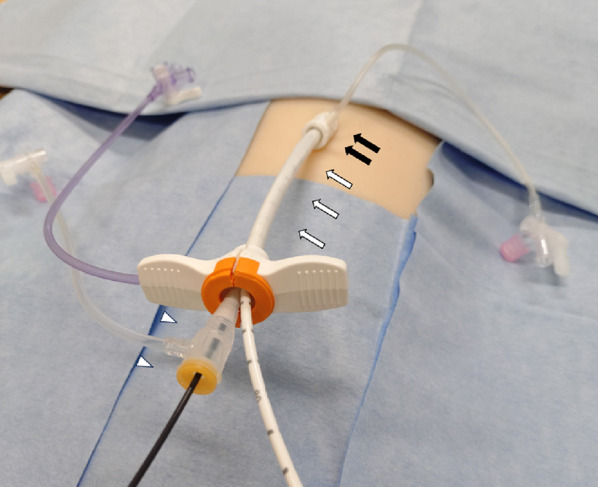 Figure 1
Peer Reviews
No public reviews on file for this paper yet. If you reviewed it on a platform where reviews are public (OpenReview, ICLR, NeurIPS, ICML), you can paste yours below so the community can read it here.
Videos
No videos yet. Explain this paper in a talk, walkthrough, or lecture? Add one.
Taxonomy
TopicsVascular Procedures and Complications · Coronary Interventions and Diagnostics · Mechanical Circulatory Support Devices
Background
Cardiac arrest due to acute coronary occlusion often requires three simultaneous interventions: Veno-arterial extracorporeal membrane oxygenation (VA-ECMO) for perfusion, Impella-based left ventricular unloading, and urgent culprit-artery recanalization [1]. When profound shock or ongoing cardiopulmonary resuscitation precludes radial access, operators must choose between two femoral options: (1) dual puncture—safe but slow and bleeding-prone or (2) single-access via the 14 Fr peel-away sheath [2]—fast but carries a higher bleeding risk. In Japan, the 16 Fr Medikit sheath is preferred for Impella insertion because its intact haemostatic valve mitigates bleeding, yet its design blocks passage of a guiding catheter, again necessitating two punctures.
We describe a streamlined coaxial solution: a 14 Fr peel-away sheath and then a 6 Fr guiding-catheter sheath are inserted through the haemostatic 16 Fr Medikit sheath, allowing true single-access Impella-supported percutaneous coronary intervention (PCI) while preserving bleeding control. The present case illustrates the feasibility of this 16 Fr → 14 Fr → 6 Fr technique in a patient with refractory ventricular fibrillation who underwent VA-ECMO, left ventricular unloading, and successful PCI without vascular complications.
Case report
A 53-year-old man collapsed unexpectedly at work. Immediate bystander cardiopulmonary resuscitation was initiated, and emergency medical services arrived 9 min later to find the patient in ventricular fibrillation (VF). Four defibrillation attempts were unsuccessful in restoring spontaneous circulation. Thirty-six minutes after the initial collapse, the patient was transferred to our hospital in refractory VF. Given the prolonged cardiac arrest, extracorporeal cardiopulmonary resuscitation was commenced. VA-ECMO was established via right femoral cannulation. Radial access could not be secured in the arrest setting; therefore, diagnostic coronary angiography was performed through the left femoral artery and demonstrated a subtotal occlusion of the proximal right coronary artery (RCA). Prior to PCI, we opted for left ventricular unloading using an Impella CP device (Abiomed, Danvers, MA, USA). A 16 Fr sheath (Medikit, Tokyo, Japan) was placed in the left common femoral artery. Following Impella CP implantation, the patient spontaneously converted to sinus rhythm without electrical cardioversion. Through this, a 14 Fr peel-away sheath supplied with the Impella system was advanced, and the Impella catheter positioned across the aortic valve into the left ventricle. To achieve single-access PCI, a 6 Fr sheath was then introduced coaxially through the 14 Fr sheath, providing a conduit for the 6 Fr guiding catheter while the Impella remained in situ (Fig. 1). After the successful completion of PCI of the RCA, the 6 Fr sheath and, subsequently, the 14 Fr peel-away sheath were withdrawn, leaving the Impella supported by the 16 Fr sheath. To mitigate the risk of lower-extremity malperfusion associated with large-bore femoral access, antegrade perfusion sheaths were inserted into both femoral arteries, ensuring continuous distal limb perfusion throughout the subsequent mechanical support period.
Discussion
Alternative single-access techniques using preclosure devices and puncturing the 14 Fr peel-away sheath have been reported by experienced operators; [3] however, in the Japanese regulatory context, concerns about bleeding from the peel-away sheath have prompted a preference for hemostatic large-bore sheaths, particularly in unstable arrest settings [4]. In Japan, the 16 Fr Medikit sheath is therefore preferred for Impella placement; however, its use traditionally precludes single-access PCI. The coaxial strategy outlined here combines the bleeding-risk advantage of the 16 Fr sheath with the procedural efficiency of single-access intervention when radial routes are unavailable. The use of a 7 Fr slender sheath is discouraged owing to tip fragility.
Fig. 1. Single-access “sheath-in-sheath” setup. A 16 Fr Medikit femoral sheath (black arrow) contains a 14 Fr peel-away Impella introducer (white arrow) and an inner 6 Fr sheath (arrowhead) for the PCI guide, allowing Impella support and coronary intervention through one puncture
Conclusion
Our case demonstrates that the 16 Fr → 14 Fr → 6 Fr configuration offers a practical balance between bleeding safety and interventional efficiency when radial access is impossible. Wider adoption may simplify complex cardiogenic-shock interventions and reduce vascular complications.