Understanding medical students’ continuance intention to use VR-based learning systems: an integrated model approach
Yanhong Zhang, Jingcheng Liu, Yiling Zhenghuang, Xiaoning Lu, Xinxin Zhang

TL;DR
This study explores why medical students keep using VR-based learning systems, finding that perceived ease and usefulness are key factors influenced by system design, social factors, and support.
Contribution
The paper introduces an integrated model combining technology acceptance and continuance theories to explain VR system usage in medical education.
Findings
System characteristics, social influence, and facilitating conditions do not directly affect continuance intention but act through perceived ease of use and usefulness.
Perceived ease of use mediates the effects of facilitating conditions and social influence on continuance intention.
Perceived usefulness mediates the impact of system characteristics and social influence on continuance intention.
Abstract
As Virtual Reality (VR) technology advances, VR-based learning systems offer medical students immersive, repeatable, and risk-free simulation environments, which are crucial for clinical skill development. Continued Intention (CI) to use these systems is a key determinant of their long-term educational impact. This study investigates the factors influencing medical students’ CI by proposing an integrated research model grounded in the Unified Theory of Acceptance and Use of Technology and continuance theory. The model posits that System Characteristics (SC), Social Influence (SI), and Facilitating Conditions (FC) influence CI indirectly through the mediating roles of Perceived Ease of Use (PE) and Perceived Usefulness (PU). Survey data were collected from 258 medical students at Chinese universities with prior experience with VR learning systems and analyzed using Structural Equation…
Genes, proteins, chemicals, diseases, species, mutations and cell lines named across the full text — each resolved to its canonical identifier and authoritative record.
Click any figure to enlarge with its caption.
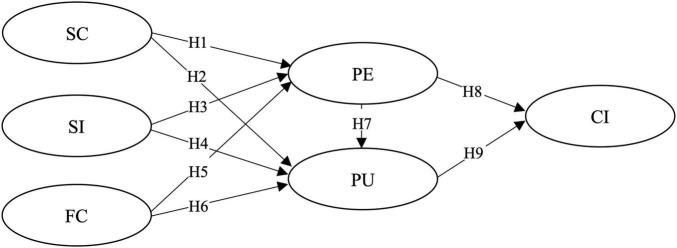 FIGURE 1
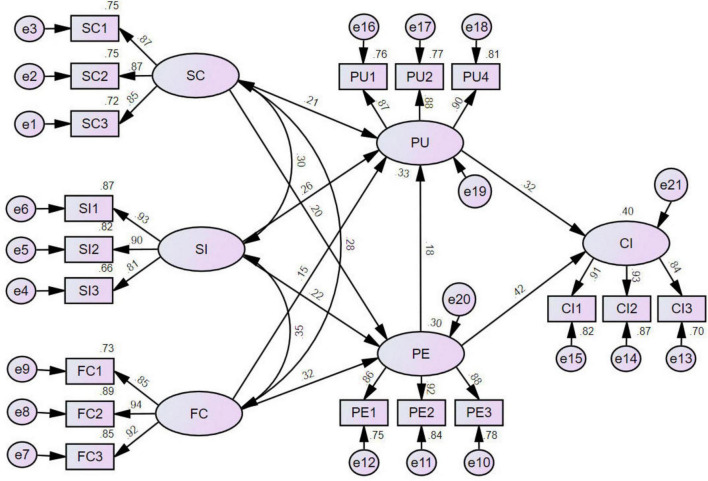 FIGURE 2
| Construct | Code | Variable measurement content | Source |
|---|---|---|---|
| SC | SC1 | The VR teaching system should feature an intuitive interface and clear navigation settings. | Dehghani and Mashhadi ( |
| SC2 | All functions of the VR teaching system should be logically designed for user-friendly operation and utilization. | ||
| SC3 | The VR teaching system should incorporate high-quality interactive design capabilities. | ||
| SI | SI1 | Due to promotional coverage across various media channels, I would be inclined to experience and utilize the VR teaching system. | Cioc et al. ( |
| SI2 | Teachers’ recommendations would influence my decision to experience and utilize the VR teaching system. | ||
| SI3 | Those around me endorse the VR teaching system. | ||
| FC | FC1 | I find it straightforward to use the VR teaching system in my daily routine. | Rani et al. ( |
| FC2 | The VR teaching system provides guidance to assist me in experiencing and utilizing it. | ||
| FC3 | The VR teaching system provides relevant services to resolve issues encountered during use. | ||
| PE | PE1 | Learning to use this VR teaching system was straightforward for me. | Davis ( |
| PE2 | I can control the VR teaching system to accomplish my desired tasks. | ||
| PE3 | I found this VR teaching system remarkably user-friendly. | ||
| PU | PU1 | I believe using this VR teaching system aids my learning. | Davis ( |
| PU2 | I found learning with this VR teaching system highly beneficial. | ||
| PU3 | I gained significant insights from using this VR teaching system. | ||
| CI | CI1 | I would use this system again for learning if possible. | Davis ( |
| CI2 | I am willing to use this VR teaching system once more. | ||
| CI3 | Compared to other VR learning formats, I prefer VR teaching system. |
| Category | Number | Percent (%) | |
|---|---|---|---|
| Age | 18 years old and under | 52 | 20.16 |
| 19 years old | 81 | 31.40 | |
| 20 years old | 50 | 19.38 | |
| 21 years old | 46 | 17.83 | |
| 22 years old and over | 29 | 11.24 | |
| Gender | Male | 121 | 46.90 |
| Female | 137 | 53.10 | |
| Year group | Year 1 | 67 | 25.97 |
| Year 2 | 63 | 24.42 | |
| Year 3 | 79 | 30.62 | |
| Year 4 | 49 | 18.99 | |
| Level of familiarity with VR teaching systems | Not at all familiar | 23 | 8.91 |
| Somewhat familiar | 46 | 17.83 | |
| Fairly familiar | 87 | 33.72 | |
| Quite familiar | 53 | 20.54 | |
| Very familiar | 49 | 18.99 | |
| Construct | Item | Significance estimate | Topic reliability | AVE | CR | ||||
|---|---|---|---|---|---|---|---|---|---|
| 5pt. | Unstd. Factor loading | SE. | Std. factor loading | SMC | |||||
| SC | SC1 | 1.006 | 0.061 | 16.460 |
| 0.865 | 0.748 | 0.740 | 0.895 |
| SC2 | 1.008 | 0.061 | 16.500 |
| 0.867 | 0.752 | |||
| SC3 | 1.000 | 0.848 | 0.719 | ||||||
| SI | SI1 | 1.184 | 0.066 | 17.926 |
| 0.931 | 0.867 | 0.781 | 0.914 |
| SI2 | 1.041 | 0.06 | 17.449 |
| 0.903 | 0.815 | |||
| SI3 | 1.000 | 0.813 | 0.661 | ||||||
| FC | FC1 | 0.782 | 0.038 | 20.527 |
| 0.854 | 0.729 | 0.824 | 0.933 |
| FC2 | 1.012 | 0.04 | 25.465 |
| 0.944 | 0.891 | |||
| FC3 | 1.000 | 0.922 | 0.850 | ||||||
| PE | PE1 | 0.899 | 0.048 | 18.732 |
| 0.864 | 0.746 | 0.787 | 0.917 |
| PE2 | 1.001 | 0.049 | 20.560 |
| 0.916 | 0.839 | |||
| PE3 | 1.000 | 0.881 | 0.776 | ||||||
| PU | PU1 | 1.000 | 0.87 | 0.757 | 0.779 | 0.913 | |||
| PU2 | 1.044 | 0.056 | 18.548 |
| 0.878 | 0.771 | |||
| PU3 | 1.098 | 0.057 | 19.178 |
| 0.899 | 0.808 | |||
| CI | CI1 | 1.060 | 0.058 | 18.198 |
| 0.913 | 0.834 | 0.791 | 0.919 |
| CI2 | 1.113 | 0.060 | 18.541 |
| 0.929 | 0.863 | |||
| CI3 | 1.000 | 0.822 | 0.676 | ||||||
| Construct | Convergent validity | Discriminant validity | |||||
|---|---|---|---|---|---|---|---|
| AVE | PU | CI | PE | FC | SI | SC | |
| PU | 0.779 |
| |||||
| CI | 0.791 | 0.472 |
| ||||
| PE | 0.787 | 0.423 | 0.546 |
| |||
| FC | 0.824 | 0.370 | 0.506 | 0.440 |
| ||
| SI | 0.781 | 0.436 | 0.545 | 0.376 | 0.354 |
| |
| SC | 0.740 | 0.382 | 0.497 | 0.342 | 0.282 | 0.301 |
|
| Index | Model indicator values | Standard | Conclusion | Source |
|---|---|---|---|---|
| CMIN | 313.601 | The smaller, the better | Acceptable | |
| DF | 123.000 | The smaller, the better | Acceptable | |
| CMIN/DF | 2.550 | < 3 | Good fit | |
| GFI | 0.882 | > 0.8 Acceptable; >0.9 Good fit | Acceptable | Bagozzi and Yi ( |
| AGFI | 0.837 | > 0.8 Acceptable; >0.9 Good fit | Acceptable | |
| CFI | 0.950 | > 0.9 | Good fit | Bagozzi and Yi ( |
| TLI(NNFI) | 0.938 | > 0.9 | Good fit | |
| RMSEA | 0.078 | < 0.08 | Good fit | Bagozzi and Yi ( |
| SRMR | 0.0435 | < 0.08 | Good fit | Hu and Bentler ( |
| Hypothesis | Relationship | Unstd. | S.E. | C.R. | P | Std.(β) | Results |
|
|---|---|---|---|---|---|---|---|---|
| H1 | SC→PE | 0.232 | 0.074 | 3.126 | 0.002 | 0.201 | Supported | 0.3 |
| H3 | SI→PE | 0.255 | 0.077 | 3.320 | < 0.001 | 0.217 | Supported | |
| H5 | FC→PE | 0.321 | 0.065 | 4.933 | < 0.001 | 0.318 | Supported | |
| H2 | SC→PU | 0.202 | 0.064 | 3.161 | 0.002 | 0.207 | Supported | 0.332 |
| H4 | SI→PU | 0.261 | 0.067 | 3.912 | < 0.001 | 0.261 | Supported | |
| H6 | FC→PU | 0.128 | 0.057 | 2.235 | 0.025 | 0.149 | Supported | |
| H7 | PE→PU | 0.154 | 0.060 | 2.572 | 0.010 | 0.182 | Supported | |
| H8 | PE→CI | 0.372 | 0.057 | 6.580 | < 0.001 | 0.430 | Supported | 0.395 |
| H9 | PU→CI | 0.317 | 0.065 | 4.885 | < 0.001 | 0.311 | Supported |
| Path | Effect type | SE | S.E. | Bootstrapping | Two-tailed significance | Std.(β) | |||
|---|---|---|---|---|---|---|---|---|---|
| Bias-corrected 95% CI | Percentile 95% CI | ||||||||
| Lower | Upper | Lower | Upper | ||||||
| SC→PU→CI | Total effect | 0.132 | 0.054 | 0.025 | 0.239 | 0.029 | 0.242 | 0.010 | – |
| Direct effect | 0.000 | 0.000 | 0.000 | 0.000 | 0.000 | 0.000 | >0.050 | – | |
| Indirect effect | 0.129 | 0.054 | 0.025 | 0.239 | 0.029 | 0.242 | 0.010 | 0.064 | |
| SI→PU→CI | Total effect | 0.165 | 0.077 | 0.013 | 0.313 | 0.022 | 0.311 | 0.034 | – |
| Direct effect | 0.000 | 0.000 | 0.000 | 0.000 | 0.000 | 0.000 | >0.050 | – | |
| Indirect effect | 0.158 | 0.077 | 0.013 | 0.313 | 0.010 | 0.311 | 0.0340 | 0.081 | |
| FC→PU→CI | Total effect | 0.102 | 0.074 | -0.008 | 0.480 | -0.014 | 0.274 | >0.050 | – |
| Direct effect | 0.000 | 0.000 | 0.000 | 0.000 | 0.000 | 0.000 | >0.050 | – | |
| Indirect effect | 0.113 | 0.074 | -0.008 | 0.274 | -0.007 | 0.274 | >0.050 | 0.046 | |
| PE→PU→CI | Total effect | 0.545 | 0.063 | 0.410 | 0.655 | 0.412 | 0.656 | <0.001 | – |
| Direct effect | 0.417 | 0.083 | 0.237 | 0.564 | 0.231 | 0.561 | <0.001 | – | |
| Indirect effect | 0.128 | 0.046 | 0.059 | 0.238 | 0.058 | 0.236 | <0.001 | 0.057 | |
| SC→PE→CI | Total effect | 0.118 | 0.085 | -0.044 | 0.290 | -0.058 | 0.272 | >0.050 | – |
| Direct effect | 0.000 | 0.000 | 0.000 | 0.000 | 0.000 | 0.000 | >0.050 | – | |
| Indirect effect | 0.118 | 0.085 | -0.044 | 0.290 | -0.058 | 0.272 | >0.050 | 0.086 | |
| SI→PE→CI | Total effect | 0.128 | 0.049 | 0.034 | 0.225 | 0.039 | 0.229 | 0.009 | – |
| Direct effect | 0.000 | 0.000 | 0.000 | 0.000 | 0.000 | 0.000 | >0.050 | – | |
| Indirect effect | 0.128 | 0.049 | 0.034 | 0.225 | 0.039 | 0.229 | 0.009 | 0.093 | |
| FC→PE→CI | Total effect | 0.183 | 0.052 | 0.083 | 0.288 | 0.090 | 0.297 | 0.001 | – |
| Direct effect | 0.000 | 0.000 | 0.000 | 0.000 | 0.000 | 0.000 | >0.050 | – | |
| Indirect effect | 0.183 | 0.052 | 0.083 | 0.288 | 0.090 | 0.297 | 0.001 | 0.137 | |
Peer Reviews
No public reviews on file for this paper yet. If you reviewed it on a platform where reviews are public (OpenReview, ICLR, NeurIPS, ICML), you can paste yours below so the community can read it here.
Videos
No videos yet. Explain this paper in a talk, walkthrough, or lecture? Add one.
Taxonomy
TopicsVirtual Reality Applications and Impacts · Technology Adoption and User Behaviour · Visual and Cognitive Learning Processes
Introduction
Medical education faces persistent challenges, including limited opportunities for practical training and the high-stakes nature of clinical environments where patient safety restricts student involvement (1, 2). Virtual reality (VR)-based learning systems have emerged as a transformative pedagogical tool, creating immersive, repeatable, and risk-free simulation environments that can bridge the gap between theory and practice (3–5).
Research on the implementation of VR in medical education is growing. Numerous studies have employed technology acceptance theories, such as the Technology Acceptance Model (TAM) and the Unified Theory of Acceptance and Use of Technology (UTAUT), to understand initial adoption by students and educators (6–9). However, the long-term success and educational return on investment of these systems depend not only on initial adoption, but also on continuance intention (CI)—defined as the user’s intention to continue using an information system after its initial adoption (10). Research specifically examining the post-adoption continuance intention to use VR systems among medical students, and the mechanisms by which external factors shape this intention, remains underdeveloped. Understanding these drivers is critical, as not all implemented VR systems achieve sustained engagement, which ultimately affects their pedagogical value and institutional impact (2, 6).
To address this gap, this study develops an integrated research model. We draw on the UTAUT and continuance theory to examine how key external factors—System Characteristics (SC), Social Influence (SI), and Facilitating Conditions (FC)—influence medical students’ CI. The model posits that these external factors exert their influence indirectly through the mediating roles of Perceived Ease of Use (PE) and Perceived Usefulness (PU), which are established core determinants of both initial and continued usage.
This study is situated within the context of Chinese higher medical education. Medical students are the focal population, as they are the primary end users of VR simulation training. A critical methodological prerequisite is that all participants have prior hands-on experience with a VR learning system, thereby ensuring the validity of measuring post-adoption continuance intention. Using survey data and Structural Equation Modeling (SEM) (11, 12), this study aims to elucidate the specific mediating pathways (e.g., SC→PU→CI) that underlie sustained usage. The findings are intended to provide theoretical insights into the post-adoption phase and evidence-based, practical recommendations for the design and implementation strategies that can support the sustained and effective integration of VR-based learning systems in medical curricula.
Theoretical research and analysis
Literature review
Virtual reality in medical education
VR technology uses computer systems to generate three-dimensional images or environments. Prior studies indicate that the use of VR technology to create virtual environments for simulation-based training constitutes a notable and promising educational strategy, representing a significant advancement in educational technology development (13–15). VR teaching methods can simulate processes in the physical world and forecast natural and social phenomena that are not feasible to replicate or experiment with in the real world (3, 7, 16). VR teaching systems are widely used in medical education, primarily for developing technical competencies (17–19). VR teaching systems are used for surgical skills training and to enhance the ability to visualize three-dimensional anatomical structures (16, 20). Hammouda et al. assessed the efficacy of a VR human anatomy simulation training program for undergraduate students in Tunisia (3). Aydin et al. conducted a crossover study that concluded VR teaching systems can aid healthcare professionals in training for neonatal resuscitation programs (21). Conversely, VR teaching systems may be used to teach soft skills, such as empathy and communication. Jans et al. conducted a comprehensive review revealing that research on VR applications indicates its potential to enhance critical thinking, clinical reasoning, clinical judgment, and clinical decision-making skills in undergraduate nursing students (22). Bracq et al. conducted a systematic review and meta-analysis, revealing that the non-technical skills emphasized in VR teaching systems mainly encompass teamwork, communication, and situational awareness (23). VR technology has considerable potential to enhance medical education (24). VR-based instructional systems can significantly aid future physicians in managing complex emergency medical situations, thus promoting the incorporation of these technologies into medical curricula (25).
Theoretical foundations: from initial adoption to continuance intention
The TAM, introduced by Davis (26), is a foundational theory for explaining initial adoption intention toward information systems (26). It posits that PE and PU are key determinants of an individual’s intention to use a new technology (26). To provide a more comprehensive understanding of technology acceptance, Venkatesh et al. synthesized eight competing models and proposed the UTAUT (27). UTAUT identifies four core direct determinants of usage intention: Performance Expectancy (similar to PU), Effort Expectancy (similar to PE), SI, and FC. Furthermore, UTAUT specifies four moderators (gender, age, experience, and voluntariness of use). The constructs of SI and FC, as defined in our study, are drawn directly from the UTAUT framework.
It is critical to note that both TAM and UTAUT were developed primarily to predict initial adoption behavior. However, the long-term success of a technology depends on users’ CI—the decision to continue using a system after its initial adoption (26, 28). To explain this post-adoption behavior, Bhattacherjee’s Expectation-Confirmation Model (ECM) of IS Continuance is the predominant theory (10). The ECM posits that continuance intention is primarily determined by user satisfaction and post-adoption perceived usefulness, both of which are shaped by the confirmation of pre-usage expectations (29).
Synthesis and positioning of the present study
In information systems research, it is recognized that cognitive and social factors that influence initial adoption often remain relevant in the post-adoption phase. Consequently, scholars have successfully integrated constructs from adoption theories (like UTAUT/TAM) with the continuance paradigm (ECM) to investigate sustained usage (2). This integrative approach allows for a nuanced understanding of how ongoing perceptions and external conditions drive continued use.
Following this integrative approach, the present study develops a research model where continuance intention to use serves as the ultimate dependent variable, consistent with ECM. To explain CI, the model incorporates key UTAUT constructs—namely, SI and FC—alongside a construct capturing SC. These external variables are hypothesized to shape users’ core cognitive evaluations, namely PE and PU (from TAM), which in turn are positioned as direct and mediating antecedents of CI. This model thus examines the indirect pathways through which external factors influence the sustained use of VR-based learning systems among medical students.
Research hypotheses
Building on the integrated theoretical framework outlined, this study proposes a research model to explain medical students’ intention to continue using VR-based learning systems. The model positions CI as the dependent variable, consistent with the post-adoption paradigm. Drawing on the UTAUT framework and prior continuance research, three external constructs—SC, SI, and FC—are introduced as antecedents (30). These external factors are hypothesized to influence CI indirectly by shaping users’ core cognitive perceptions: PE and PU, which are established as direct predictors of both initial and continued usage intention (10, 27). The specific research hypotheses are developed as follows.
The influence of SC
SC refers to the functional and interactive attributes of the VR learning system, such as interface design, logical workflow, and interactivity (31, 32). High-quality system design is expected to influence users’ perceptions of its usability and utility positively. Prior research in educational technology continuance has shown that system quality is a significant antecedent to PE and PU (2, 32). Therefore, we hypothesize:
H1: SC positively influences PE regarding the VR learning system.
H2: SC positively influences PU regarding the VR learning system.
The influence of SI
SI refers to the degree to which a medical student perceives that essential others (e.g., peers, instructors, the broader academic community) believe they should use the system (33, 34). In the context of post-adoption behavior, social norms and peer recommendations can reinforce and validate one’s ongoing perceptions of a technology. Studies on the continuance use of e-learning systems have confirmed the role of SI in shaping PU and PE (34, 35). Therefore, we hypothesize:
H3: SI positively influences PE regarding the VR learning system.
H4: SI positively influences PU regarding the VR learning system.
The influence of FC
FC refers to the degree to which a medical student believes that organizational and technical infrastructure exists to support the use of the system (e.g., accessible guidance, reliable technical support, adequate resources) (36). In a continuance context, strong facilitating conditions can reduce post-adoption effort and reinforce the perception that continued use is straightforward. Research in mobile learning continuance has linked FC to PE (9, 33, 36). Therefore, we hypothesize:
H5: FC positively influences PE regarding the VR learning system.
H6: FC positively influences PU regarding the VR learning system.
The core relationships from the integrated model
The integrated model retains the core relationships posited by TAM but applies them to predict continuance intention. Specifically, PE is expected to directly affect both PU and CI, whereas PU is expected to directly affect CI. These relationships have been validated in numerous continuance studies that integrate TAM constructs (1, 10, 32). Therefore, we hypothesize:
H7: PE positively influences PU.
H8: PE positively influences CI.
H9: PU positively influences CI.
The resulting research model integrating these hypotheses is presented in Figure 1.
Research framework. H1–H9 refer to the nine hypotheses.
Materials and methods
Research methods
This study employed a cross-sectional survey design. Data analysis was performed following a two-step SEM approach using SPSS 26.0 and AMOS 26.0. This analytical strategy allows simultaneous testing of the measurement model (relationships between indicators and latent constructs) and the structural model (hypothesized paths between constructs), which is well-suited for assessing the plausibility of our pre-specified theoretical framework. It is important to note that, while SEM tests hypothesized causal relationships, the cross-sectional nature of our data supports interpreting these findings as robust associative evidence for the proposed model rather than definitive proof of causality.
Questionnaire design
Data were collected via a structured questionnaire. To ensure the validity of measuring continuance intention to use, participants were required to confirm they had used a VR-based learning system at least once in the past month. The questionnaire comprised: a) demographic items and b) measurement scales for all model constructs, adapted from established literature (Table 1). All items used a seven-point Likert scale (1 = Strongly Disagree, 7 = Strongly Agree). To enhance content validity and clarity, a pilot study was conducted with 50 eligible medical students. Feedback led to minor wording improvements, confirming the instrument’s comprehensibility.
Data collection and screening
The online survey was distributed to medical students at Chinese universities. To mitigate response bias, the introduction emphasized anonymity and academic-use only. Two instructed attention-check items (e.g., “Please select ‘Agree’ for this statement”) were embedded to identify inattentive respondents. Data cleaning involved a multi-step protocol: (a) Removal of 13 responses with completion times < 60 seconds. (b) Examination of missing data. The rate was minimal (< 0.5% per variable), and Little’s MCAR test was non-significant (χ^2^ = 15.32, p > 0.05), supporting the use of Full Information Maximum Likelihood (FIML) estimation in SEM for handling missingness. This yielded 258 valid responses for analysis. The final sample characteristics are in Table 2. The restriction to recent VR users, while essential for measuring post-adoption continuance, is acknowledged as a factor affecting generalizability to novice populations.
Data analysis procedures
Before SEM, data were screened using SPSS. Univariate normality was assessed using skewness and kurtosis (all within ± 2 and ± 7). Multicollinearity was examined by calculating Variance Inflation Factors (VIFs) for all predictor constructs in a regression framework; all VIFs were below 2.0, indicating no issue. Multivariate outliers were assessed using Mahalanobis distance (p < 0.001), and none were found.
We evaluated reliability and validity. Convergent validity was established by requiring: (a) all indicator factor loadings > 0.70 and statistically significant, (b) Composite Reliability (CR) > 0.80, and (c) Average Variance Extracted (AVE) > 0.50 (37). Discriminant validity was confirmed using the Fornell-Larcker criterion (AVE square root > inter-construct correlations).
After confirming a satisfactory measurement model, the structural model (Figure 1) was evaluated. Model fit was assessed using χ^2^/df, Comparative Fit Index (CFI), Tucker-Lewis Index (TLI), Root Mean Square Error of Approximation (RMSEA), and Standardized Root Mean Square Residual (SRMR) (38). No post hoc model modifications were performed to maintain theoretical integrity. Path coefficients were examined to test hypotheses H1-H9. To test the proposed mediating effects (H1-H6), a bias-corrected bootstrap procedure with 5,000 resamples was used to estimate 95% confidence intervals for indirect effects.
Results
Reliability and validity
The measurement model demonstrated strong psychometric properties. As shown in Table 3, all factor loadings were significant and exceeded 0.70 (range: 0.75–0.94). All constructs exhibited high internal consistency, with CR values ranging from 0.86 to 0.93. All AVE values exceeded 0.50 (range: 0.62–0.77), confirming convergent validity. Discriminant validity was established, as the square root of each construct’s AVE (diagonal in Table 4) was greater than its correlations with other constructs.
Model fit and hypothesis testing
The structural model demonstrated a good fit to the data (χ^2^/df = 2.55, CFI = 0.95, TLI = 0.938, RMSEA = 0.078, SRMR = 0.0435), with all indices meeting established thresholds for acceptability. This supports the plausibility of the hypothesized model for testing the proposed relationships.
As presented in Figure 2 and Table 5, all nine research hypotheses (H1–H9) were supported by significant path coefficients. Specifically, the external constructs exerted significant influences on the core mediators: SC, SI, and FC all positively affected both PE (H1, H3, H5: β = 0.201, 0.217, 0.318, respectively, all p < 0.01) and PU (H2, H4, H6: β = 0.207, 0.261, 0.149, respectively, all p < 0.05). In turn, PE positively influenced both PU (H7: β = 0.182, p = 0.010) and CI (H8: β = 0.430, p < 0.001). PU also exhibited a strong direct effect on CI (H9: β = 0.311, p < 0.001).
Path diagram. Values on the straight arrows between variables represent the standardized path coefficients.
This pattern of results provides comprehensive support for the integrated model. Crucially, the significant paths from all three external factors (SC, SI, FC) to the mediators (PE and PU), coupled with the strong, significant paths from the mediators to CI—and the absence of any specified direct paths from the external factors to CI—empirically confirm the proposed fully mediated relationship structure. Perceived Ease of Use emerged as the most influential direct determinant of continuance intention.
Mediation analysis
To test the proposed mediation mechanisms, a bootstrap analysis was performed. The results (Table 6) confirmed that all indirect paths from the external constructs to CI were statistically significant, while any hypothesized direct paths were not specified in the model and were found to be non-significant upon testing, collectively supporting a model of full mediation.
A detailed examination of the specific indirect pathways (Table 7) reveals how each external factor operates. First, both SC and SI influence CI by enhancing PU (SC→PU→CI: β = 0.064; SI→PU→CI: β = 0.081). This indicates that a well-designed VR system and positive social norms promote sustained use primarily by convincing medical students of the system’s learning value. Second, SI and, more distinctly, FC influence CI by improving PE (SI→PE→CI: β = 0.093; FC→PE→CI: β = 0.137). This suggests that a supportive institutional environment and peer endorsements foster continued engagement by reducing the perceived effort required to use the technology.
The standardized indirect effects (β) ranged from 0.057 to 0.137 for the significant specific indirect paths. Following Cohen’s guidelines, these represent small to moderate effect sizes. Notably, the path from Facilitating Conditions to CI via PE (β = 0.137) was the strongest, highlighting the critical role of institutional support in lowering usage barriers. In summary, the mediation analysis provides robust evidence that the influence of SC, SI, and FC on CI is fully mediated by PE and PU. The distinct pathways identified clarify the cognitive mechanisms through which different external factors sustain engagement with VR learning systems.
Discussion
Interpretation of key findings
This study proposed and tested an integrated model to explain medical students’ CI to use VR-based learning systems. The results strongly support the model’s central premise: external factors—SC, SI, and FC—influence CI indirectly, with PE and PU serving as full mediators. This pattern underscores that for post-adoption engagement, objective features and social-environmental factors must positively shape users’ core cognitive evaluations to sustain their intention to continue using the technology.
The significant pathways from PE and PU to CI reaffirm their foundational role not only in initial adoption but also in continuance (26–28, 39, 40). The finding that PE affects CI both directly and indirectly (via PU) suggests that reducing operational complexity is a critical first step that also amplifies the system’s perceived value (41, 42). Conversely, PU’s direct effect on CI highlights that the sustained motivation to use the system is ultimately driven by a clear appraisal of its benefits for learning (43).
Comparison with prior research
The findings of this study extend and refine existing knowledge on technology continuance in educational contexts. First, the confirmation of a fully mediated model, where SC, SI, and FC influence CI only through PE and PU, aligns with and strengthens a growing body of research advocating for integrated models in post-adoption studies (2, 31). This pattern suggests that, after initial adoption, objective and social-environmental factors must translate into positive user cognitions to sustain behavior, a nuance that pure adoption models like UTAUT do not fully capture.
Second, the significant SC→PU path (H2) resonates with prior work highlighting system quality as a cornerstone of perceived usefulness in e-learning (31). For medical VR, this implies that beyond technological immersion, clinical fidelity and pedagogical relevance are paramount for sustaining use (25). Conversely, the non-significant SC→PE→CI pathway, alongside the significant FC→PE path (H5), suggests that for these users, ease of use is less about intrinsic system design elegance and more about external support structures. This finding partially contrasts with some e-learning studies and highlights the unique technical and cognitive demands of VR, making institutional support crucial.
Third, the dual role of SI in enhancing both PU (H4) and PE (H3) underscores its enduring power in the post-adoption stage. This extends the UTAUT framework into continuance contexts, confirming that recommendations from peers and instructors continue to shape usefulness and ease-of-use evaluations over time (26, 27). In the collective learning environment of medical education, SI may be a particularly potent lever for sustaining engagement.
Finally, the strong direct effect of PE on CI (H8), even stronger than that of PU on CI (H9), offers a critical insight. While PU is often the dominant predictor in initial TAM studies (26), our finding suggests that for complex, skill-based technologies like VR, reducing ongoing operational friction (PE) may become equally or more important for continuance than reinforcing perceived benefits. This aligns with continuance studies emphasizing post-adoption effort expectancy (41).
Theoretical implications
The findings offer two key theoretical contributions. First, they validate the utility of integrating constructs from adoption theories (UTAUT/TAM) within a continuance framework. By positioning CI as the dependent variable and demonstrating that SC, SI, and FC operate through the established mediators of PE and PU, this study provides a validated model for investigating sustained technology use in educational settings. This bridges a theoretical gap between research on initial acceptance and long-term engagement.
Second, the results delineate specific mediation pathways, offering a more nuanced understanding than a direct-effects model. The data indicate that system design and social influence primarily bolster perceptions of usefulness, while social influence and institutional support structures more strongly enhance perceptions of ease of use. Mapping these distinct routes clarifies how different types of interventions might target specific cognitive levers to foster continuance intention.
Practical implications
The identified indirect pathways translate into actionable recommendations for different stakeholders. For Instructional Designers and Developers (Targeting SC→PU), the focus should extend beyond technical immersion to ensure that VR scenarios are pedagogically aligned and clinically relevant. Demonstrating straightforward utility for mastering specific competencies is paramount for fostering PU and, consequently, CI. For Educators and Administrators (Targeting SI→PE/PU), fostering a supportive community of practice is essential. Integrating the system into formal curricula, facilitating peer sharing of experiences, and showcasing instructor endorsements can amplify both its perceived usefulness and ease of use within the student community. For IT Support and Institutions (Targeting FC→PE), reducing post-adoption friction is crucial. Providing seamless access, reliable technical support, and intuitive guidance materials directly enhances PE, lowering the barrier to consistent use.
Limitations and future research
This study’s inherent design limitations point to valuable future research directions. First, the cross-sectional data establish robust associative relationships but cannot definitively confirm causality or capture temporal dynamics in perception and intention. Longitudinal studies are needed to trace these evolutions. Second, while sampling experienced users was methodologically necessary, it limits the generalizability of findings to novice populations. Future work should examine how these mechanisms differ across stages of user experience. Third, the study focused on behavioral intention. Although intention is a strong predictor, research linking these perceptual constructs to actual sustained usage behavior and, separately, to objective learning outcomes, would provide a more complete assessment of VR system success.
Conclusion
This study validated an integrated model to explain medical students’ continuance intention to use VR-based learning systems. The central finding is that SC, SI, and FC do not directly affect continuance intention but exert their influence fully through the mediators of PE and PU. Specifically, the analysis delineated two primary pathways: (1) SC and SI bolster CI by enhancing PU, and (2) SI and FC bolster CI by enhancing PE. Notably, PE emerged as the strongest direct driver of CI, underscoring the critical importance of minimizing post-adoption effort for sustained use.
These results bridge adoption and continuance theories, providing a validated framework for understanding sustained technology engagement in medical education. For practice, they offer clear, evidence-based guidance: instructional designers should focus on pedagogical relevance to enhance usefulness, educators should leverage social communities to reinforce both ease of use and usefulness, and institutions must invest in robust technical support to reduce usage barriers. Future longitudinal research is recommended to trace the evolution of these perceptions and link them to objective learning outcomes.
The reference list from the paper itself. Each links out to its DOI / PubMed record.
- 1Suliman M Zhang W Suluman R Sleiman K. Medical student’s acceptance of mobile learning: integrating TAM model with perceived reusability. Educ Inf Technol. (2025) 30:3621–44. 10.1007/s 10639-024-12917-3 · doi ↗
- 2Cheng Y. Investigating medical professionals’ continuance intention of the cloud-based e-learning system: an extension of expectation–confirmation model with flow theory. J Enterp Inf Manag. (2020) 34:1169–202. 10.1108/JEIM-12-2019-0401 · doi ↗
- 3Hammouda S Maoua M Bouchahma M. The effectiveness of VR-based human anatomy simulation training for undergraduate medical students. BMC Med Educ. (2025) 25:816. 10.1186/s 12909-025-07402-5 40452030 PMC 12128225 · doi ↗ · pubmed ↗
- 4Einloft J Bedenbender S Michelsen M Meyer H Russ P Heidtmann A Structured exposure achieves high acceptance of immersive technology among medical students and educators. Cyberpsychol Behav Soc Netw. (2024) 27:363–71. 10.1089/cyber.2023.0297 38513055 · doi ↗ · pubmed ↗
- 5Mergen M Graf N Meyerheim M. Reviewing the current state of virtual reality integration in medical education - a scoping review. BMC Med Educ. (2024) 24:788. 10.1186/s 12909-024-05777-5 39044186 PMC 11267750 · doi ↗ · pubmed ↗
- 6Briz-Ponce L Pereira A Carvalho L Juanes-Méndez J García-Peñalvo F. Learning with mobile technologies – Students’ behavior. Comput Hum Behav. (2017) 72:612–20. 10.1016/j.chb.2016.05.027 · doi ↗
- 7Noble S Saville J Foster LL. VR as a choice: what drives learners’ technology acceptance? Int J Educ Technol High Educ. (2022) 19:6. 10.1186/s 41239-021-00310-w · doi ↗
- 8Van Raaij E Schepers J. The acceptance and use of a virtual learning environment in China. Comput Educ. (2008) 50:838–52. 10.1016/j.compedu.2006.09.001 · doi ↗