Atomistic Theory of Hot-Carrier Generation in Aluminum Nanoparticles
Gengyue Dong, Simão João, Hanwen Jin, Johannes Lischner

TL;DR
This paper explains how hot electrons and holes are generated in aluminum nanoparticles and how their energy distribution differs from other metals.
Contribution
A new theoretical model combining Maxwell equations and tight-binding simulations is used to study hot-carrier generation in aluminum.
Findings
The energetic distribution of hot carriers in aluminum is nearly constant across allowed energies.
High-energy hot carriers near the Fermi level decrease at higher photon energies due to band structure effects.
Hot-carrier properties depend on nanoparticle diameter and environmental dielectric constant.
Abstract
Hot electrons and holes generated from the decay of localized surface plasmons (LSPs) in aluminum nanostructures have significant potential for applications in photocatalysis, photodetection, and other optoelectronic devices. Here, we present a theoretical study of hot-carrier generation in aluminum nanospheres using a recently developed modeling approach that combines a solution of the macroscopic Maxwell equation with large-scale atomistic tight-binding simulations. Different from standard plasmonic metals, such as gold or silver, we find that the energetic distribution of hot electrons and holes in aluminum nanoparticles is almost constant for all allowed energies. Only at relatively high photon energies, a reduction of the generation rate of highly energetic holes and electrons close to the Fermi level is observed, which is attributed to band structure effects suppressing interband…
Genes, proteins, chemicals, diseases, species, mutations and cell lines named across the full text — each resolved to its canonical identifier and authoritative record.
Click any figure to enlarge with its caption.
 1
1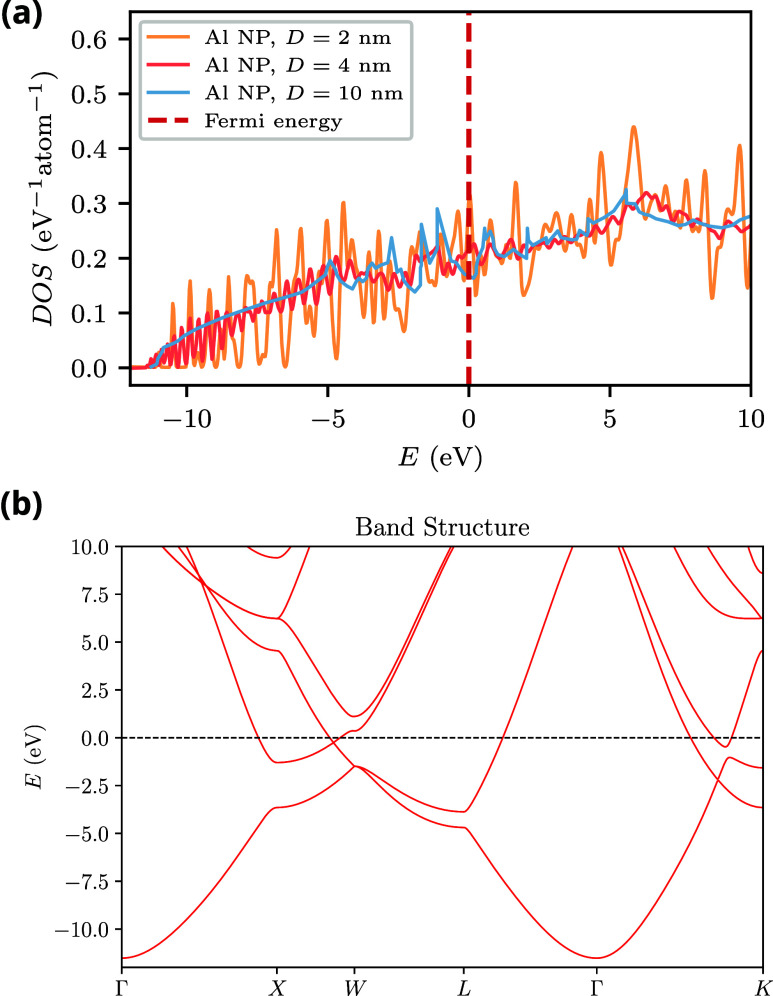 2
2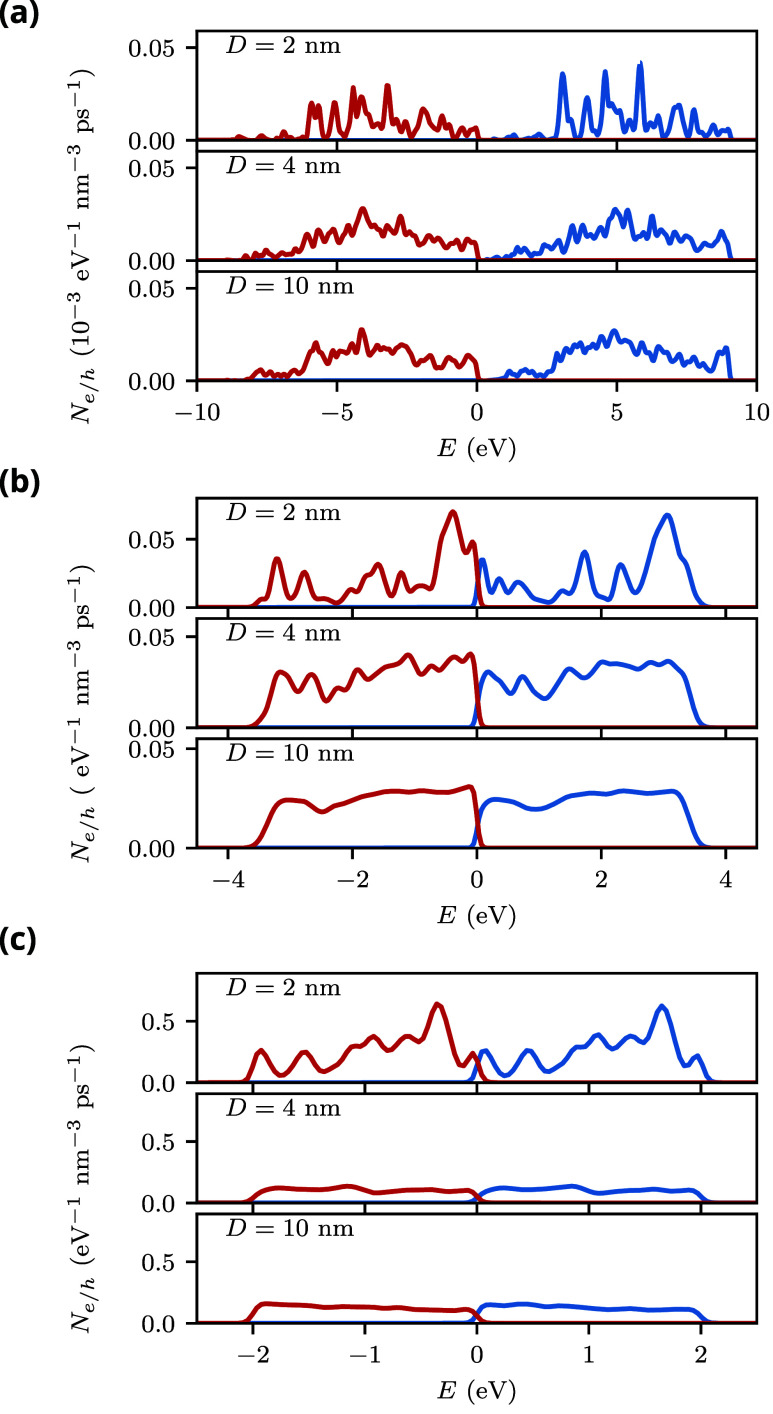 3
3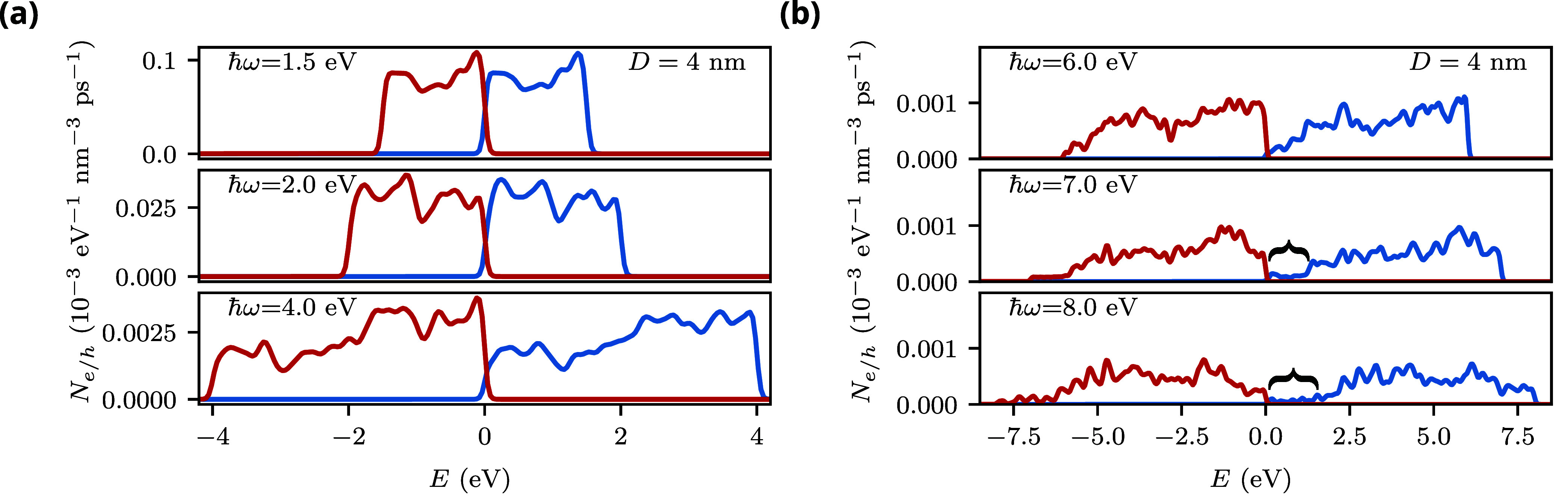 4
4- —Engineering and Physical Sciences Research Council10.13039/501100000266
- —Royal Society10.13039/501100000288
Peer Reviews
No public reviews on file for this paper yet. If you reviewed it on a platform where reviews are public (OpenReview, ICLR, NeurIPS, ICML), you can paste yours below so the community can read it here.
Videos
No videos yet. Explain this paper in a talk, walkthrough, or lecture? Add one.
Taxonomy
TopicsGold and Silver Nanoparticles Synthesis and Applications · Plasmonic and Surface Plasmon Research · GaN-based semiconductor devices and materials
Introduction
The decay of localized surface plasmons (LSPs) in metallic nanoparticles generates energetic electrons and holes. ?,? These hot carriers can be harnessed in nanoscale devices for photodetection, ?−? ? ? photocatalysis, ?−? ? ? ? ? ? ? and photovoltaics. ?−? ? ? ? ? ? In particular, current semiconductor-based devices for harvesting solar energy cannot absorb photons with energies smaller than the band gap. ?−? ? ? This limitation can be overcome by combining semiconductors with metallic nanoparticles, which can absorb sub-band gap photons and then inject hot carriers into the semiconductor, thereby enhancing device efficiencies. ?,? Standard plasmonic metals, such as gold or silver, exhibit excellent optical properties,? but their high cost restricts their use in large-scale devices. This challenge motivates the exploration of alternative plasmonic materials that are earth-abundant and therefore cheaper. ?,?
Aluminum, the third most abundant element in the Earth’s crust, holds substantial potential for large-scale applications due to its low cost. ?,? Aluminum nanoparticles exhibit strong plasmon resonances that can be tuned from the ultraviolet into the visible spectrum.? This ultraviolet (UV) capability is a distinct advantage over gold and silver; for instance, Dubey et al. developed an aluminum plasmonics-enhanced GaN photodetector achieving record-high responsivity (670 A W^1–^) and detectivity (1.48 × 10^15^ cm Hz^1/2^ W^1–^) at 355 nm. Their work demonstrated aluminum’s superior performance for UV applications due to its high plasma frequency and low intrinsic loss in this regime.? Beyond optoelectronics, the Halas group’s pioneering studies demonstrated the potential of aluminum nanostructures for hot-carrier generation and plasmonic photocatalysis, highlighting the importance of the native oxide on the nanoparticle surface for carrier extraction and catalytic performance. ?,? Subsequent studies from the same group introduced aluminum-based antenna–reactor architectures that exploit the tunability of the oxide shell to control hot-carrier transfer processes.? To bridge the gap to practical use, large-scale fabrication techniques using self-assembly nanoparticle template methods have also enabled the controllable preparation of aluminum nanoparticles with tunable sizes, demonstrating their potential for scalable hot-carrier devices.?
Besides experimental investigations, theoretical modeling has been critical for elucidating the fundamental mechanisms governing hot-carrier dynamics in aluminum nanostructures. Sundararaman et al.? and Zhang? employed density-functional theory (DFT) to study the generation of hot carriers from surface plasmon decay and their relaxation due to electron–electron and electron–phonon interactions in aluminum and other metals. Douglas et al. used a computational approach that combines reactive force field molecular dynamics with DFT.? They simulated the oxidation of aluminum nanoclusters and analyzed the resulting structures using the time-dependent density-functional tight-binding approach to reveal how oxidation affects the plasmonic properties. Nordlander and co-workers employed electromagnetic simulations based on the finite-element method coupled with a Monte Carlo approach to investigate aluminum-based antenna-reactor photocatalytic systems.? They demonstrated that the native aluminum oxide layer can function as a catalytically active reactor when it is paired with the plasmonic aluminum core. While these studies have provided important insights into the behavior of hot carriers in aluminum nanoparticles, a detailed systematic understanding of the dependence of hot-carrier properties on nanoparticle size, photon energy, and the environment’s dielectric constant is still missing.
In this paper, we use a recently developed atomistic modeling technique, which combines a solution of the macroscopic Maxwell equations with large-scale tight-binding models, to evaluate Fermi’s golden rule to study hot-carrier generation in aluminum nanoparticles (AlNPs).? We do not model relaxation processes here, though we have recently developed an atomistic approach capable of producing steady-state distributions in large nanoparticles.? We present results for spherical AlNPs with diameters up to 10 nm, which contain more than 30,000 atoms. In contrast to standard plasmonic materials, such as Ag and Au, we find that the hot-carrier generation rates in AlNPs are almost constant as a function of hot-carrier energy over the allowed energy range. Only for high photon energies is a reduction in the generation rate of low-energy electrons and high-energy holes observed, which is attributed to band structure effects affecting interband transitions. We also analyze the dependence of hot-carrier generation rates on the nanoparticle size and the dielectric constant of the nanoparticle environment. The insights from these calculations can inform experimental efforts toward highly efficient aluminum-based hot-carrier devices.
Methods
Absorption Cross-Section
Previous work has established that the optical properties of aluminum nanoparticles can be accurately described using Maxwell’s equations. ?,?−? ? Here, we use the quasistatic approximation to determine the absorption cross-section of a spherical nanoparticle of radius R embedded in an environment with dielectric constant ϵ_m_ given by
where λ is the wavelength of the light and ϵ(ω) is the dielectric function of bulk aluminum taken from experiment.? The absorption cross-section typically exhibits a peak at the LSP frequency, i.e., when ϵ(ω_LSP_) = −2ϵ_m_. Note that the LSP frequency does not depend on the nanoparticle size in the quasistatic approximation. The quasistatic approximation is accurate when λ ≫ R.
It can be seen from eq that the absorption cross-section can be tuned by embedding the nanoparticle in host media with different optical dielectric constants. Moreover, the oxide layer on the surface of the nanoparticle results in a redshift of the LSP frequency. ?,?−? ? In our simulations, we treat ϵ_m_ as an adjustable parameter that captures all external factors, such as embedding medium, substrate, and oxide shell, that affect the frequency of the localized surface plasmon.
Hot-Carrier Generation Rate
The hot-electron generation rate N e (E, ω) per unit volume and energy of aluminum nanoparticles is given by
where V denotes the volume of the nanoparticle and Γ_if_ is the transition rate between initial state i and final state f (with energies E i and E f, respectively), induced by the total potential Φ̂_tot_ (ω), which includes the electric potential of the light and the induced potential resulting from the dielectric response of the nanoparticle. Γ_if_ is given by Fermi’s golden rule ?,?
where f(E) denotes the Fermi–Dirac distribution function at room temperature and the total potential operator Φ̂_tot_(ω) is evaluated using the quasistatic approximation, ?,? which is valid because we only consider nanoparticles with diameters up to 10 nm, i.e., much smaller than the wavelength of light.
A tight-binding basis is used to represent the nanoparticle states |i⟩ and ⟨f| in eq. We assume that the wave functions of states that are involved in the LSP decay can be accurately represented as linear combinations of 3s, 3p, and 3d atomic orbitals. The corresponding tight-binding Hamiltonian is constructed using an orthogonal two-center parametrization derived from ab initio density-functional theory calculations.? To efficiently evaluate Fermi’s golden rule for large nanoparticles, we use the kernel polynomial method. ?,?−? ? To reduce the statistical error introduced by the stochastic trace evaluation of the kernel polynomial method, we use a large number of random vectors: for small nanoparticles with diameters of 2 nm, 6000 random vectors are required to achieve convergence, while only 200 random vectors are needed for nanoparticles with a diameter of 4 and 10 nm. Similar techniques are used to calculate the electronic density of states (DOS) of the nanoparticles.
Our formalism is similar to the method developed by Govorov and co-workers, who solve the equation of motion for the electronic density matrix under continuous wave illumination to obtain the steady-state hot-carrier distribution. ?−? ? However, these authors use electronic wave functions obtained from a nonatomistic particle-in-a-well approach. Also, they include relaxation effects, while this paper only considers hot-carrier generation.?
Results and Discussion
We study the optical, electronic, and optoelectronic properties of spherical AlNPs. Nanoparticles with diameters of 2 nm (252 atoms), 4 nm (2,021 atoms), and 10 nm (31,575 atoms) are investigated. Atomistic models are constructed by carving spherical nanoparticles from bulk material. Specifically, we first chose an atom as the center of the nanoparticle and removed all atoms whose distance from the central atom is greater than the nanoparticle radius. We also investigated the effect of different dielectric environments on the nanoparticle properties.
Absorption Cross-Section in Different Environments
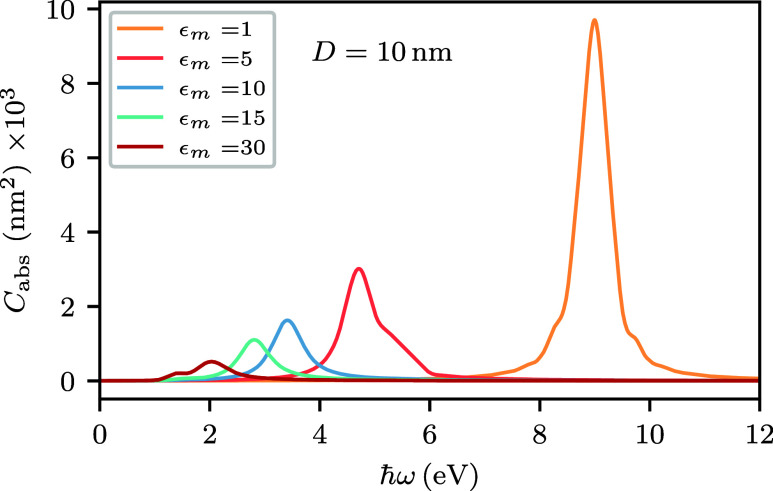
Figure shows the absorption cross-sections of spherical AlNPs embedded in environments with different dielectric constants ϵ_m_. As ϵ_m_ increases, the absorption peak red-shifts from the ultraviolet region to the visible spectrum. In vacuum, the peak is found at 9.0 eV, while for ϵ_m_ = 30, its energy is reduced to 2.0 eV. For ϵ_m_ = 30, the absorption cross-section exhibits a pronounced shoulder near 1.4 eV, which originates from an optically active interband transition.? In addition to the red-shift of the LSP peak, a significant decrease in the LSP peak height is observed. This is caused by an increase in the imaginary part of ϵ(ω) at low frequencies.?
Quasistatic absorption cross-sections C abs of spherical Al nanoparticles with 10 nm diameter, embedded in environments with dielectric constants ϵm = 1, 5, 10, 15, and 30.
Experimentally, Yu and co-workers synthesized spherical aluminum nanoparticles with different diameters.? The smallest nanoparticles that they studied have a diameter of 84 nm and an LSP energy of 3.49 eV. A similar LSP energy is obtained from the quasistatic approximation when an environment dielectric constant ϵ_m_ ≈ 10 is used to capture the effect of the surface oxide layer and dielectric screening from the environment.
Electronic Density of States
Figure(a) shows the density of states (DOS) of spherical AlNPs with different diameters. For the smallest nanoparticles (D = 2 nm), the DOS is characterized by a series of sharp peaks that reflect the discreteness of the electronic states arising from quantum confinement effects. As the diameter increases, the discrete peaks gradually merge to form a continuous curve. At low energies, the nanoparticle DOS closely resembles that of a free-electron gas, which is proportional to the square root of the energy. This behavior can be understood by analyzing the electronic band structure of Al (see Figure(b)), which features a parabolic band whose minimum is located at the center of the first Brillouin zone, i.e., at the Γ point. Sharp features in the electronic band structure, such as the behavior near the L point, correspond to van Hove singularities, where the group velocity vanishes, producing characteristic peaks in the density of states.
(a) Density of states of spherical aluminum nanoparticles of diameters D = 2, 4, and 10 nm from tight-binding. (b) Band structure of bulk Al obtained from a tight-binding calculation.
Hot-Carrier Generation
Figure shows the hot-carrier generation rates as a function of carrier energy of spherical AlNPs in different dielectric environments at their respective plasmon energies. Note that the plasmon energy does not depend on the diameter in the quasistatic approximation, which is used in this work. Similar to the DOS discussed in the previous section, we observe that the hot-carrier generation rates for small nanoparticles exhibit many discrete peaks that merge to form continuous curves for larger nanoparticles. When the nanoparticles are in a vacuum (Figure(a)), the LSP energy is 9.0 eV. This energy is divided between the hot electron and the hot hole. Interestingly, we find that very few electrons with energies close to the Fermi level are generated. At approximately 2 eV, a sharp increase occurs in the hot-electron generation rate, and the generation rate exhibits a broad peak centered near 5 eV. As a consequence of energy conservation, the hot-hole distribution has a broad peak near −4 eV and a sharp reduction near −7 eV.
Hot-carrier generation rates of spherical Al nanoparticles with different diameters D in different dielectric environments. For each environment, the generation rate is calculated at the corresponding LSP energy. (a) ϵm = 1 and ωLSP = 9.0 eV; (b) ϵm = 10 and ωLSP = 3.4 eV; and (c) ϵm = 30 and ωLSP = 2.0 eV.
When the dielectric constant of the environment increases, the LSP energy is reduced, and therefore the hot carriers are distributed over a smaller energy window around the Fermi level compared to the vacuum case (see Figure(b,c)). Notably, both the hot-electron and the hot-hole generation rate for the larger nanoparticles are almost constant over the allowed energy range. This is very different from the hot-carrier distributions of transition metal nanoparticles, such as Au or Ag, which exhibit prominent peaks due to interband transitions from occupied d-states into unoccupied states with mixed sp-character.?
Our findings are in good agreement with ab initio calculations of hot-carrier generation at Al surfaces by Sundararaman and co-workers.? These authors analyzed the decay of surface plasmons due to momentum-conserving interband transitions. For small plasmon energies (2 eV), they find constant hot-electron and hot-hole distributions caused by transitions in the vicinity of the X and W points of the first Brillouin zone, while for larger plasmon energies (6 eV), no electrons with energies close to the Fermi level are generated. The suppression of hot-electron generation near the Fermi level at high photon energies can be understood as follows: to excite a hot electron near the Fermi level with a high-energy photon, energy conservation requires the creation of a hole at a deep below the Fermi level. At energies less than approximately −5 eV, the band structure of aluminum becomes highly parabolic (see Figure(b)). In other words, the materials start to behave like a free-electron gas, which does not support interband transitions.
In addition to interband transitions, our calculations also capture LSP decay channels involving surface-enabled intraband transitions. Previous free-electron model calculations (which do not capture interband transitions) predicted that intraband transitions give rise to relatively constant hot-electron and hot-hole distributions for all nanoparticle sizes.? Our calculations do not agree with this prediction, suggesting that the interband transitions dominate plasmon decay in aluminum nanoparticles. Further evidence for this conclusion is provided by the size dependence of the hot-carrier generation rates: the hot-carrier generation rates per atom are only weakly size-dependent for larger nanoparticles, indicating that bulk-allowed interband transitions (which scale with the nanoparticle volume) dominate over surface-enabled intraband transitions (which scale with the surface area).
Finally, we study the dependence of the hot-carrier generation rate on photon energy. Figure shows the hot-carrier generation rates of an AlNP (D = 4 nm and ϵ_m_ = 30) for different photon energies. The lowest photon energy (ℏω = 1.5 eV) corresponds to the low-energy shoulder in the absorption cross-section caused by interband transitions. Notably, we observe that the hot-carrier generation rates at this photon energy are significantly larger than those at the LSP energy (ℏω = 2.0 eV). This agrees with the experimental finding of Zhou et al., who observed higher rates of hot electron-induced hydrogen dissociation on AlNPs when interband transitions are optically excited compared to the excitation of LSPs.?
Hot-carrier generation rates of spherical Al nanoparticles for photon energies of 1.5, 2.0, and 4.0 eV (a) and 6.0, 7.0, and 8.0 eV (b). Results were obtained for nanoparticles with a diameter of 4 nm, immersed in a medium with a dielectric constant ϵm = 30. The brackets highlight energy windows near the Fermi level in which very few electrons are generated.
While the hot-carrier generation rates are almost constant over the allowed energy range for small photon energies, they become less flat at a photon energy of 4 eV. In particular, fewer electrons with energies close to the Fermi level are generated. This trend continues at even higher photon energies, see Figure(b): at ℏω = 7 eV, almost no electrons with energies close to the Fermi level are produced. This is consistent with the hot-carrier generation rate of nanoparticles in vacuum (see Figure(a)). Besides the change of their shape as a function of energy, the total magnitude of the hot-carrier generation rates becomes smaller at higher photon energies as a consequence of the weaker field enhancement when the photon energy is not resonant with the LSP energy. Because of this, the experimental detection of the reduction of the hot-electron generation rate at the Fermi level is likely to be challenging unless nanoparticles with very thin oxide layers can be fabricated.
Conclusion
We have studied hot-carrier generation in spherical aluminum nanoparticles by using an atomistic modeling approach. We investigated the role of nanoparticle size, incident light frequency, and environment dielectric constants on the hot-carrier properties. For a range of photon energies in the visible and near-ultraviolet regimes, the hot-carrier generation rates are approximately constant as a function of hot-carrier energy in the allowed energy range. For higher photon energies, a reduction in the generation rate of electrons near the Fermi level is observed and attributed to the band structure effects, reducing the number of available interband transitions. Our calculations demonstrate that the hot-carrier properties in aluminum nanoparticles are qualitatively different from those of standard plasmonic materials, such as silver or gold, and also highly tunable, paving the way for aluminum-based nanoscale devices for energy harvesting and photonic technologies. Future work should focus on modeling relaxation processes of hot carriers due to electron–electron and electron–phonon interactions.?
The reference list from the paper itself. Each links out to its DOI / PubMed record.
- 1Govorov A. O.Zhang W.Skeini T.Richardson H.Lee J.Kotov N. A.Gold nanoparticle ensembles as heaters and actuators: Melting and collective plasmon resonances Nanoscale Res. Lett.200618410.1007/s 11671-006-9015-7 · doi ↗
- 2Hartland G. V.Besteiro L. V.Johns P.Govorov A. O.What’s so hot about electrons in metal nanoparticles?ACS Energy Lett.201721641165310.1021/acsenergylett.7b 00333 · doi ↗
- 3Duan Y.Zhu Y.Li K.Wang Q.Wang P.Yu H.Yan Z.Zhao X.Cu 2O-Au nanowire field-effect phototransistor for hot carrier transfer enhanced photodetection Nanotechnology 20193024520210.1088/1361-6528/ab 0f 4d 30865937 · doi ↗ · pubmed ↗
- 4Koo J.-J.Kim Z. H.Radical-Mediated C–C Coupling of Alcohols Induced by Plasmonic Hot Carriers J. Phys. Chem. Lett.2022133740374710.1021/acs.jpclett.2c 0079835446033 · doi ↗ · pubmed ↗
- 5Alam K. M.Gusarov S.Supur M.Kumar P.Kobryn A. E.Cui K.Mc Creery R. L.Shankar K.Hot hole transfer from Ag nanoparticles to multiferroic Y Mn 2O 5 nanowires enables superior photocatalytic activity J. Mater. Chem. C 2022104128413910.1039/D 1TC 06106 B · doi ↗
- 6Zhang Y.Guo W.Zhang Y.Wei W. D.Plasmonic Photoelectrochemistry: In View of Hot Carriers Adv. Mater.202133200665410.1002/adma.20200665433977588 · doi ↗ · pubmed ↗
- 7Zhao J.Nguyen S. C.Ye R.Ye B.Weller H.Somorjai G. A.Alivisatos A. P.Toste F. D.A Comparison of Photocatalytic Activities of Gold Nanoparticles Following Plasmonic and Interband Excitation and a Strategy for Harnessing Interband Hot Carriers for Solution Phase Photocatalysis ACS Cent. Sci.2017348248810.1021/acscentsci.7b 0012228573211 PMC 5445529 · doi ↗ · pubmed ↗
- 8Fujishima A.Honda K.Electrochemical photolysis of water at a semiconductor electrode Nature 1972238373810.1038/238037 a 012635268 · doi ↗ · pubmed ↗