From Needle to Necrosis: A Case Report on Nicolau Syndrome
Ramya A, Ambigai SSK, Adikrishnan Swaminathan

TL;DR
This case report describes a rare complication called Nicolau syndrome following an intramuscular injection, highlighting its progression from pain to tissue necrosis.
Contribution
The novelty lies in presenting a detailed case report and review of Nicolau syndrome triggered by diclofenac injection.
Findings
Nicolau syndrome can occur after intramuscular diclofenac injection.
The syndrome progresses from pain and discoloration to ischemia and necrosis.
Understanding inciting factors is crucial for preventing serious complications.
Abstract
Nicolau syndrome is a rare but dreaded complication that can occur after a routine injection. It causes pain followed by ischemia and necrosis of the area, sometimes leading to serious and potentially life-threatening complications. Various drugs have been attributed to causing this, but only after being administered via an injection. What begins as pain and discoloration of the skin over the injection site quickly takes a sinister turn to become ischemic, ultimately leading to tissue necrosis. As the practice of administering injections is a major part of general medical practice, it becomes crucial to understand the inciting factors and know the potential complications of this otherwise harmless procedure. Here we report a 51-year-old daily wage worker who had pain followed by dark discoloration and ultimately necrosis and ulceration following an intramuscular injection of…
Genes, proteins, chemicals, diseases, species, mutations and cell lines named across the full text — each resolved to its canonical identifier and authoritative record.
Click any figure to enlarge with its caption.
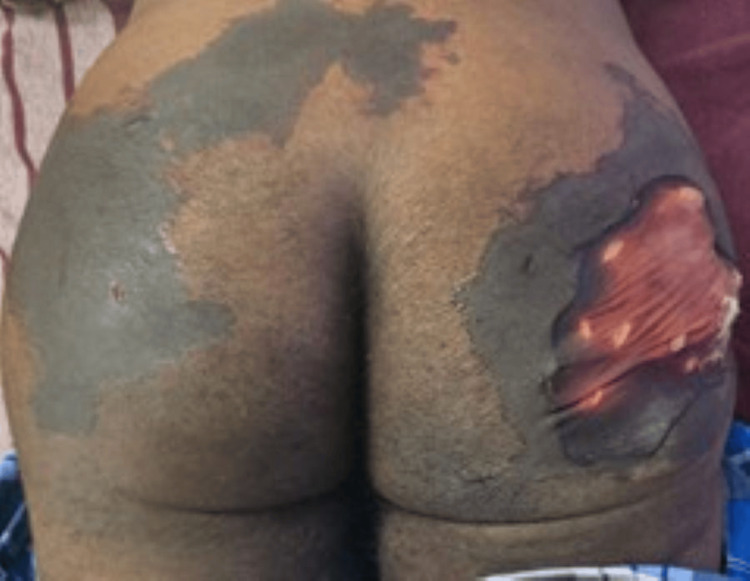 Figure 1
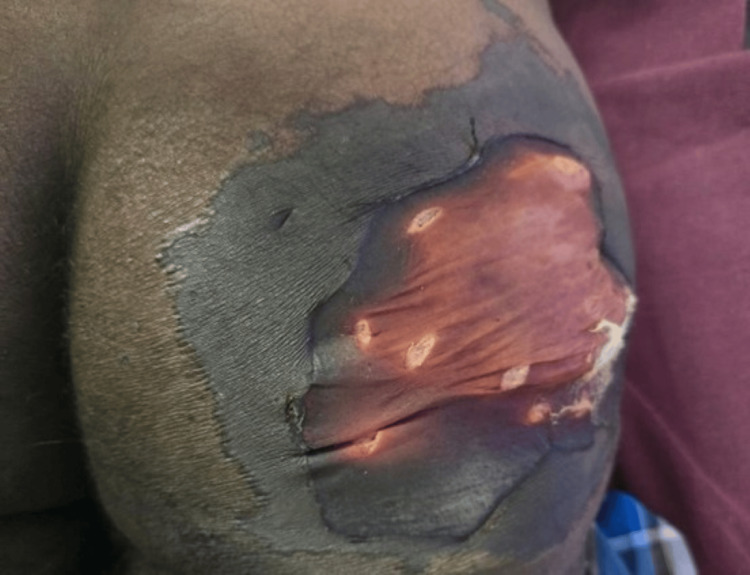 Figure 2
| Phase | Clinical features | Intervention | Reference |
| Initial phase Immediately after injection | Erythema to bluish discoloration of skin | External ice application worsens the extent of cutaneous necrosis and must be avoided at all costs | [ |
| Acute phase lasts from 24 hours to 3 days post injection | Painful erythematous or livedoid indurated plaque; can also be called as livedoid dermatitis | Systemic steroids, anticoagulants | [ |
| Necrotic phase from 5 to 15 days | Tissue necrosis leading to erosions and ulcers | Broad-spectrum antibiotics, analgesics, daily dressings, and surgical debridement | [ |
| Immediate complications | Necrotizing fasciitis, sepsis, death due to septic shock | Broad-spectrum antibiotics, analgesics, daily dressings, and surgical debridement | [ |
| Late complications | Extensive scarring, contractures, deformities, | Corrective surgeries | [ |
| Rare sequelae | Soft tissue sarcoma | Biopsy | [ |
| Investigations | Findings |
| Ultrasonography | Area of diffuse edema within the muscles |
| Computerized tomography | Well-defined lesion with inflammatory changes and central gas collection |
| Magnetic resonance imaging | Areas of focal muscle necrosis |
| Histopathological examination | Fat necrosis with predominant eosinophilic infiltration with no evidence of vasculitis |
Peer Reviews
No public reviews on file for this paper yet. If you reviewed it on a platform where reviews are public (OpenReview, ICLR, NeurIPS, ICML), you can paste yours below so the community can read it here.
Videos
No videos yet. Explain this paper in a talk, walkthrough, or lecture? Add one.
Taxonomy
TopicsIntramuscular injections and effects · Facial Rejuvenation and Surgery Techniques · HIV, Drug Use, Sexual Risk
Introduction
Nicolau syndrome (NS), also known as Embolia cutis medicamentosa, is an uncommon but serious complication following an intramuscular injection [1]. It can lead to various degrees of tissue necrosis ranging from intense pain and skin ulceration to ischemic necrosis of the entire limb [2]. While the pathogenesis of the disease still remains to be discovered, arterial wall irritation and arterial occlusion seem to play a major part in causing the ischemia and necrosis which heals with a disfiguring scar [3-5]. Various drugs, including non-steroidal anti-inflammatory drugs (NSAIDs), antibiotics, and vitamins, all of which are commonly administered as intramuscular injections in day-to-day practice, are implicated in the etiology of NS [6,7]. Considering the popularity of injections as an easy and effective way to administer drugs and treat patients, awareness and recognition of NS becomes important to a dermatologist.
Case presentation
Here we report a 51-year-old man, a daily wage worker by occupation, who came to the hospital with dark discoloration and ulceration of the skin over the gluteal region. The patient was apparently normal five days earlier, after which he was treated at a local hospital with an intramuscular injection of diclofenac for complaints of pain in both legs. He revealed a history of pain over the injection site that started two hours after the injection and progressed overnight to an intense throbbing type of pain. There was also a history of redness of skin over the injection site that progressed to a dark discoloration of the region, ultimately leading to peeling of the skin and development of painful erosion over the injection site, after which he came to our hospital for further management.
There was no history of topical irritant application or native medication use. The patient also had no history of fluid or pus-filled lesions, or a history of penetrating trauma or surgery before the onset of lesions. He had no complaints of similar cutaneous or mucosal lesions. There was no history of any drug allergies in the past. He gave a history of being treated multiple times for similar complaints with diclofenac intramuscular injections, following which he had no such complaints.
On examination, the vitals were normal and general examination was unremarkable with no lymphadenopathy. Dermatological examination showed a wide area of necrosis involving both bilateral gluteal regions of size 10 x 15 cm (Figure 1).
Areas of necrosis noted over the bilateral gluteal region
There was also a large erosion of size 6 x 5 cm noted over the right gluteal region (Figure 2).
Area of ulceration noted over the right gluteal region
Peripheral pulses of the bilateral lower limbs were normal.
The patient was admitted for further management. Though differential diagnoses like necrotizing fascitis and cellulitis were considered, after considering the arc of clinical history, a diagnosis of NS was made. He was started on broad spectrum IV antibiotics. Wound debridement was done and antibiotics with daily dressing were continued to which he responded well. The necrotic areas resolved with exfoliation followed by re-epithelialization. The patient was discharged with broad spectrum oral antibiotics and advice regarding proper wound care and dressing for the healing erosions and is currently under follow-up.
Discussion
Described in the early 1920s by Nicolau and Freudenthal, NS was initially observed after the injection of bismuth salts for the treatment of syphilis [8,9]. It is an iatrogenic disease that can be caused by intra-arterial, intramuscular, intravenous, intra-articular or subcutaneous injections [8-13]. Various drugs, including NSAIDs, penicillin, steroids, Vitamin K, vaccines and dermatological procedures like hyaluronic acid fillers, mesotherapy and sclerotherapy, are attributed to causing NS [14,15].
The exact pathogenesis of NS is still being studied, but multiple theories have been offered. With the eventual outcome being ischemia and necrosis, vasospasm secondary to needle prick, embolus formation due to increased viscosity of the drug, and vasoconstriction due to periarticular injection are the various patho-mechanisms proposed [1]. Though multiple drugs are found to cause this syndrome, diclofenac, the drug that was administered to this patient, is the most common cause [1]. It is a cyclooxygenase inhibitor that inhibits prostaglandin synthesis, causing vasoconstriction, contributing to the pathogenesis of NS [16].
The site affected is based on the route of administering the injection, ranging from the thighs, arms, gluteal region, and the abdomen to the knees and shoulders. The three phases of the disease with clinical features and the various complications are detailed in Table 1.
Clinical suspicion and relevant history taking play a major role in diagnosis as mentioned in this case report. Other findings noted in the various investigations are listed in Table 2.
Conclusions
Thus, NS is a rare yet distressing disorder of the skin that follows an injection. Though the intramuscular route was found to be most commonly associated, injections in general are found to be an inciting factor. The commonness of the causative factor, the excruciating pain faced by the patient, and the risk of sepsis and the disfigurement that follows healing, all make understanding and preventing this disease crucial. Though the pathogenesis is not fully understood, early identification plays a vital role in treating this disorder. Educating the general practitioners about the right principles of administering injections and explaining the perils should this disease occur is vital to reduce the incidence of this iatrogenic syndrome.
The reference list from the paper itself. Each links out to its DOI / PubMed record.
- 1Nicolau syndrome: a literature review World J Dermatol Kim KK Chae DS 10310742015 https://doi.org/10.5314/wjd.v 4.i 2.103.
- 2Nicolau syndrome in 29 months boy: another report of Iran Scholars Journal of Medical Case Reports Fazel M Asbagh PA Afshin A Shariat M Fazel M Akhlaghi M 28929132015 https://saspublishers.com/article/7888/
- 3Nicolau’s syndrome Indian Pediatr Srivastava P Someshwar S Jerajani H 356522015 https://www.indianpediatrics.net/apr 2015/apr-356.htm 25929650 · pubmed ↗
- 4An avoidable adverse drug reaction: Nicolau syndrome Int Wound J Gulseren D Sahin EB Bozdogan O Artuz F 440441142017 https://doi.org/10.1111/iwj.12663.2761150910.1111/iwj.12663 PMC 7949571 · doi ↗ · pubmed ↗
- 5Nicolau syndrome: an iatrogenic cutaneous necrosis J Cutan Aesthet Surg Nischal K Basavaraj H Swaroop M Agrawal D Sathyanarayana B Umashankar N 929522009 https://doi.org/10.4103/0974-2077.58523.2080859710.4103/0974-2077.58523 PMC 2918347 · doi ↗ · pubmed ↗
- 6Five cases of livedo-like dermatitis (Nicolau's syndrome) due to bismuth salts and various other non-steroidal anti-inflammatory drugs J Eur Acad Dermatol Venereol Corazza M Capozzi O Virgilit A 585588152001 https://doi.org/10.1046/j.1468-3083.2001.00320.x.1184322410.1046/j.1468-3083.2001.00320.x · doi ↗ · pubmed ↗
- 7Nicolau's syndrome induced by intramuscular vitamin K injection in two extremely low birth weight infants Int J Dermatol Puvabanditsin S Garrow E Weerasethsiri R Joshi M Brandsma E 10471049492010 https://doi.org/10.1111/j.1365-4632.2009.04392.x.2088326810.1111/j.1365-4632.2009.04392.x · doi ↗ · pubmed ↗
- 8Livedoid and gangrenous dermatitis of the buttock, following intramuscular injections in syphilis. A case of bismuthic arterial embolism (Article in French)Ann Mal Vener Nicolau S 321339201925 https://numerabilis.u-paris.fr/ressources/pdf/medica/bibnum/epo 0720/epo 0720.pdf