Merkel cell carcinoma in Singapore
Trang T.T. Chu, Zhi Yi Alicia Seet, Ellie C.E. Choi, Peter K.C. Goon

Abstract
Genes, proteins, chemicals, diseases, species, mutations and cell lines named across the full text — each resolved to its canonical identifier and authoritative record.
Click any figure to enlarge with its caption.
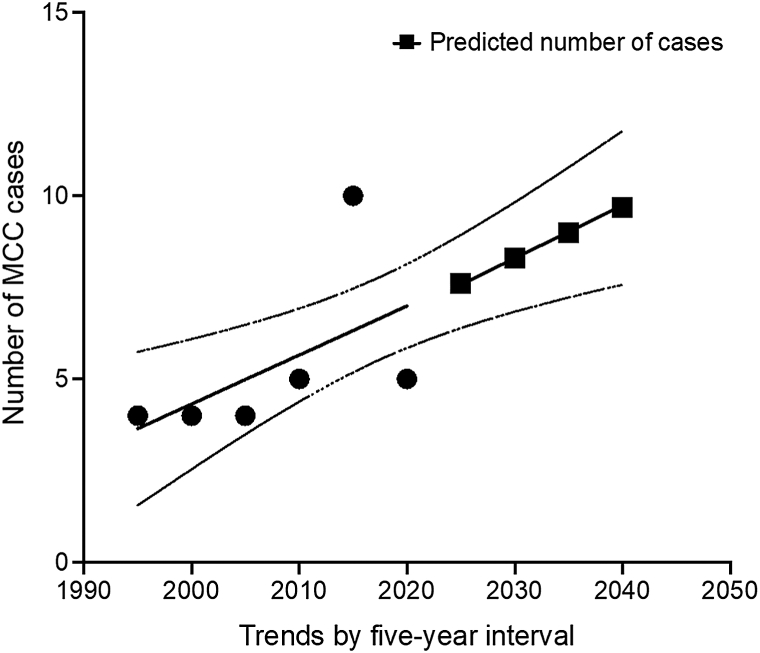 Figure 1
Peer Reviews
No public reviews on file for this paper yet. If you reviewed it on a platform where reviews are public (OpenReview, ICLR, NeurIPS, ICML), you can paste yours below so the community can read it here.
Videos
No videos yet. Explain this paper in a talk, walkthrough, or lecture? Add one.
Taxonomy
TopicsPolyomavirus and related diseases · Animal Virus Infections Studies · Infectious Encephalopathies and Encephalitis
To the Editor: Merkel cell carcinoma (MCC) is a rare but highly aggressive, life-threatening skin cancer1^,^2 with poor prognosis and high recurrence. Patients are predominantly fair-skinned, aged >75 years, with the cancer occurring on ultraviolet-exposed body sites.1^,^3 MCC incidence is increasing worldwide, with a >95% rise in the United States from 2000-2013 (0.7 expected cases per 100,000 person-years),2 and a threefold increase in the United Kingdom from 2004-2013.1 Increasing crude incidence rates from Asia have also emerged,3^,^4 but none report age-standardized incidence rates (ASIs) allowing for direct comparison.
This study aimed to (1) analyze MCC ASIs in Singapore relative to steep increases in the West and (2) estimate case numbers for 2030 onwards. Singapore has comparable GDP and living standards to the West, but with strong year-round equatorial UV exposure and a predominantly Asian population (Fitzpatrick skin types 3-6).
Deidentified data from the Singapore National Registry of Diseases Office (population-based) were retrieved (01/01/1968-31/12/2022). MCC cases were retrieved with International Classification of Diseases (ICD) categories ICD, Ninth Revision (1968-1992), ICD for Oncology, Second Edition (1993-2002), ICD for Oncology, Third Edition (2003 onward), and histology code (8247/3). Singapore’s first MCC case in 1997 determined the study period of 1997-2021.
32 MCC cases (male = 16, female = 16) were identified in Singapore from 1997-2021 (Fig 1). Except for 1 patient aged 30-34 years, age at diagnosis was 63.0-95.8 (median = 82.1) years, with 62.5% (20) of patients aged ≥80 years. MCC incidence is increasing—12 cases were diagnosed from 1997-2007 and 20 over the same duration from 2011-2021 (Table I). Median survival time postdiagnosis was 1.6 years only. ASI was 0.035 expected cases per 100,000 person-years referenced to the standard world population. Disease incidence was highest in patients aged 80-84 years (ASI = 0.074) and ≥90 years (ASI = 0.058). Predicted future incidence was extrapolated via simple linear regression (Fig 1), with a projected increase of 8 new cases per 5 years by 2030 and 10 new cases per 5 years by 2040.Fig 1. Number of cases of MCC in Singapore, 1997-2021 (in 5-year blocks). MCC, Merkel cell carcinoma.Table IASIs for Merkel cell carcinoma in SingaporeAge group, iNo. of cases, d_iPerson-years at risk, yi_ (1997-2021)Age-specific incidence (per 100,000 person-years) 100000∗ (d_i/yi)WHO World Standard population, wiExpected cases in standard population, diwi/yi_0-405,001,272088,5690.0005-905,607,829086,8700.00010-1405,794,372085,9700.00015-1905,828,362084,6700.00020-2405,923,551082,1710.00025-2906,682,308079,2720.00030-3417,329,875076,0730.01035-3907,716,109071,4750.00040-4407,766,387065,8770.00045-4907,452,754060,3790.00050-5406,705,986053,6810.00055-5905,681,214045,4840.00060-6414,532,9540.02237,1870.00865-6923,397,8150.05929,5900.01770-7452,403,5710.20822,0920.04675-7931,589,4530.18915,1950.02980-848988,6600.80990970.07485-893545,7750.55043980.024>= 909300,5082.99519500.058Total3291,197,0490.035100,0000.035ASIs, Age-standardized incidence rates; WHO, World Health Organization.∗For purposes of comparison, the WHO Standard age group ≥90 is an aggregate of the age groups 90-94, 95-99, and 100+.
MCC incidence in Singapore remains relatively rare, with a significantly lower ASI (0.035) than that of well-established cohorts in the United Kingdom (0.65),3 the United States (0.7),2 and Australia (1.6).3 The rarity of MCC in Asian populations means that epidemiology data are sparse and may not align with trends observed in the West.
The observed 1:1 sex ratio differs from the male preponderance previously described in largely Eurocentric cohorts1, 2, 3 and conversely the female predominance in smaller Asian cohorts. Further research is required to ascertain if this is a characteristic of the Singaporean population or simply an artefact.
87.5% (28) of cases were of Chinese ethnicity, exceeding that of Singapore’s 74.3% Chinese population.5 This may be attributed to fairer skin as an established MCC risk factor, with the highest incidence rates from Western cohorts comprising more than 90% White patients.3 Merkel cell polyomavirus infection/integration into MCC is now an established risk factor in the West and will be a vital area of future research in Singapore.
This study presents analysis of MCC ASIs in Singapore over 25 years and estimates of future incidence rates. While the overall burden of MCC in Singapore remains low, increasing incidence rates and the lethality of the cancer pose a growing concern.
Conflicts of interest
None disclosed.
The reference list from the paper itself. Each links out to its DOI / PubMed record.
- 1Goon P.K.Greenberg D.C.Igali L.Levell N.J.Merkel cell carcinoma: rising incidence in the East of England J Eur Acad Dermatol Venereol 301220162052205510.1111/jdv.1382827515234 · doi ↗ · pubmed ↗
- 2Paulson K.G.Park S.Y.Vandeven N.A.Merkel cell carcinoma: current US incidence and projected increases based on changing demographics J Am Acad Dermatol 7832018457463.e 210.1016/j.jaad.2017.10.02829102486 PMC 5815902 · doi ↗ · pubmed ↗
- 3Mohsen S.T.Price E.L.Chan A.-W.Incidence, mortality and survival of Merkel cell carcinoma: a systematic review of population-based studies Br J Dermatol 1906202481182410.1093/bjd/ljad 40437874770 · doi ↗ · pubmed ↗
- 4Shinogi T.Nagase K.Inoue T.Merkel cell carcinoma: a systematic review of the demographic and clinical characteristics of 847 cases in Japan J Dermatol 48720211027103410.1111/1346-8138.1587533847013 · doi ↗ · pubmed ↗
- 5Singapore Department of Statistics Sing Stat table builder - Singapore residents by age group, ethnic group and sexhttps://tablebuilder.singstat.gov.sg/table/TS/M 810011