Determination of Eight Benzene Homologs in Ambient Air and Indoor Air in Residential Areas by Secondary Thermal Desorption–Gas Chromatography
Tao Liu, Xiaoxue Yuan, Tiankuo Yang, Changxiao Yang, Hui Zhao, Jiwen Jiang, Jun Feng

TL;DR
This study developed a new method to accurately measure benzene-related compounds in both outdoor and indoor air using an improved thermal desorption gas chromatography technique.
Contribution
The novel contribution is an optimized solvent-free secondary thermal desorption–gas chromatography method for reliable detection of benzene homologs in complex air samples.
Findings
The method achieved baseline separation of xylene isomers and showed high linearity (R² > 0.992) with detection limits between 50–120 ng/m³.
Spiked recoveries ranged from 90.5% to 117.3%, with relative standard deviations between 0.8% and 9.2%, indicating high accuracy and precision.
Significant correlations were found between indoor and outdoor concentrations of benzene homologs in residential areas.
Abstract
This study developed and comprehensively validated an optimized analytical method based on secondary thermal desorption–gas chromatography (STD‐GC) for the simultaneous determination of eight key benzene homologs in ambient and indoor air of residential areas. Compared to solvent desorption and single‐stage thermal desorption, STD demonstrates superior desorption efficiency, reduced matrix interference, fully automated rapid operation, complete analyte transfer, thereby eliminating analyte losses while enhancing analytical accuracy and sensitivity, and solvent‐free ensuring friendly to human and the environment. Aiming at the characteristics of target compounds and complex environmental matrices (e.g., humidity, coexisting interferents), sampling parameters, thermal desorption conditions, and gas chromatographic separation conditions were systematically optimized, with particular…
Genes, proteins, chemicals, diseases, species, mutations and cell lines named across the full text — each resolved to its canonical identifier and authoritative record.
Click any figure to enlarge with its caption.
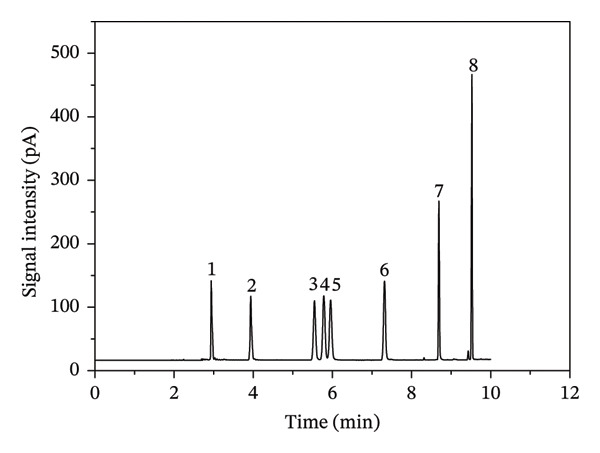 Figure 1
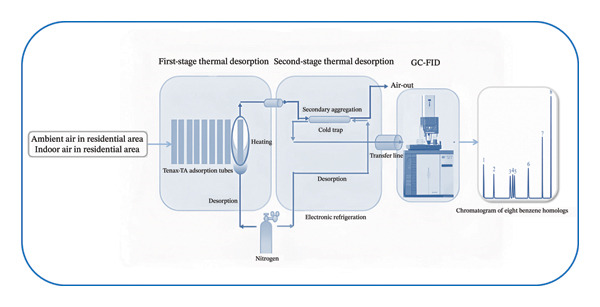 Figure 2
Peer Reviews
No public reviews on file for this paper yet. If you reviewed it on a platform where reviews are public (OpenReview, ICLR, NeurIPS, ICML), you can paste yours below so the community can read it here.
Videos
No videos yet. Explain this paper in a talk, walkthrough, or lecture? Add one.
Taxonomy
TopicsIndoor Air Quality and Microbial Exposure · Toxic Organic Pollutants Impact · Odor and Emission Control Technologies