Moving Beyond Self-Report in Characterizing Drug Addiction: Using Drug-Biased Behavior to Predict Treatment Completion and Dropout in Heroin-Primary, Medication-Maintained Opioid Use Disorder
Natalie McClain, Ahmet O. Ceceli, Kathryn Drury, Greg Kronberg, Eric L. Garland, Nelly Alia-Klein, Rita Z. Goldstein

TL;DR
This study shows that objective behavioral tests, not self-reports, better predict treatment success in opioid use disorder.
Contribution
First demonstration that drug-biased behavioral measures predict treatment outcomes better than self-reports in opioid use disorder.
Findings
Individuals with opioid use disorder showed higher drug-biased choice and fluency compared to healthy controls.
Drug-biased behavioral measures predicted treatment completion and dropout more reliably than self-report measures.
Behavioral tasks demonstrated strong test-retest reliability and significant predictive power for clinical outcomes.
Abstract
Drug addiction is accompanied by enhanced salience attributed to drug over nondrug cues. This bias can be objectively measured and is reliable but underutilized in informing clinical end points, where self-report measures are most commonly used, with limited success. We investigated whether behavioral picture choice (laboratory-simulated measure of drug seeking) and verbal fluency (drug and nondrug words generated) revealed drug-biased processing in 59 individuals with opioid use disorder (iOUDs) compared with 29 healthy control (HC) individuals; assessed twice, we also inspected the test-retest reliability of these tools. All iOUDs were heroin primary, abstinent (160.58 ± 188.18 days), and stabilized on medication for OUD at an inpatient treatment facility at baseline. Then, we tested whether, compared with self-report measures, these drug-biased behavioral measures could better…
Genes, proteins, chemicals, diseases, species, mutations and cell lines named across the full text — each resolved to its canonical identifier and authoritative record.
Click any figure to enlarge with its caption.
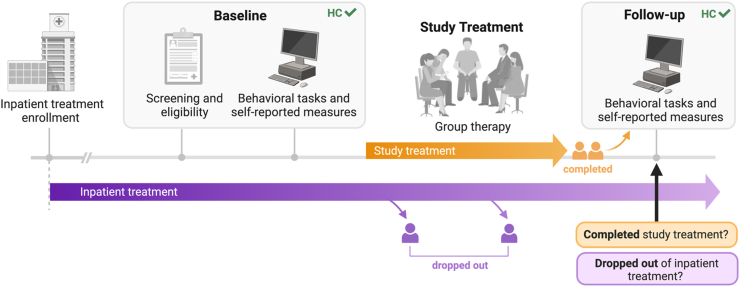 Figure 1
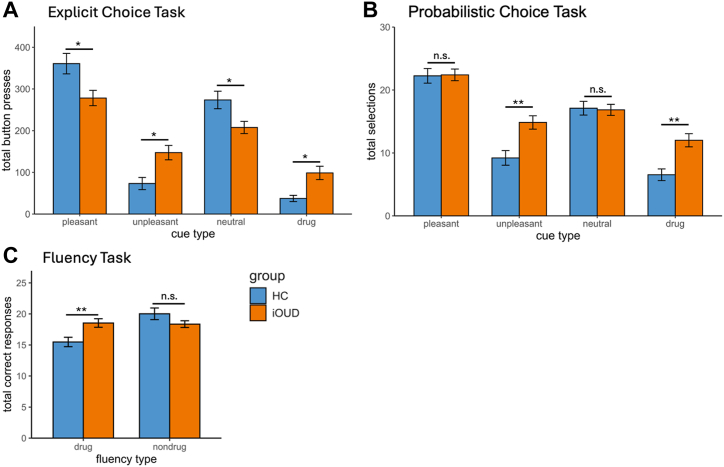 Figure 2
Peer Reviews
No public reviews on file for this paper yet. If you reviewed it on a platform where reviews are public (OpenReview, ICLR, NeurIPS, ICML), you can paste yours below so the community can read it here.
Videos
No videos yet. Explain this paper in a talk, walkthrough, or lecture? Add one.
Taxonomy
TopicsSubstance Abuse Treatment and Outcomes · Opioid Use Disorder Treatment · Anxiety, Depression, Psychometrics, Treatment, Cognitive Processes