Prehospital Point-of-Care Lactate as a Predictor of Early Operative and Emergency Interventions in Trauma Patients: A Systematic Review
Mosab A Alabas, Nasser M Hakami, Fahad Y Azyabi, Haneen Y Alsayed, Maen A Idris, Nasser F Alshanbari, Naif N Althagafi, Ahmed H Alabdele, Mohammad M Alfaidi, Abdulaziz A Alabdulrahman, Jerayed K Aljerayed

TL;DR
This paper reviews how measuring lactate in trauma patients before hospital arrival can help predict the need for urgent surgery or emergency care.
Contribution
The study systematically evaluates prehospital lactate as a novel predictor for early operative interventions in trauma patients.
Findings
Elevated prehospital lactate is linked to a higher chance of early invasive treatments.
Lactate measurements outperform traditional metrics in normotensive trauma patients.
Lactate is most predictive of immediate surgery within six hours of injury.
Abstract
Early identification of trauma patients requiring immediate operative or emergency intervention remains a major challenge in the prehospital setting. Traditional physiological parameters, such as systolic blood pressure and shock index, may fail to detect occult hypoperfusion, particularly in patients with normal blood pressure (normotensive). Prehospital point-of-care (POC) lactate measurement, which allows rapid bedside assessment of blood lactate levels, has emerged as a potential biomarker to improve early risk stratification and guide timely surgical preparedness. Evidence from observational studies suggests that elevated prehospital lactate is consistently associated with an increased likelihood of early invasive management, including emergency surgery, interventional radiology, and resuscitative care. Lactate appears to offer superior or complementary predictive performance…
Genes, proteins, chemicals, diseases, species, mutations and cell lines named across the full text — each resolved to its canonical identifier and authoritative record.
Click any figure to enlarge with its caption.
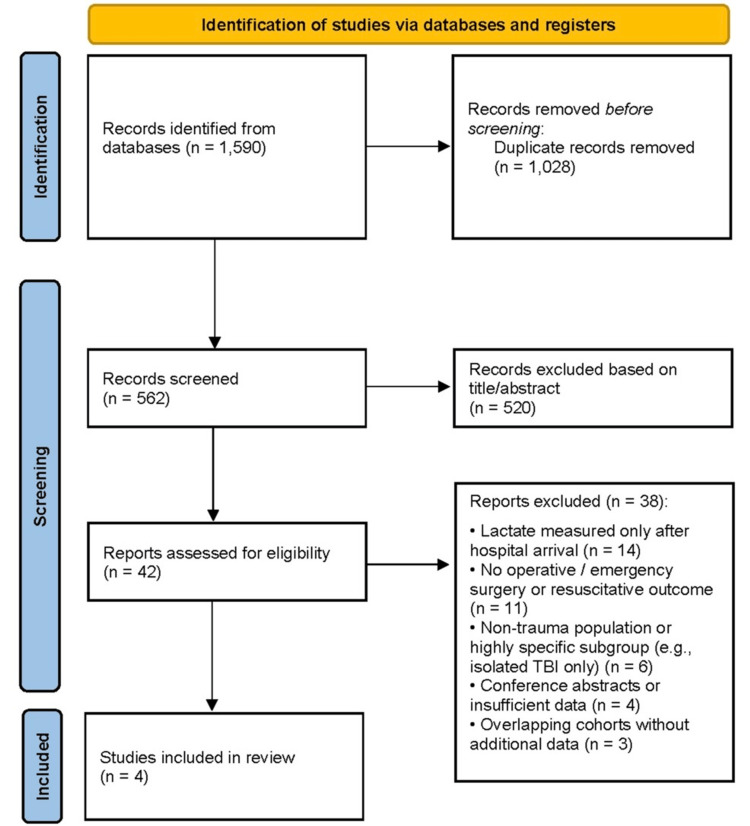 Figure 1
Peer Reviews
No public reviews on file for this paper yet. If you reviewed it on a platform where reviews are public (OpenReview, ICLR, NeurIPS, ICML), you can paste yours below so the community can read it here.
Videos
No videos yet. Explain this paper in a talk, walkthrough, or lecture? Add one.
Taxonomy
TopicsTrauma, Hemostasis, Coagulopathy, Resuscitation · Hemodynamic Monitoring and Therapy · Sepsis Diagnosis and Treatment