Clinical characterization and management of persistent genital arousal disorder/genito-pelvic dysesthesia (PGAD/GPD): a registry study
Franziska Maxi Lisa Marie Kümpers, Sophie Köhne, Tillmann H C Krüger

TL;DR
This study describes the clinical features and management of a rare condition called persistent genital arousal disorder, highlighting its complex nature and the need for interdisciplinary treatment.
Contribution
The study provides a detailed clinical characterization of PGAD/GPD through a registry of 92 patients, identifying symptom patterns and comorbidities.
Findings
PGAD/GPD symptoms are often tingling sensations, frequently localized in the clitoris or glans penis, with high rates of swelling and spontaneous orgasms.
Most patients reported mental stress and tight clothing as triggers, while distraction and warmth were common relieving factors.
High rates of psychiatric comorbidities, especially depression, were observed, often developing after symptom onset.
Abstract
Persistent genital arousal disorder (PGAD)/genito-pelvic dysesthesia (GPD) is a disabling disease, where patients perceive prolonged genital arousal without sexual desire. The condition mainly occurs in women. Etiopathological considerations reach from peripheral to central nervous system mechanisms. To clinically and anamnestically characterize patients with PGAD/GPD using data from a dedicated patient registry. This study comprises a detailed description of 92 patients with PGAD/GPD from a registry data bank. Investigations included clinical characterization of PGAD/GPD-symptoms, assessment of sexual, urogynecological, somatic, and psychiatric history as well as clinical examination and treatments. The primary outcome was to identify common clinical features, symptom patterns, trigger and relieving factors, comorbidities, and therapeutic strategies. Persistent genital arousal…
Genes, proteins, chemicals, diseases, species, mutations and cell lines named across the full text — each resolved to its canonical identifier and authoritative record.
Click any figure to enlarge with its caption.
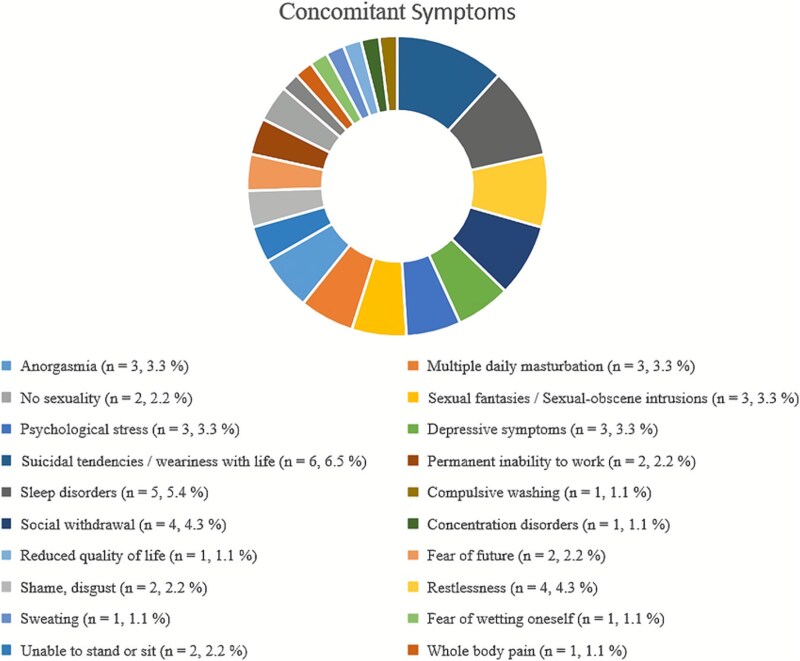 Figure 1
 Figure 2
Peer Reviews
No public reviews on file for this paper yet. If you reviewed it on a platform where reviews are public (OpenReview, ICLR, NeurIPS, ICML), you can paste yours below so the community can read it here.
Videos
No videos yet. Explain this paper in a talk, walkthrough, or lecture? Add one.
Taxonomy
TopicsSexual function and dysfunction studies · Female Genital Mutilation/Cutting Issues · Genital Health and Disease