Treadmill perturbation-based balance training to prevent unrecovered falls in fall-prone older adults with and without cognitive impairment: protocol for the multi-center randomized controlled TRAIL study
J Koschate-Storm, C Werner, J Bartel, JM Bauer, C Becker, S Drefs, N El-Seoud, C Giehl, M Hackbarth, N Hezel, J Klenk, U Trampisch, R Wirth, T Zieschang, M Schwenk

TL;DR
This study tests if treadmill balance training can help older adults, including those with cognitive issues, avoid falls that leave them unrecovered.
Contribution
The study introduces a novel treadmill-based perturbation training protocol for fall-prone older adults, including those with cognitive impairment.
Findings
The TRAIL study will assess if treadmill perturbation training reduces unrecovered falls in older adults.
Results may provide evidence for a low-volume balance training approach for high-risk populations.
Proxy reporting will be used to improve fall data accuracy in participants with cognitive impairment.
Abstract
Approximately one-third of older adults fall each year, most often due to slips or trips. Fall incidence is even higher in those with cognitive impairment (CI). Among older adults who fall, about 50% are unable to get up without assistance. Such unrecovered falls are particularly critical, as they are linked to prolonged lying periods, an increased risk of medical complications, and mortality. As unrecovered falls require third-party assistance, they offer an opportunity to incorporate proxy information into fall reporting to reduce recall bias. Perturbation-based balance training (PBT) aims to improve recovery reactions in response to balance disturbances such as slips and trips and thereby prevent falls. This task-specific approach has shown promise in reducing falls in low-risk older adults. However, its efficacy in high-risk populations, especially in participants with CI, remains…
Genes, proteins, chemicals, diseases, species, mutations and cell lines named across the full text — each resolved to its canonical identifier and authoritative record.
Click any figure to enlarge with its caption.
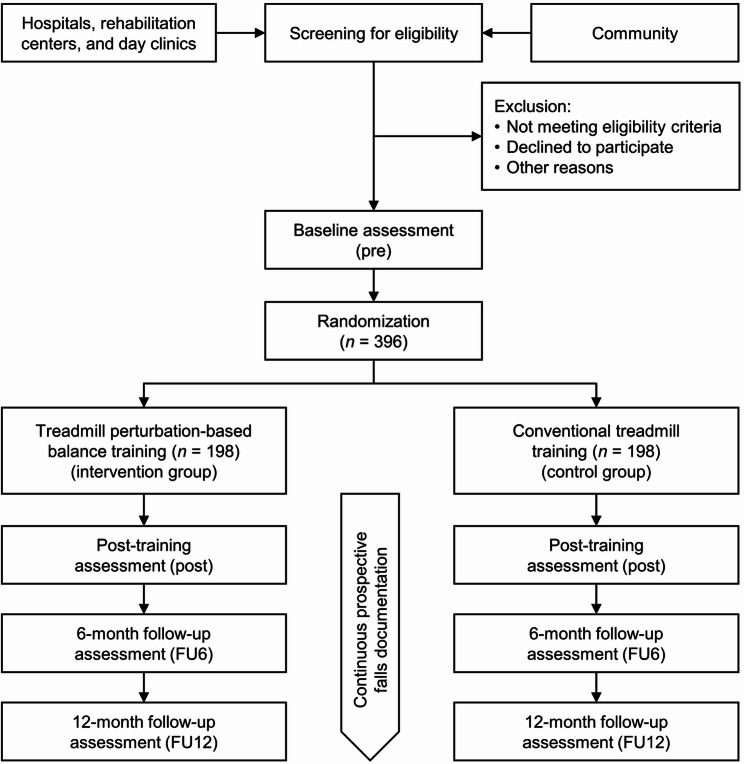 Figure 1
 Figure 2
Peer Reviews
No public reviews on file for this paper yet. If you reviewed it on a platform where reviews are public (OpenReview, ICLR, NeurIPS, ICML), you can paste yours below so the community can read it here.
Videos
No videos yet. Explain this paper in a talk, walkthrough, or lecture? Add one.
Taxonomy
TopicsBalance, Gait, and Falls Prevention · Context-Aware Activity Recognition Systems · Physical Activity and Health