Insecticide-treated screening of windows for household protection against insecticide-resistant Anopheles gambiae sensu lato in Côte d’Ivoire: a semi-field trial
Marius Gonse Zoh, Antoine Barreaux, Edouard Dangbenon, Alphonsine Amanan Koffi, Ludovic Phamien Ahoua Alou, Soromane Camara, N’Guessan Brou, Serge Yao Koffi, Matthew Brian Thomas, Raphael N’Guessan

TL;DR
A study in Côte d’Ivoire tested insecticide-treated window screens to reduce malaria-carrying mosquitoes indoors, showing promising results in lowering mosquito entry and feeding.
Contribution
This study introduces insecticide-treated window screens as a novel household intervention against insecticide-resistant malaria mosquitoes.
Findings
Insecticide-treated window screens with eave blocking reduced mosquito entry by 31.8% compared to standard control houses.
Damaging the insecticide-treated screens reduced effectiveness, but two small holes still provided significant protection.
The combination of insecticide-treated screens and eave blocking showed comparable impact to insecticide-treated eave tubes with untreated screens.
Abstract
Despite the significant impact of long-lasting insecticidal nets (LLINs) and indoor residual spraying (IRS) on malaria, 597,000 deaths from malaria were still recorded in 2023. Additional measures are clearly needed to complement current tools. We assessed the efficacy of insecticide-treated window screens (a piece of PermaNet 3.0 containing deltamethrin + piperonyl butoxide) versus untreated window screening and eave tube inserts treated with β-cyfluthrin as household interventions against Anopheles gambiae sensu lato. Between August and October 2022, five experimental houses in Kolongonouan village, central Côte d’Ivoire, were used under semi-field conditions to evaluate the following interventions: (i) standard control house with small openings in the eaves and no window screens (SCH); (ii) insecticide-treated screening (ITS) of windows with small openings in the eaves (ITS op);…
Genes, proteins, chemicals, diseases, species, mutations and cell lines named across the full text — each resolved to its canonical identifier and authoritative record.
Click any figure to enlarge with its caption.
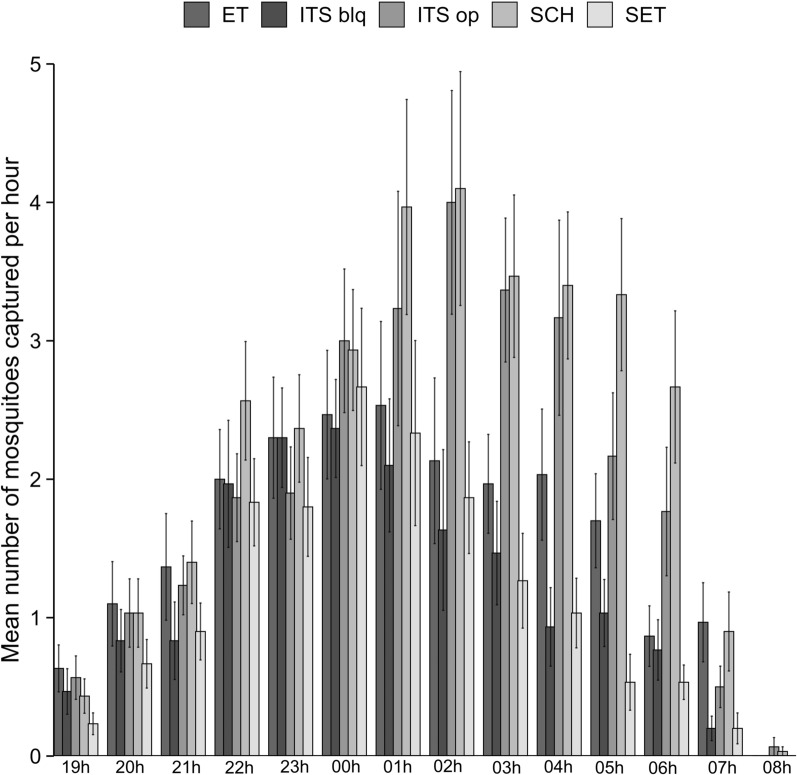 Figure 1
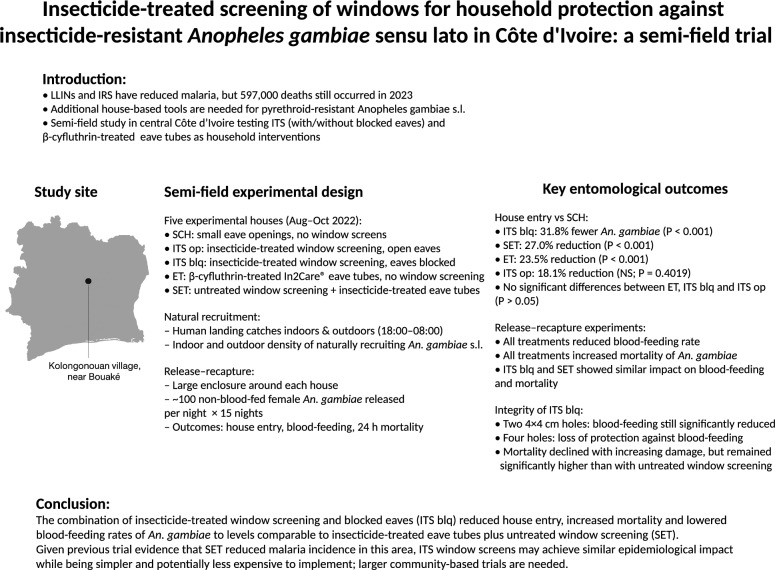 Figure 2
Peer Reviews
No public reviews on file for this paper yet. If you reviewed it on a platform where reviews are public (OpenReview, ICLR, NeurIPS, ICML), you can paste yours below so the community can read it here.
Videos
No videos yet. Explain this paper in a talk, walkthrough, or lecture? Add one.
Taxonomy
TopicsMalaria Research and Control · Mosquito-borne diseases and control · Insect Pest Control Strategies