Random vs. blocked perturbation training on reactive balance control in peripheral neuropathy: A protocol study for a randomized controlled trial
Razieh Javadian Kootenayi, Razieh Mofateh, Mehrnoosh Zakerkish, Neda Orakifar, Saeideh Monjezi, Mohammad Mehravar, Maryam Seyedtabib

TL;DR
This study compares random and blocked balance training methods to improve balance control in people with diabetic peripheral neuropathy.
Contribution
It introduces a novel application of practice schedule concepts in perturbation-based balance training for reactive balance control.
Findings
Blocked and random training methods will be compared for their effects on reactive balance control.
Outcomes will be measured immediately and one day after training to assess persistency and transfer.
The study includes three difficulty levels of platform motion during balance training.
Abstract
Diabetic peripheral neuropathy (DPN) is the leading cause of disturbances in reactive balance control. The repeated, external mechanical perturbations in perturbation-based balance training(PBBT) evoke balance recovery strategies; which subsequently improve reactive balance performance. Using the practice schedule concept of motor learning in the design of PBBT is a relatively new approach related to balance exercises. This study aims to investigate the effects of blocked and random PBBT on reactive balance control and its persistency and transfer to conditions different from those experienced during training. Individuals with DPN will be recruited and randomly allocated to one of the three groups: random, blocked, and control group. Random and blocked PBBT groups will receive single-session balance training, including unexpected perturbations of platform during quiet standing in two…
Genes, proteins, chemicals, diseases, species, mutations and cell lines named across the full text — each resolved to its canonical identifier and authoritative record.
Click any figure to enlarge with its caption.
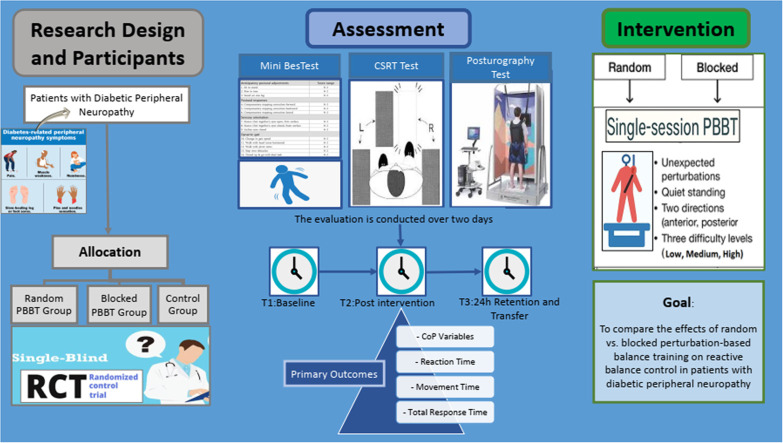 Figure 1
Peer Reviews
No public reviews on file for this paper yet. If you reviewed it on a platform where reviews are public (OpenReview, ICLR, NeurIPS, ICML), you can paste yours below so the community can read it here.
Videos
No videos yet. Explain this paper in a talk, walkthrough, or lecture? Add one.
Taxonomy
TopicsBalance, Gait, and Falls Prevention · Stroke Rehabilitation and Recovery · Muscle activation and electromyography studies