Complete Genome Sequences of Eleven Cluster DJ Gordonia rubripertincta Bacteriophages
Ping An, Meredith Barbieri, Dawn C. Bisi, Kristen Butela, Aimee H. Danley, Christina Grogan, Ben Hilldorfer, Bhaswati Manish, Kevin K. McDade, Eliza J. Neumann, Aparna Nigam, Rachelle Patterson, Ananya Saini, Samantha Walker, Otto G. Williams, Marcie H. Warner

TL;DR
This paper reports the complete genome sequences of 11 new phages that infect a specific soil bacterium, highlighting unique genetic features.
Contribution
The study provides new insights into the genomic diversity and unique characteristics of cluster DJ phages infecting Gordonia rubripertincta.
Findings
The phages have an average genome length of 60,185 bp and contain around 91 predicted genes.
Cluster DJ phages have a significantly lower G+C content (51.6%) compared to their host bacterium (~67%).
These phages exhibit unusual gene organization in lysis and include two related major tail protein genes.
Abstract
Eleven novel cluster DJ Gordonia rubripertincta phages were isolated from soil collected in Pittsburgh, PA and Omaha, NE. The genomes of these phages have an average length of 60,185 bp and contain an average of 91 predicted genes. Genes with putative roles in structure, assembly, lysis, and nucleic acid processing were identified. Cluster DJ phages have an unusually low average G+C content (51.6%) compared to G. rubripertincta (~67%). These phages are also unusual in the organization of genes involved in lysis, the inclusion of two related major tail protein genes, and the absence of a candidate tail assembly chaperone gene.
Genes, proteins, chemicals, diseases, species, mutations and cell lines named across the full text — each resolved to its canonical identifier and authoritative record.
Click any figure to enlarge with its caption.
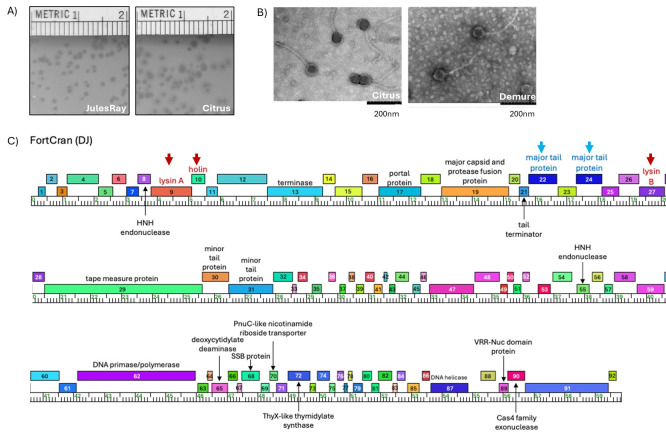 Figure 1
Peer Reviews
No public reviews on file for this paper yet. If you reviewed it on a platform where reviews are public (OpenReview, ICLR, NeurIPS, ICML), you can paste yours below so the community can read it here.
Videos
No videos yet. Explain this paper in a talk, walkthrough, or lecture? Add one.
Taxonomy
TopicsBacteriophages and microbial interactions · Genomics and Phylogenetic Studies · Protist diversity and phylogeny