Caenorhabditis inopinata shows reduced attraction and increased head-swinging compared with C. elegans in plate chemotaxis
Eddy Sukmawinata, Melis Konno, Xiaolan Li, Masaya Ono, Taisei Kikuchi

TL;DR
This study compares the chemotactic behaviors of two nematode species, finding differences in odor preference and movement patterns linked to their ecological niches.
Contribution
The study reveals novel differences in chemotactic behavior and locomotion between C. elegans and C. inopinata.
Findings
C. elegans showed strong attraction to all six odorants tested, while C. inopinata responded to only three.
C. inopinata exhibited slower movement and more head-swinging compared to C. elegans.
C. inopinata rarely performed pirouette-like turns, indicating divergent locomotory strategies.
Abstract
Chemoreception underpins essential animal behaviors. Caenorhabditis inopinata , a close relative of C. elegans that inhabits fig syconia, provides an opportunity to test how microhabitat shapes odor preference. Using two-point chemotaxis assays, we compared these species across six volatile odorants. C. elegans showed strong attraction to all odorants, whereas C. inopinata responded only to 2,4,5-trimethylthiazole, 2-butanone, and diacetyl. In addition, C. inopinata moved more slowly under both odorant and non-odorant conditions, displayed frequent head-swinging, and rarely executed pirouette-like turns. These findings indicate divergence in odor preference and locomotory behavior, suggesting differences in chemotactic navigation associated with distinct ecological contexts.
Genes, proteins, chemicals, diseases, species, mutations and cell lines named across the full text — each resolved to its canonical identifier and authoritative record.
Click any figure to enlarge with its caption.
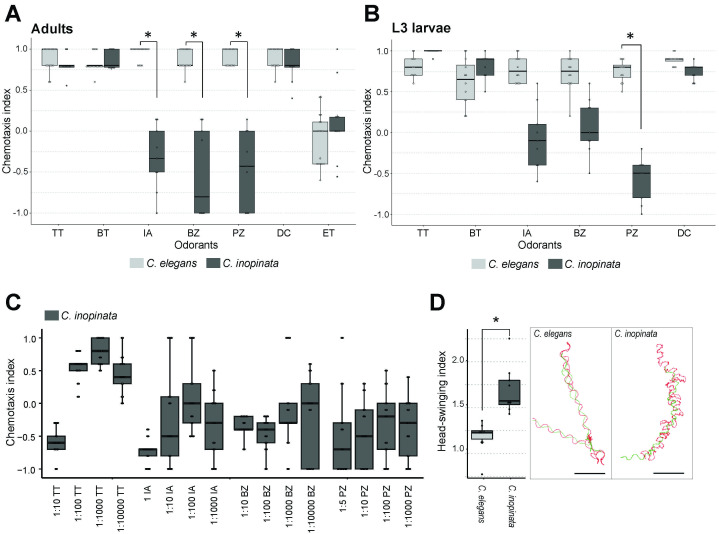 Figure 1
Peer Reviews
No public reviews on file for this paper yet. If you reviewed it on a platform where reviews are public (OpenReview, ICLR, NeurIPS, ICML), you can paste yours below so the community can read it here.
Videos
No videos yet. Explain this paper in a talk, walkthrough, or lecture? Add one.
Taxonomy
TopicsGenetics, Aging, and Longevity in Model Organisms · Neurobiology and Insect Physiology Research · Olfactory and Sensory Function Studies