Soil microbiome analysis of a northeastern deciduous forest in SUNY Old Westbury, Long Island, New York
Fernando Emilio Nieto Fernandez, Patricia Roccanova, Bettina Fantal-Pinckombe, Raymond Catapano

TL;DR
This study analyzed soil bacteria in a New York forest, finding diversity linked to tree types and soil pH.
Contribution
The study reveals spatial variation in soil microbiome diversity tied to specific tree species and soil pH in a northeastern forest.
Findings
Three bacterial phyla (Acidobacteriota, Proteobacteriota, Actinobacteriota) account for 91% of the soil bacteria.
Sites with black birch (Betula lenta) showed significantly higher diversity compared to other sites.
Microbiome composition varied significantly with pH and vegetation type.
Abstract
We studied spatial changes in soil bacterial microbiome composition and diversity in a 111 acres old growth mixed hardwood forest plot in Long Island, NY. Forty soil samples were collected from four forest transects across the forest plot representing various soil features, and dominant vegetation. Three phyla account for 91% of the bacteria in the samples, Acidobacteriota (43%), Proteobacteriota (30%), and Actinobacteriota (18%). We also found 16 different classes and 33 orders. Sites dominated by black birch, Betula lenta were significant more diverse than all other sites. We also found significant differences in microbiome composition based on pH and vegetation.
Genes, proteins, chemicals, diseases, species, mutations and cell lines named across the full text — each resolved to its canonical identifier and authoritative record.
Click any figure to enlarge with its caption.
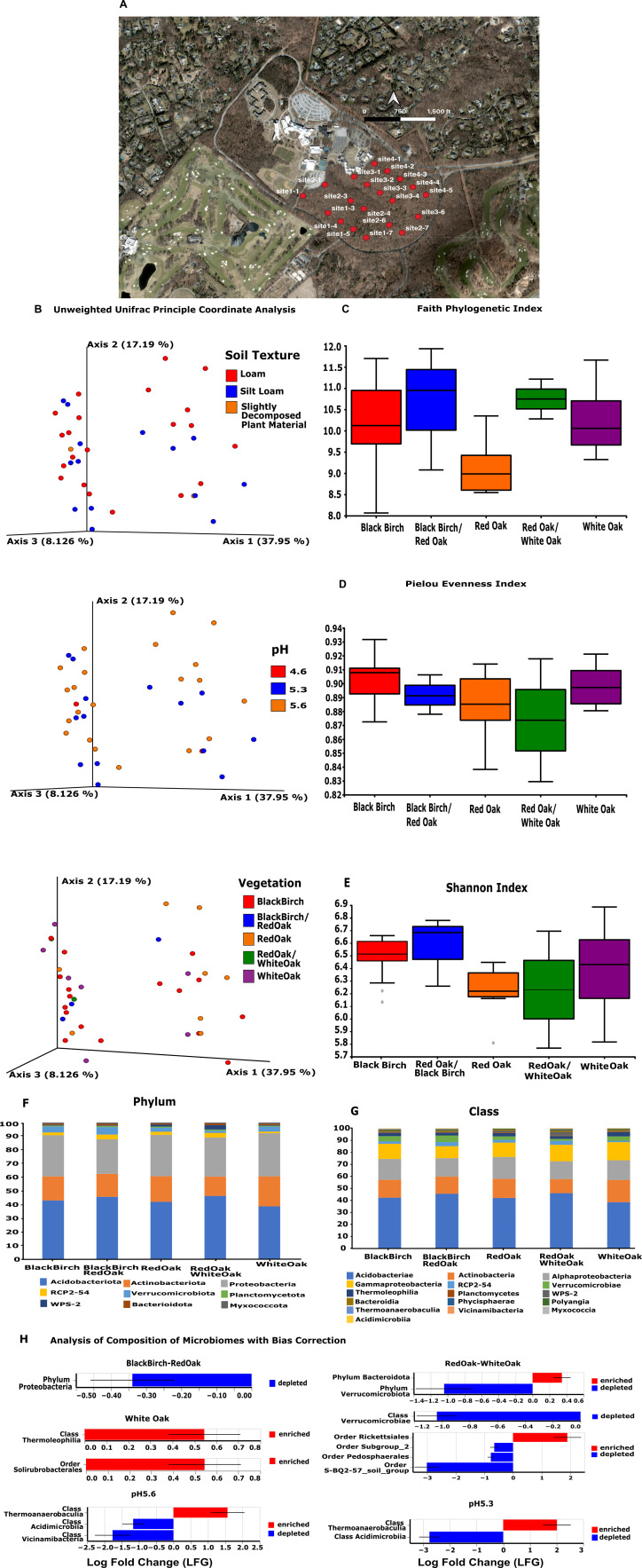 Figure 1
Peer Reviews
No public reviews on file for this paper yet. If you reviewed it on a platform where reviews are public (OpenReview, ICLR, NeurIPS, ICML), you can paste yours below so the community can read it here.
Videos
No videos yet. Explain this paper in a talk, walkthrough, or lecture? Add one.
Taxonomy
TopicsSoil Carbon and Nitrogen Dynamics · Microbial Community Ecology and Physiology · Polar Research and Ecology