High salt tolerance but no local adaption to road salts in Tetrahymena ciliates
Zadia Swain, Marc Aboulehaf, Karissa Plum, Rebecca A. Zufall

TL;DR
This study found that Tetrahymena ciliates have high salt tolerance but no local adaptation to road salt pollution in freshwater ecosystems.
Contribution
The study reveals that Tetrahymena populations are not locally adapted to road salt salinization despite high salt tolerance.
Findings
No significant correlation was found between salt tolerance and road distance in Tetrahymena populations.
Tetrahymena ciliates showed unexpectedly high salt tolerance across all tested strains.
The lack of local adaptation could be due to migration patterns or sampling limitations.
Abstract
Road salt application improves road safety but leads to salinization of nearby freshwater ecosystems. If populations readily adapt to their local salinity environment, then we expect to find differences in salt tolerance between populations found near vs. far from roads. We determined the salt tolerance of 10 wild strains of the freshwater microbial eukaryote Tetrahymena . We found no significant correlation between salt tolerance and road distance, suggesting that these populations are not locally adapted to their salinity environment. This result may be due to the unexpectedly high salt tolerance across lines, unknown patterns of migration between ponds, or sampling conditions.
Genes, proteins, chemicals, diseases, species, mutations and cell lines named across the full text — each resolved to its canonical identifier and authoritative record.
Click any figure to enlarge with its caption.
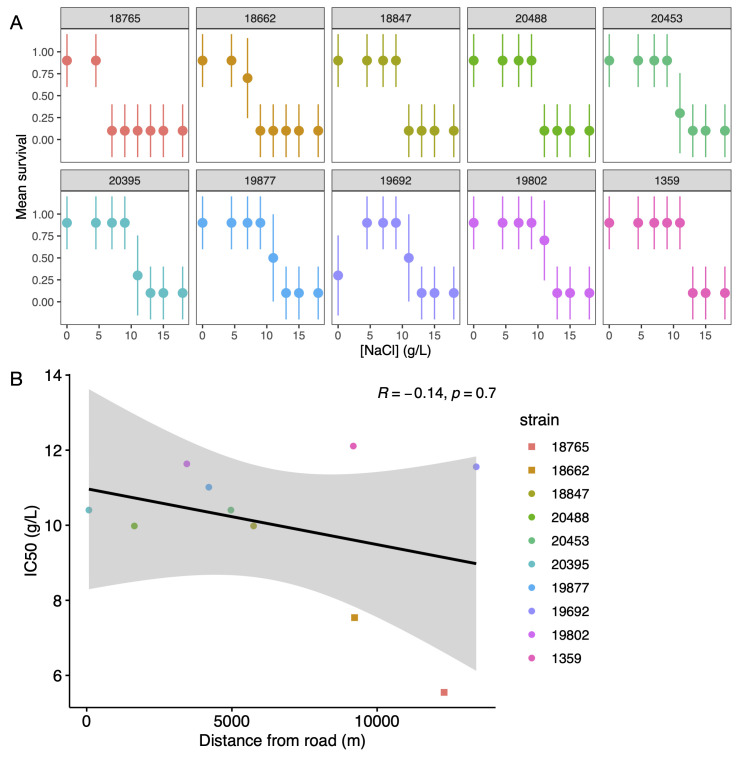 Figure 1
Peer Reviews
No public reviews on file for this paper yet. If you reviewed it on a platform where reviews are public (OpenReview, ICLR, NeurIPS, ICML), you can paste yours below so the community can read it here.
Videos
No videos yet. Explain this paper in a talk, walkthrough, or lecture? Add one.
Taxonomy
TopicsSmart Materials for Construction · Urban Stormwater Management Solutions · Wildlife-Road Interactions and Conservation