Clinical Outcomes and Learning Curve of Endoscopic Ultrasound‐Guided Hepaticogastrostomy During the Implementation Phase in Inexperienced Centers: A Multicenter Retrospective Study
Junichi Kaneko, Tatsunori Satoh, Yosuke Kobayashi, Azumi Suzuki, Shinya Kawaguchi

TL;DR
This study shows that endoscopic ultrasound-guided hepaticogastrostomy can be safely performed in inexperienced centers with proper expertise, as procedure time improves with experience.
Contribution
The study evaluates the feasibility and learning curve of EUS-HGS in inexperienced centers, identifying predictors of adverse events.
Findings
EUS-HGS had a 94% technical success rate and 11% serious adverse events rate in inexperienced centers.
Procedure time decreased as institutional experience increased, but success rates and adverse events did not show significant trends.
Ascites was identified as an independent predictor of serious adverse events.
Abstract
Endoscopic ultrasound‐guided hepaticogastrostomy (EUS‐HGS) is a technically demanding procedure performed predominantly at centers with high expertise. Its feasibility and learning curves in inexperienced centers remain unclear. This study aimed to evaluate the initial clinical outcomes and learning curves of EUS‐HGS implemented in inexperienced centers. Between September 2018 and December 2020, four tertiary care centers specializing in pancreaticobiliary disease implemented EUS‐HGS. The first 20 patients who underwent EUS‐HGS at each institution were retrospectively enrolled. The primary outcomes were technical success, procedure time, and serious (moderate‐to‐severe) adverse events (AEs). A learning curve analysis was conducted using chronological quartiles. Logistic regression was used to identify the predictors of technical failure and serious AEs. The overall technical success…
Genes, proteins, chemicals, diseases, species, mutations and cell lines named across the full text — each resolved to its canonical identifier and authoritative record.
Click any figure to enlarge with its caption.
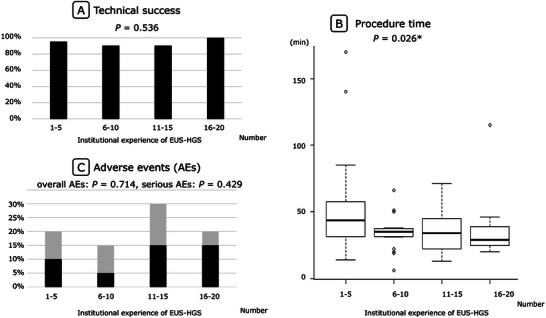 Figure 1
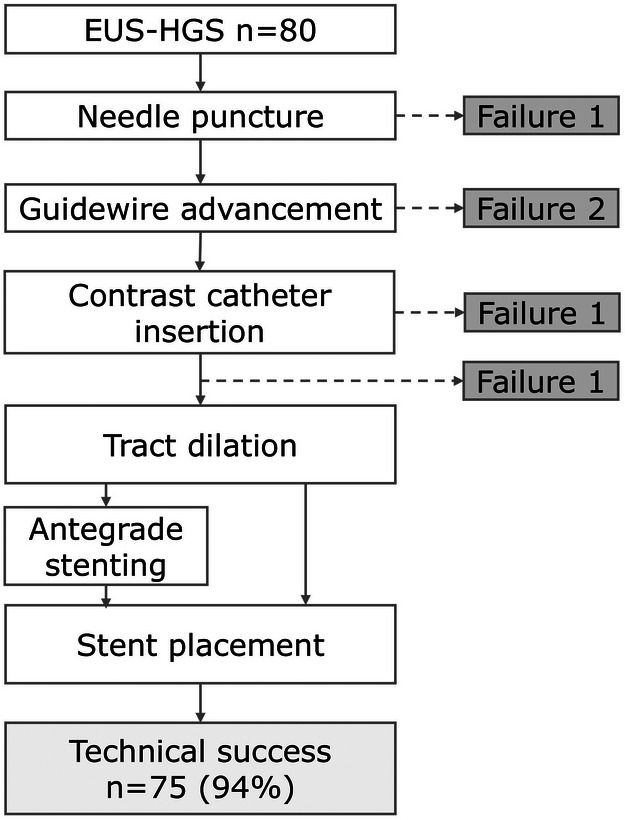 Figure 2
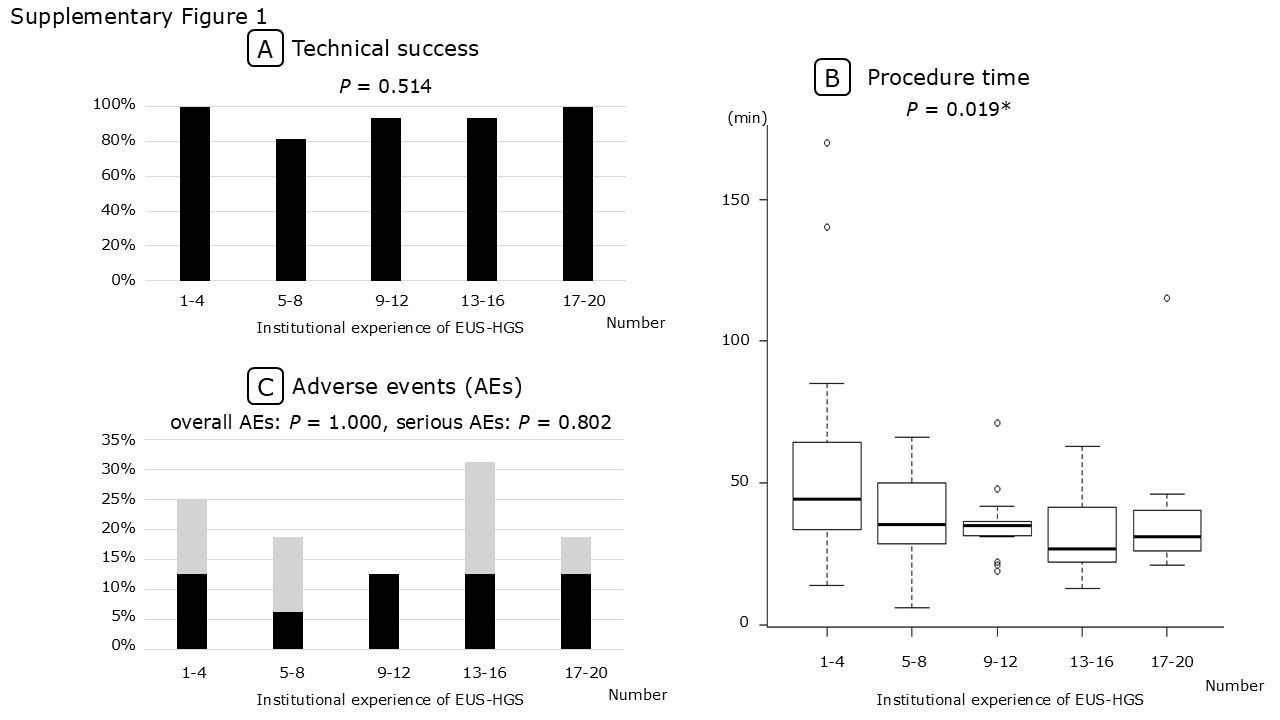 Figure 3
Peer Reviews
No public reviews on file for this paper yet. If you reviewed it on a platform where reviews are public (OpenReview, ICLR, NeurIPS, ICML), you can paste yours below so the community can read it here.
Videos
No videos yet. Explain this paper in a talk, walkthrough, or lecture? Add one.
Taxonomy
TopicsGallbladder and Bile Duct Disorders · Pancreatic and Hepatic Oncology Research · Pediatric Hepatobiliary Diseases and Treatments