Drift detection on feature attributions for monitoring visual reinforcement learning models in maritime port surveillance
Francisco Javier Iriarte, Beatrice Azoubel, Adrián Carrizo-Pérez, Andrés Chica Linares, Luis Unzueta, Ignacio Arganda-Carreras, Ahmed Mohy Ibrahim, Ayoola Babatunde Fadola, Adeola Oluwatoyin OSUNDIRAN, Alexandru Pohontu

TL;DR
This paper introduces FADMON, a new method to monitor AI models in port surveillance by detecting changes in how the models interpret data, improving security and understanding.
Contribution
FADMON introduces XAI-driven drift detection on feature attributions for image-based models, enabling concept-level monitoring of DRL systems.
Findings
FADMON consistently detects drift in all drifted scenarios with mean p-values of 0.000 across 30 repetitions.
FADMON provides semi-supervised explainable model monitoring, detecting changes in model interpretation rather than just data.
The method achieves comparable performance to established drift detection techniques while offering interpretability.
Abstract
Maritime activity is expanding globally, increasing the demand for robust port security systems capable of detecting illegal trafficking. Due to the growing sophistication of smuggling methods, law enforcement agencies require advanced surveillance and prevention technologies such as those developed in the SMAUG project. In this context, initiatives such as the SMAUG project aim to deliver integrated surveillance capabilities coordinated by a high-level deep reinforcement learning (DRL) decision-making system that operates on image-based environmental representations. Despite their effectiveness, DRL models are closed-boxes, complicating continuous model monitoring (CMM). Conventional drift detection captures shifts in input or output distributions yet often fails to explain underlying problems. Explainable AI (XAI) techniques can provide a complementary approach with insights into the…
Genes, proteins, chemicals, diseases, species, mutations and cell lines named across the full text — each resolved to its canonical identifier and authoritative record.
Click any figure to enlarge with its caption.
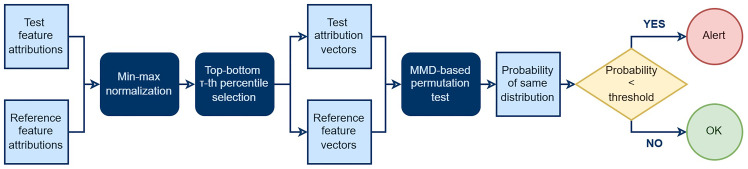 Figure 1
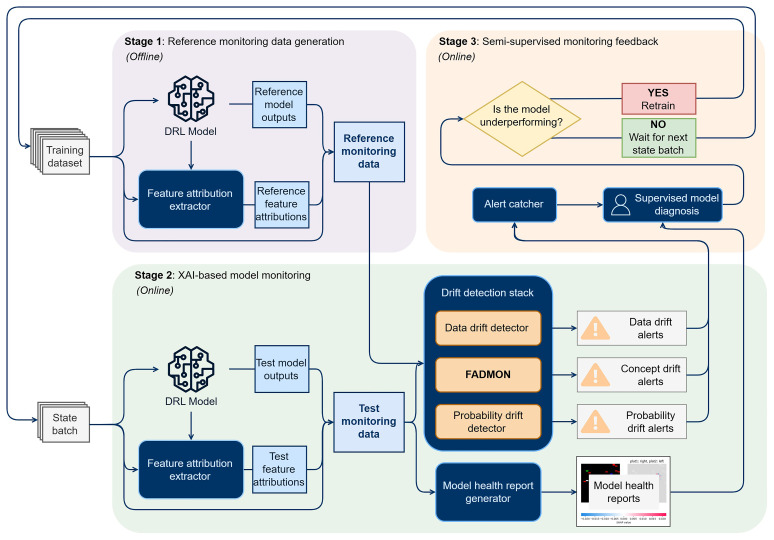 Figure 2
 Figure 3
 Figure 4
Peer Reviews
No public reviews on file for this paper yet. If you reviewed it on a platform where reviews are public (OpenReview, ICLR, NeurIPS, ICML), you can paste yours below so the community can read it here.
Videos
No videos yet. Explain this paper in a talk, walkthrough, or lecture? Add one.
Taxonomy
TopicsData Stream Mining Techniques · Explainable Artificial Intelligence (XAI) · Anomaly Detection Techniques and Applications