Body Mass Index, Left Ventricular Wall Stress, and NT-proBNP in Elderly Adults
Audrey White, Shi Huang, Vineet Agrawal, Katherine N. Bachmann, Evan L. Brittain, Debra D. Dixon, Leonie Dupuis, Erica Garner, Kelly Schlendorf, Thomas J. Wang, Deepak K. Gupta

TL;DR
Higher BMI in elderly adults is linked to increased heart wall stress, but not to higher levels of a heart stress hormone, which is lower in heavier individuals.
Contribution
This study reveals that increased left ventricular wall stress partially explains the inverse relationship between BMI and NT-proBNP in older adults without heart failure.
Findings
BMI positively correlates with diastolic wall stress (DWS) but not systolic wall stress (SWS).
DWS positively correlates with NT-proBNP levels, but this does not fully explain the inverse BMI-NT-proBNP relationship.
BMI's inverse association with NT-proBNP is only partially mediated by DWS.
Abstract
Obesity is a major risk factor for heart failure (HF). Natriuretic peptides (NPs) are cardioprotective hormones released in response to left ventricular (LV) wall stress (WS). Paradoxically, body mass index (BMI) and NP levels are inversely related, suggesting that the associations between BMI, WS, and NPs are not fully understood, particularly among individuals without HF. The purpose of this study was to test the hypothesis that WS mediates, in part, the relationship between BMI and NP levels. In 4,444 Atherosclerosis Risk in Communities study participants without HF who underwent transthoracic echocardiography (median 75 years, BMI 27.7 kg/m2, 58% women, 18% Black), LV end-diastolic and end-systolic WS (DWS, SWS) were calculated from chamber dimensions, E/e’, and blood pressure. Mediation analysis was performed using the product of coefficients method adjusted for demographics,…
Genes, proteins, chemicals, diseases, species, mutations and cell lines named across the full text — each resolved to its canonical identifier and authoritative record.
Click any figure to enlarge with its caption.
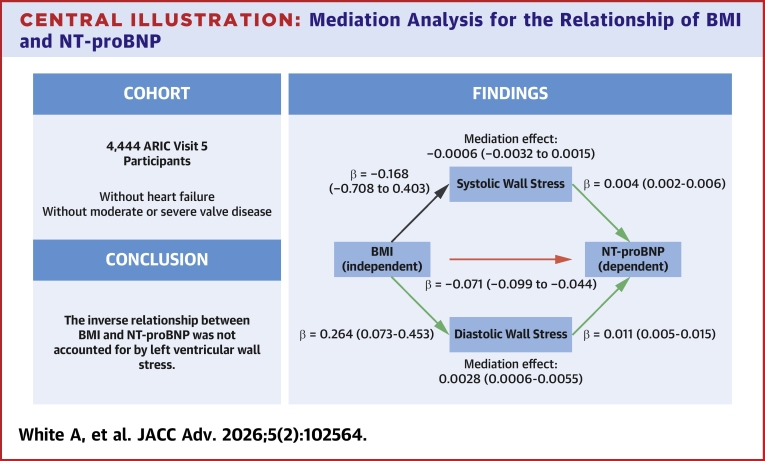 Figure 1
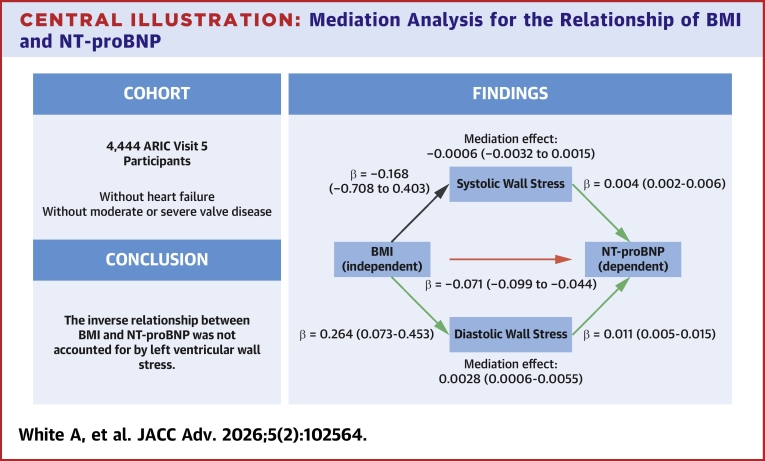 Figure 2
Peer Reviews
No public reviews on file for this paper yet. If you reviewed it on a platform where reviews are public (OpenReview, ICLR, NeurIPS, ICML), you can paste yours below so the community can read it here.
Videos
No videos yet. Explain this paper in a talk, walkthrough, or lecture? Add one.
Taxonomy
TopicsCardiovascular Function and Risk Factors · Heart Failure Treatment and Management · Cardiovascular and exercise physiology