Nephrosclerosis-Related Histopathological Findings by Cortical Region From a Japanese Community-Based Study
Hirokazu Marumoto, Takaya Sasaki, Emi Oishi, Satoko Sakata, Mao Shibata, Yoshihiko Furuta, Jun Hata, Yoshinao Oda, Takanari Kitazono, Nobuo Tsuboi, Takashi Yokoo, Toshiharu Ninomiya

TL;DR
This study examines how kidney damage from nephrosclerosis varies in different parts of the kidney cortex and its link to kidney function decline in elderly Japanese individuals.
Contribution
The study reveals a cortical region-dependent gradient of nephrosclerotic lesions and their association with kidney dysfunction.
Findings
Histopathologic lesions worsened with declining kidney function across all cortical regions.
Superficial cortex showed more glomerulosclerosis and interstitial fibrosis, while juxtamedullary cortex showed more arterial and arteriolar damage.
Tubulointerstitial and arterial lesions were more strongly linked to kidney dysfunction than glomerular lesions.
Abstract
Nephrosclerosis is a major cause of end-stage kidney disease. However, few studies have addressed the association between kidney function and nephrosclerosis-related histopathologic findings because most cases of nephrosclerosis are diagnosed based on clinical signs without a kidney biopsy. Cross-sectional study. Autopsy specimens of kidneys were obtained from 181 individuals who died within 6 years of a community-wide health examination in 2007 and who had an autopsy at the time of death. Histopathologic findings, including glomerular, tubulointerstitial, and vascular lesions, were evaluated as outcome variables in relation to estimated glomerular filtration rate. The kidney cortex in each specimen was divided into 3 equally spaced cortical regions (superficial, middle, and juxtamedullary cortex) to assess depth-dependent lesion distribution. Glomerular, tubulointerstitial, and…
Genes, proteins, chemicals, diseases, species, mutations and cell lines named across the full text — each resolved to its canonical identifier and authoritative record.
Click any figure to enlarge with its caption.
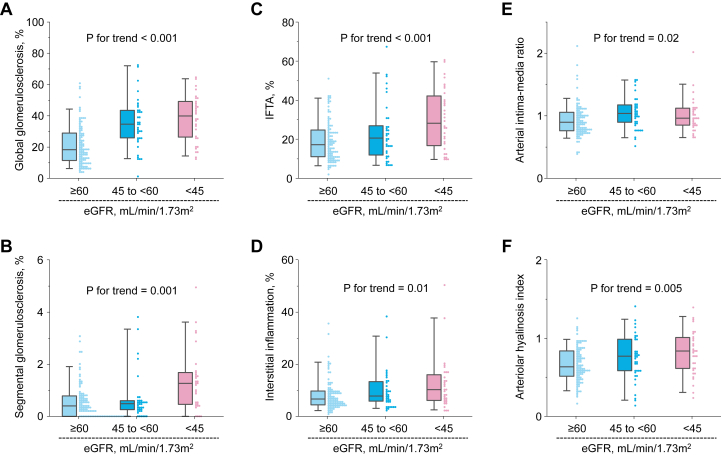 Figure 1
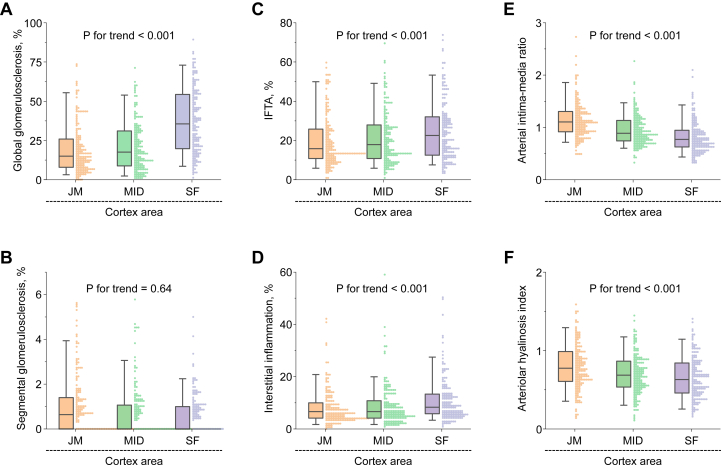 Figure 2
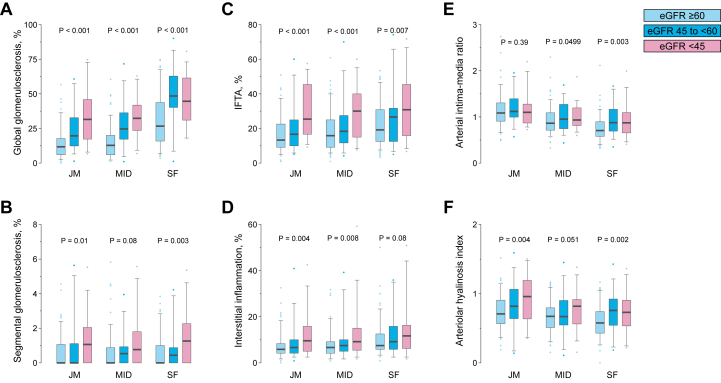 Figure 3
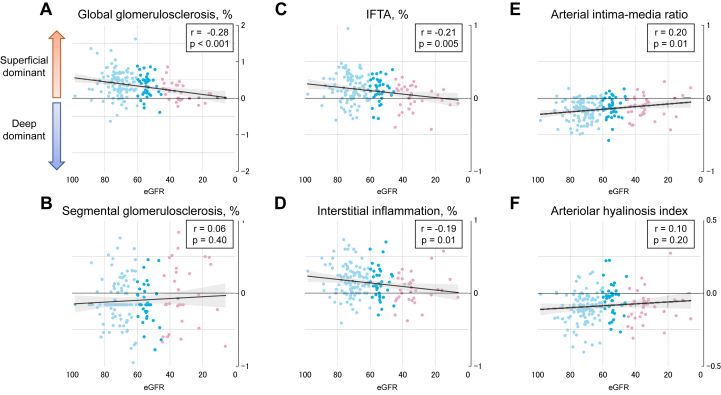 Figure 4
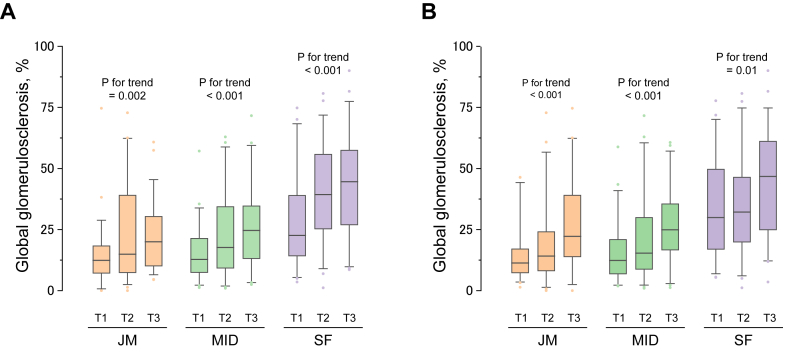 Figure 5
Peer Reviews
No public reviews on file for this paper yet. If you reviewed it on a platform where reviews are public (OpenReview, ICLR, NeurIPS, ICML), you can paste yours below so the community can read it here.
Videos
No videos yet. Explain this paper in a talk, walkthrough, or lecture? Add one.
Taxonomy
TopicsRenal Diseases and Glomerulopathies · Chronic Kidney Disease and Diabetes · MRI in cancer diagnosis