Mapping glucose-induced hemodynamics in white fat depots with label-free optoacoustics
Nikolina-Alexia Fasoula, Nikoletta Katsouli, Michael Kallmayer, Vasilis Ntziachristos, Angelos Karlas

TL;DR
This study uses a non-invasive imaging technique to show how glucose affects blood flow in fat tissue, revealing differences between people with low and high BMI.
Contribution
The study introduces multispectral optoacoustic tomography as a novel method for label-free, non-invasive imaging of glucose-induced hemodynamics in white fat depots.
Findings
Higher BMI individuals showed reduced glucose-induced hyperemic responses in SAT at 60 minutes postprandially.
Abdominal SAT showed more active hemodynamics than femoral SAT in both BMI groups.
MSOT results correlated with longitudinal blood tests for cardiometabolic markers.
Abstract
Subcutaneous adipose tissue (SAT) hemodynamics is an indicator of cardiometabolic health. Herein, we demonstrate a non-invasive approach for imaging SAT hemodynamics in humans using multispectral optoacoustic tomography (MSOT). We evaluated different SAT depots in individuals with low (< 24 kg/m²) and high (≥ 24 kg/m²) BMI, with each group consisting of 8 participants, during oral glucose challenges. Our results indicate a significant decrease in glucose-induced hyperemic responses within SAT for individuals with higher BMI, at 60 min postprandially. MSOT also revealed that abdominal SAT exhibited a more active hemodynamic status compared to femoral SAT in both groups when compared to baseline measurements. MSOT readouts were further validated against longitudinal blood tests of triglycerides, glucose, lactate, and cholesterol. We introduce MSOT as a new method for studying SAT…
Genes, proteins, chemicals, diseases, species, mutations and cell lines named across the full text — each resolved to its canonical identifier and authoritative record.
Click any figure to enlarge with its caption.
 Figure 1
 Figure 2
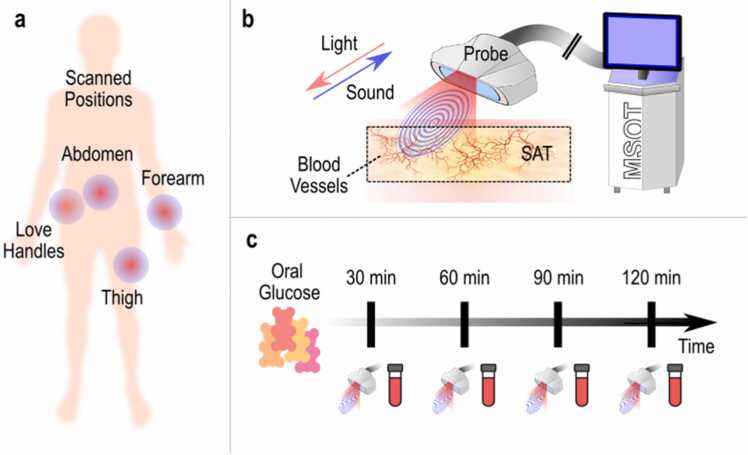 Figure 3
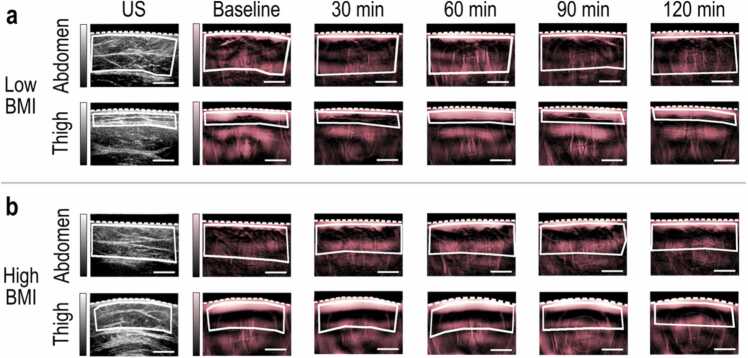 Figure 4
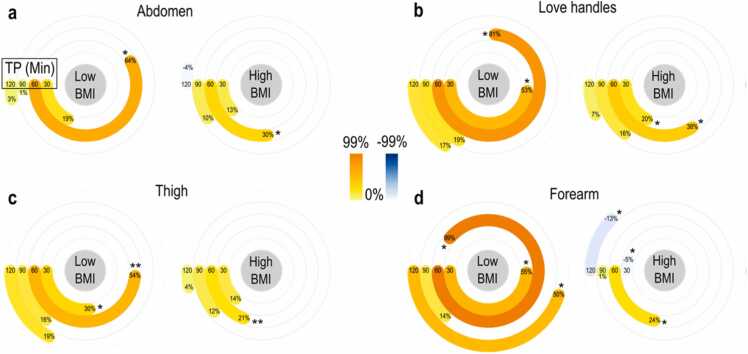 Figure 5
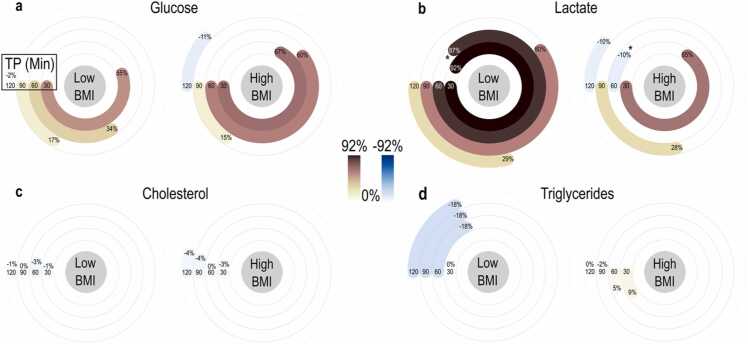 Figure 6
Peer Reviews
No public reviews on file for this paper yet. If you reviewed it on a platform where reviews are public (OpenReview, ICLR, NeurIPS, ICML), you can paste yours below so the community can read it here.
Videos
No videos yet. Explain this paper in a talk, walkthrough, or lecture? Add one.
Taxonomy
TopicsPhotoacoustic and Ultrasonic Imaging · Cardiovascular Disease and Adiposity · Optical Imaging and Spectroscopy Techniques