Genetic Encoding of a Trifunctional Photo‐Cross‐Linker with a Cleavable Alkyl Ester Moiety
Masahiro Takayama, Tomoya Tsubota, Takao Yamaguchi, Kosuke Chiba, Takumi Yoshida, Yoshiyuki Hari, Yu‐Shi Tian, Daisuke Takaya, Asuka Mori, Tomohito Tsukamoto, Kenji Ishimoto, Yukio Ago, Yoshiaki Okada, Kensaku Sakamoto, Takefumi Doi, Kaori Fukuzawa, Satoshi Obika

TL;DR
Researchers created a new amino acid that can be used to study protein interactions in cells, with features that allow capturing and releasing proteins for detailed analysis.
Contribution
A novel trifunctional photo-cross-linker with an alkaline-cleavable alkyl ester is genetically encoded for enhanced protein interaction studies.
Findings
DiZAAsu was successfully genetically encoded in mammalian cells using an engineered archaeal tRNA synthetase.
The trifunctional DiZAAsu enabled cross-linking, biotinylation, and alkaline-based cleavage of protein complexes.
The system reduced nonspecific contamination during purification of cross-linked complexes.
Abstract
Genetically encoded photo‐cross‐linkable amino acids (PAAs) are powerful tools for analyzing direct protein–protein interactions (PPIs) in mammalian cells. Cleavable PAAs are particularly useful, enabling covalent capture and subsequent release of interacting partners, which facilitates the characterization of interaction interfaces using mass spectrometry. However, the limited options for cleavable linker structures have restricted the design of PAAs. In this study, we genetically encoded a novel trifunctional PAA, DiZAAsu, which contains three distinct chemical groups: diazirine, alkyne, and alkaline‐cleavable alkyl ester moieties. An archaeal pyrrolysyl‐tRNA synthetase was engineered to incorporate DiZAAsu efficiently into proteins in mammalian cells. We demonstrated the in‐cell photoreactive function of diazirine by cross‐linking the DiZAAsu‐introduced GRB2 protein to its binding…
Genes, proteins, chemicals, diseases, species, mutations and cell lines named across the full text — each resolved to its canonical identifier and authoritative record.
Click any figure to enlarge with its caption.
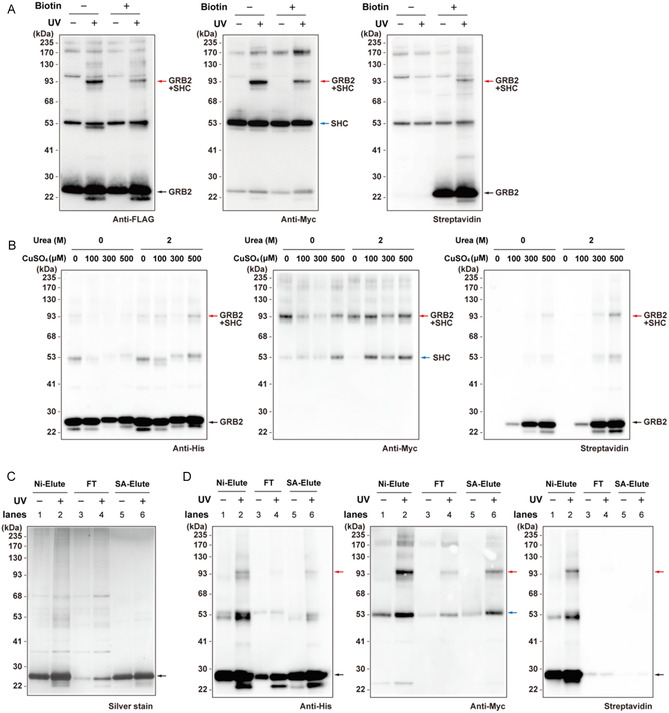 Figure 1
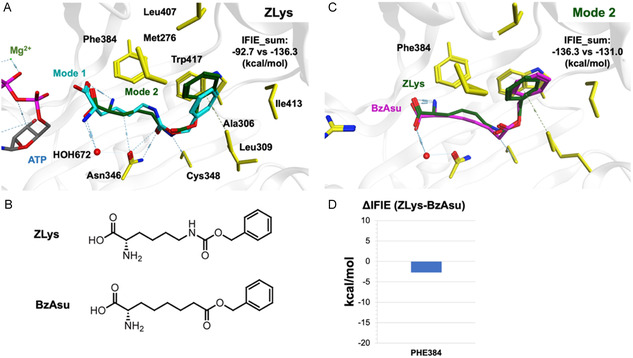 Figure 2
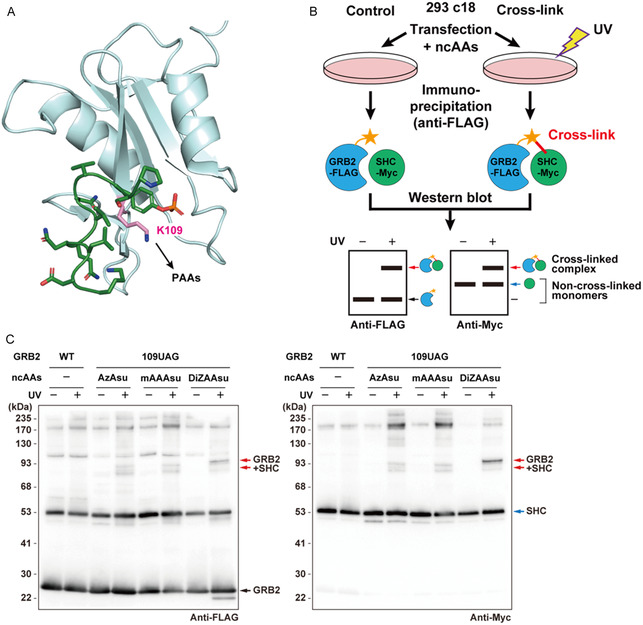 Figure 3
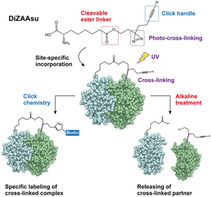 Figure 4
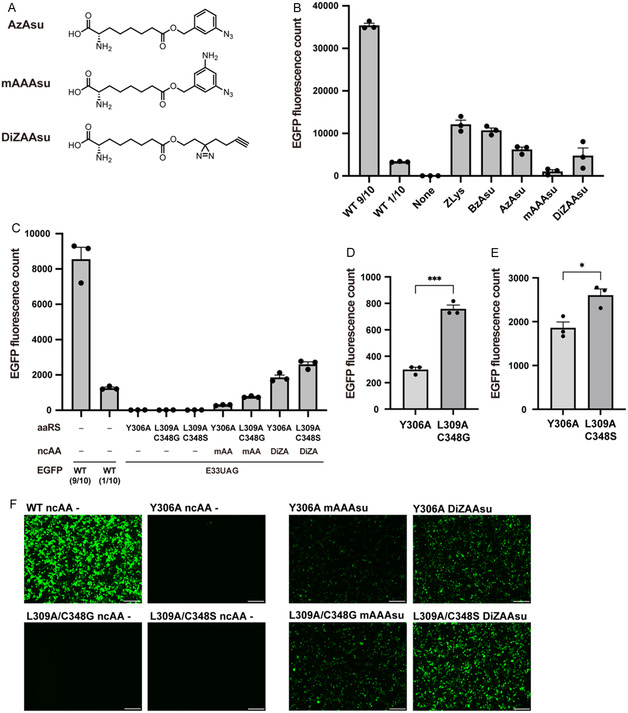 Figure 5
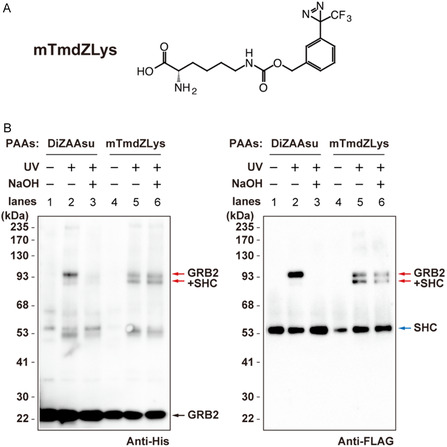 Figure 6
Peer Reviews
No public reviews on file for this paper yet. If you reviewed it on a platform where reviews are public (OpenReview, ICLR, NeurIPS, ICML), you can paste yours below so the community can read it here.
Videos
No videos yet. Explain this paper in a talk, walkthrough, or lecture? Add one.
Taxonomy
TopicsClick Chemistry and Applications · Biotin and Related Studies · Photochromic and Fluorescence Chemistry