A multi-task EEG emotion recognition method based on emotion-dimension coupling constraints
Guolin Chen

TL;DR
This paper introduces a new multi-task framework for EEG-based emotion recognition that improves accuracy and interpretability by modeling the relationships between valence, arousal, and dominance.
Contribution
The novel MLT-EDCC framework uses emotion-dimension coupling constraints to model inter-dimensional relationships during end-to-end training.
Findings
MLT-EDCC achieved 97.68%, 97.74%, and 97.41% accuracy on DEAP for valence, arousal, and dominance.
On DREAMER, the model reached 96.16%, 95.78%, and 95.96% accuracy for the same dimensions.
Embedding psychological and neurophysiological priors as constraints improves robustness and generalizability.
Abstract
Electroencephalography (EEG)-based emotion recognition seeks to enable multidimensional inference of valence, arousal, and dominance (V–A–D) from non-invasive brain signals. However, most existing methods either process each dimension in isolation or adopt single-task pipelines, which underutilize cross-dimensional information and reduce both generalization and physiological interpretability. To overcome these limitations, we propose a multi-task framework with emotion-dimension coupling constraints (MLT-EDCC) that explicitly encodes inter-dimensional priors during end-to-end training. A shared encoder and three task-specific branches are jointly optimized under three complementary constraints: the V–A circular geometric constraint to enforce circumplex structure, the A–D energy alignment constraint to regulate intensity associations, and the V–D correlation constraint to preserve…
Genes, proteins, chemicals, diseases, species, mutations and cell lines named across the full text — each resolved to its canonical identifier and authoritative record.
Click any figure to enlarge with its caption.
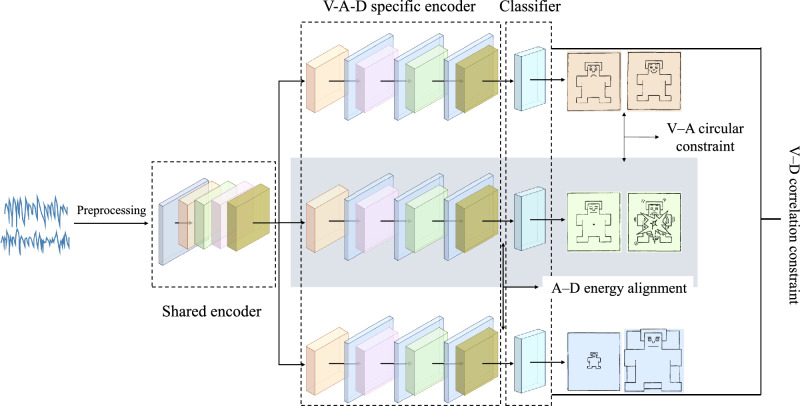 Figure 1
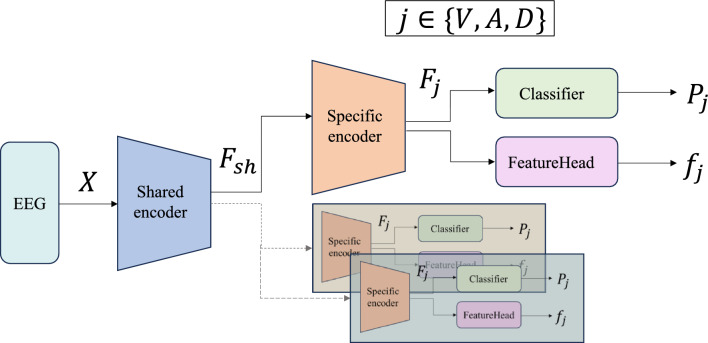 Figure 2
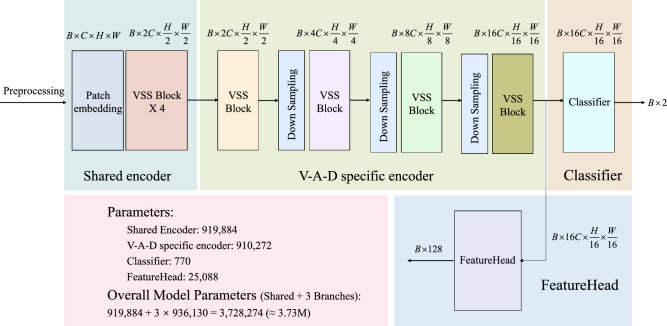 Figure 3
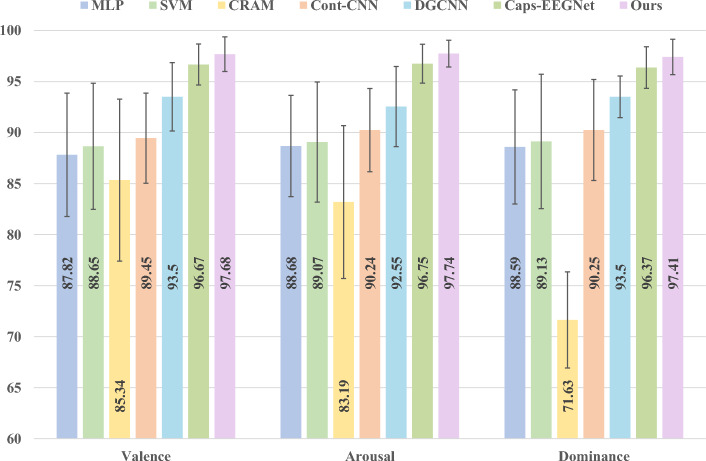 Figure 4
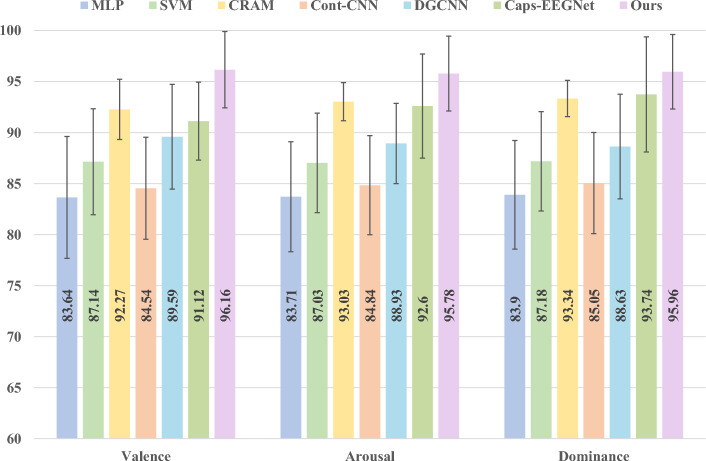 Figure 5
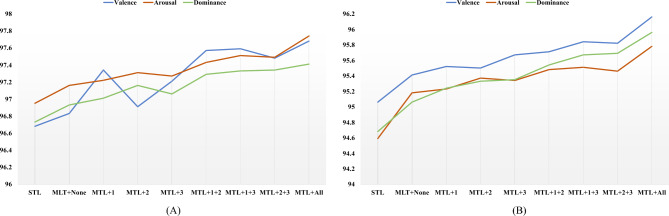 Figure 6
 Figure 7
 Figure 8
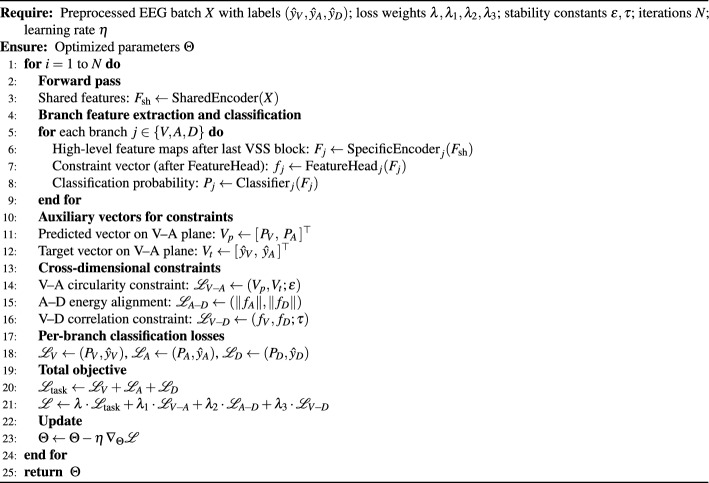 Figure 9
Peer Reviews
No public reviews on file for this paper yet. If you reviewed it on a platform where reviews are public (OpenReview, ICLR, NeurIPS, ICML), you can paste yours below so the community can read it here.
Videos
No videos yet. Explain this paper in a talk, walkthrough, or lecture? Add one.
Taxonomy
TopicsEmotion and Mood Recognition · EEG and Brain-Computer Interfaces · Sleep and Work-Related Fatigue