Generative super-resolution of turbulent flows via stochastic interpolants
Martin Schiødt, Nikolaj T. Mücke, Clara M. Velte

TL;DR
This paper introduces a new method using generative models to enhance the resolution of turbulent flow data, capturing fine-scale details from low-resolution inputs.
Contribution
The novel use of stochastic interpolants for patch-wise super-resolution of turbulent flows is introduced and shown to outperform existing methods.
Findings
Patch-wise application of stochastic interpolants reconstructs unresolved flow scales efficiently and accurately.
The method recovers key statistical quantities like the kinetic energy spectrum with high fidelity.
Stochastic interpolants outperform competing generative models in super-resolution quality.
Abstract
Capturing the intricate multiscale features of turbulent flows remains a fundamental challenge due to the limited resolution of experimental data and the computational cost of high-fidelity simulations. In many practical scenarios only coarse representations of the flows are feasible, leaving crucial fine-scale dynamics unresolved. This study addresses that limitation by leveraging generative models to perform super-resolution of velocity fields and reconstruct the unresolved scales from low-resolution conditionals. In particular, the recently formalized stochastic interpolants are employed to super-resolve a case study of two-dimensional turbulence. Key to our approach is the iterative application of stochastic interpolants over local patches of the flow field, that enables efficient reconstruction without the need to process the full domain simultaneously. The patch-wise strategy is…
Genes, proteins, chemicals, diseases, species, mutations and cell lines named across the full text — each resolved to its canonical identifier and authoritative record.
Click any figure to enlarge with its caption.
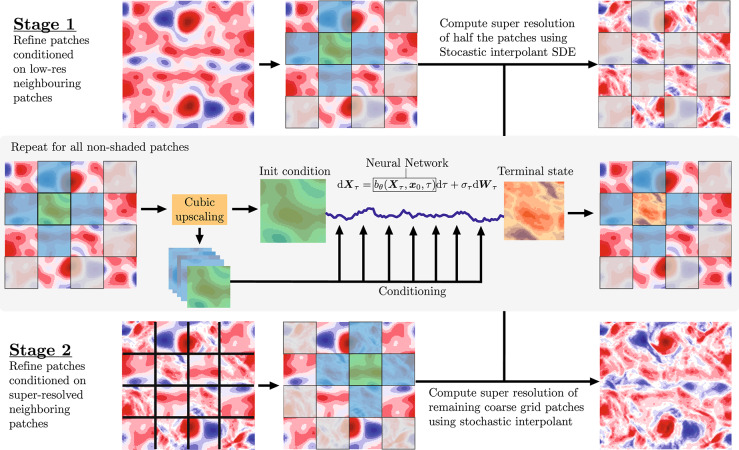 Figure 1
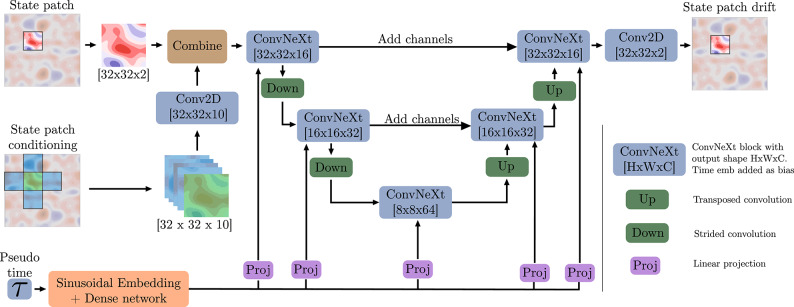 Figure 2
 Figure 3
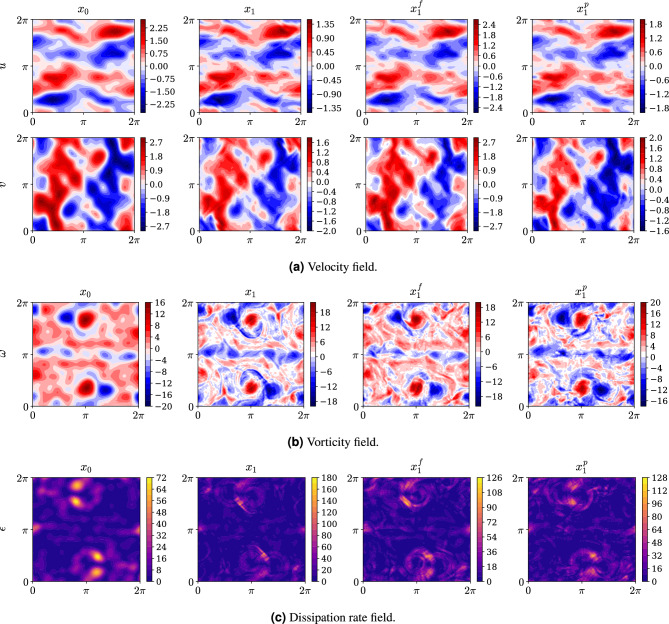 Figure 4
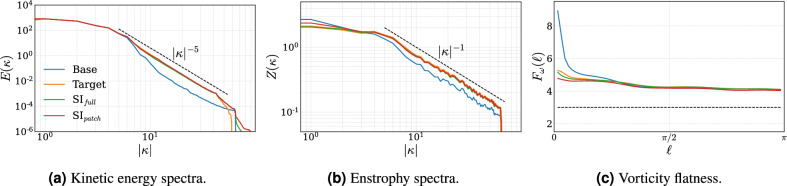 Figure 5
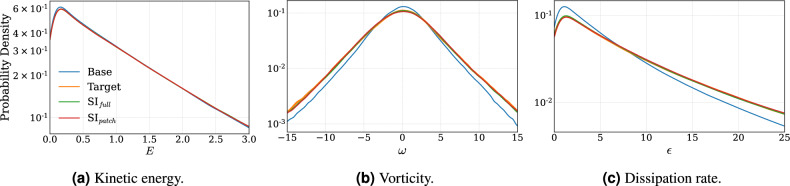 Figure 6
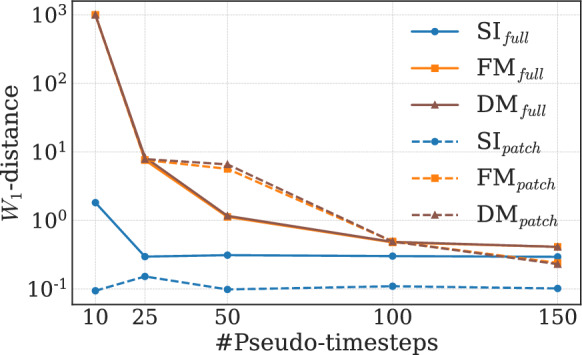 Figure 7
Peer Reviews
No public reviews on file for this paper yet. If you reviewed it on a platform where reviews are public (OpenReview, ICLR, NeurIPS, ICML), you can paste yours below so the community can read it here.
Videos
No videos yet. Explain this paper in a talk, walkthrough, or lecture? Add one.
Taxonomy
TopicsModel Reduction and Neural Networks · Generative Adversarial Networks and Image Synthesis · Fluid Dynamics and Turbulent Flows