Relationship between right and left ventricle function in subjects free of cardiovascular diseases: a population-based MRI study
Ricarda von Krüchten, Roberto Lorbeer, Susanne Rospleszcz, Annette Peters, Stefan Karrasch, Holger Schulz, Bernard E. Bulwer, Charlotte Wintergerst, Esther Askani, Thierno D. Diallo, Fabian Bamberg, Christopher L. Schlett, Blerim Mujaj

TL;DR
This study shows that right and left ventricle functions are strongly linked in people without heart disease, regardless of lung volume.
Contribution
The study reveals a strong RV-LV relationship independent of lung volumes in a population without cardiovascular disease.
Findings
RV end-diastolic volume is positively linked to LV end-diastolic, end-systolic, and stroke volumes.
RV end-systolic volume is also positively associated with LV parameters but inversely with ejection fraction.
Adjusting for lung volumes does not change the RV-LV associations observed.
Abstract
Right (RV) and left ventricular (LV) volumetric measurements by cardiac magnetic resonance imaging (MRI) are established for assessing systolic and diastolic function, but the role of MRI-derived lung volumes in LV function remains unclear. This study investigated the relationship between RV and LV function, considering lung volumes. In the KORA-MRI cohort, 361 subjects underwent 3 T whole-body MRI. Cardiac functional parameters were measured from cine-steady-state free precession sequences using cvi42. Lung volumes were derived semi-automatically with an in-house algorithm. Linear regression analyses assessed RV-LV relationships, adjusted for age, sex, cardiovascular risk factors, and lung volumes. Among 361 subjects (mean age 56.1 ± 9.1 years; 43% women), RV end-diastolic volume was positively associated with LV end-diastolic (β = 28.1, p < 0.001), end-systolic (β = 11.0, p < 0.001),…
Genes, proteins, chemicals, diseases, species, mutations and cell lines named across the full text — each resolved to its canonical identifier and authoritative record.
Click any figure to enlarge with its caption.
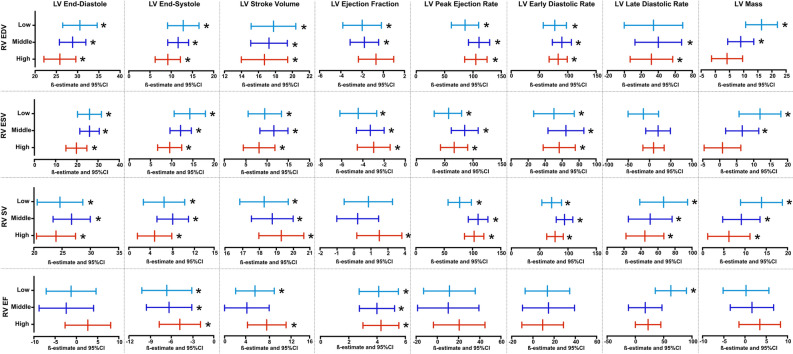 Figure 1
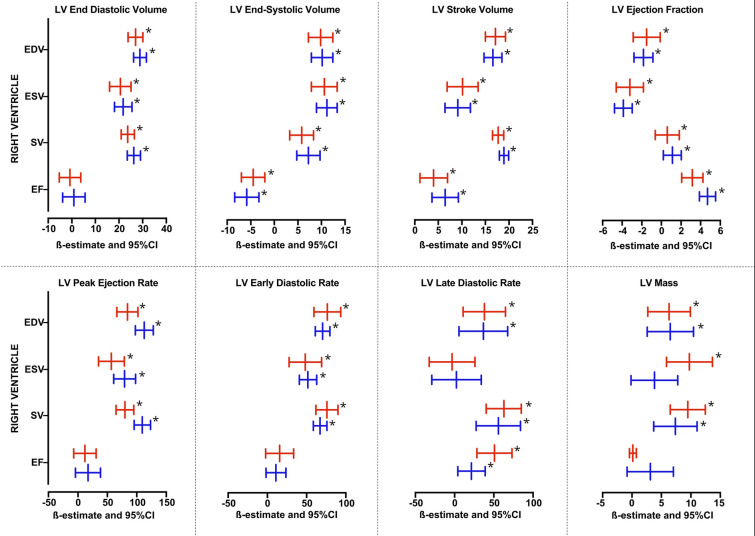 Figure 2
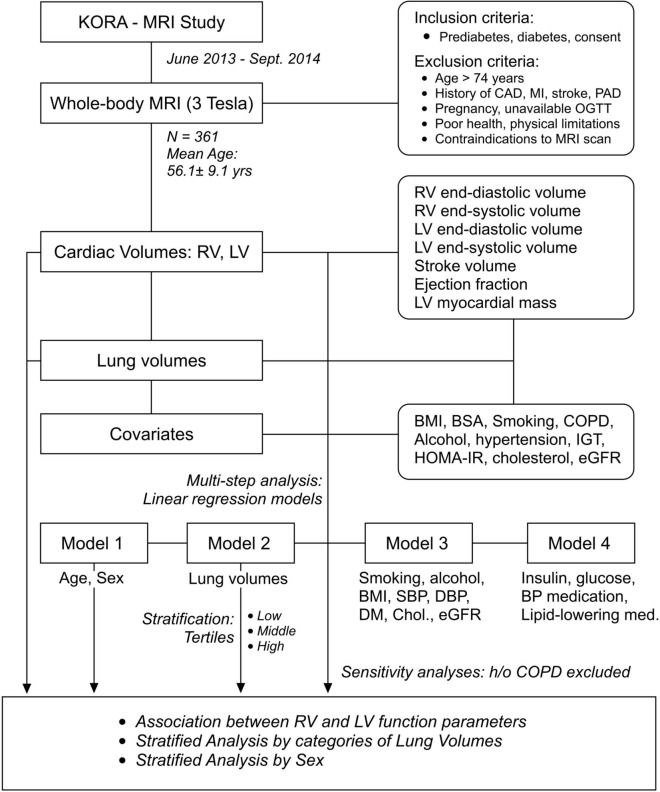 Figure 3
Peer Reviews
No public reviews on file for this paper yet. If you reviewed it on a platform where reviews are public (OpenReview, ICLR, NeurIPS, ICML), you can paste yours below so the community can read it here.
Videos
No videos yet. Explain this paper in a talk, walkthrough, or lecture? Add one.
Taxonomy
TopicsAtomic and Subatomic Physics Research · Pulmonary Hypertension Research and Treatments · Cardiac Imaging and Diagnostics