Plasma p-tau217, quantified by the fully automated LUMIPULSE G platform, outperforms p-tau181 in predicting amyloid pathology in cognitive complaints patients
Anuschka Silva-Spínola, João Durães, João Pedro Guedes de Oliveira, Miguel Tábuas-Pereira, Marisa Lima, Alexandre de Mendonça, Isabel Santana, Inês Baldeiras

TL;DR
A blood test measuring p-tau217 is better than p-tau181 at predicting Alzheimer's disease amyloid pathology in patients with cognitive complaints.
Contribution
Plasma p-tau217 outperforms p-tau181 in detecting amyloid pathology using a fully automated platform.
Findings
Plasma p-tau217 showed stronger correlations with CSF biomarkers than p-tau181.
A single p-tau217 cutoff achieved 88% agreement with CSF-defined amyloid status.
A two-cutoff framework reduced misclassification in amyloid status determination.
Abstract
Plasma phosphorylated tau (p-tau) biomarkers offer a minimally invasive alternative for detecting Alzheimer’s disease (AD) pathology. We evaluated the diagnostic performance of plasma p-tau217 relative to p-tau181 using the fully automated LUMIPULSE platform. A total of 494 consecutively recruited patients with cognitive complaints from the Coimbra cohort were divided into exploratory and internal validation sets, and an external set of 100 well-characterized patients with mild cognitive impairment was obtained from Lisbon. Plasma biomarkers were assessed in relation to cerebrospinal fluid (CSF) AD biomarkers and evaluated their ability to detect amyloid pathology, defined by the CSF Aβ42/40 ratio. In the exploratory dataset, plasma p-tau217 showed stronger correlations with CSF biomarkers and higher accuracy in identifying amyloid positivity than p-tau181 (AUC = 0.90 vs. 0.81, p <…
Genes, proteins, chemicals, diseases, species, mutations and cell lines named across the full text — each resolved to its canonical identifier and authoritative record.
Click any figure to enlarge with its caption.
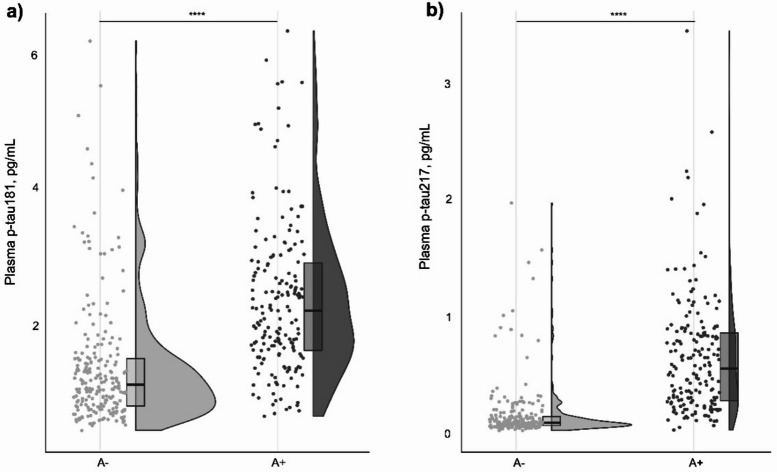 Figure 1
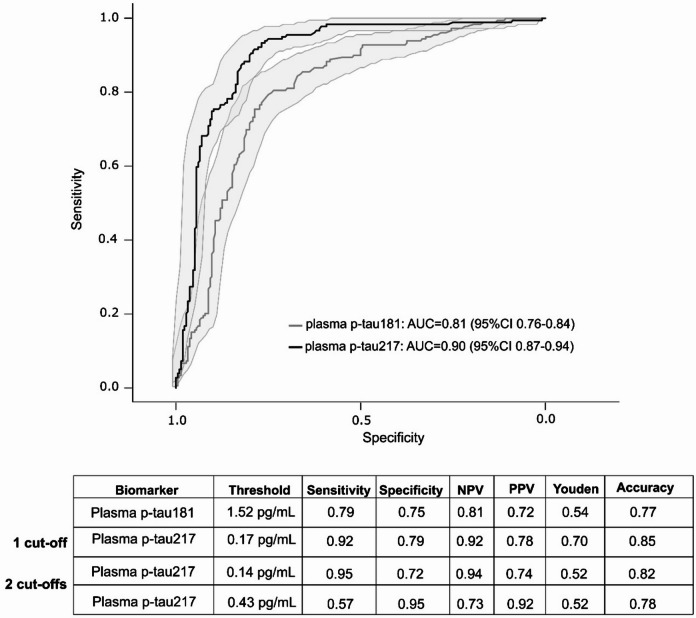 Figure 2
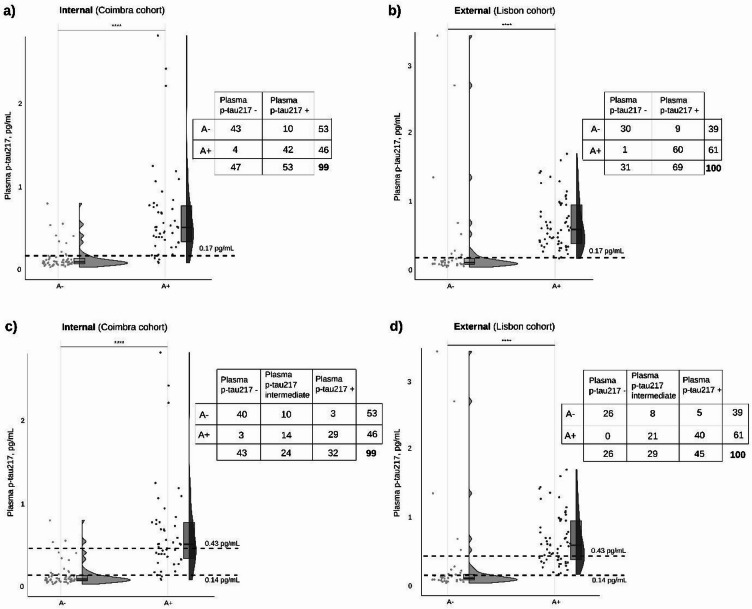 Figure 3
Peer Reviews
No public reviews on file for this paper yet. If you reviewed it on a platform where reviews are public (OpenReview, ICLR, NeurIPS, ICML), you can paste yours below so the community can read it here.
Videos
No videos yet. Explain this paper in a talk, walkthrough, or lecture? Add one.
Taxonomy
TopicsDementia and Cognitive Impairment Research · Alzheimer's disease research and treatments · Intracerebral and Subarachnoid Hemorrhage Research