A probabilistic deep learning approach for choroid plexus segmentation in autism spectrum disorder
Filippo Bargagna, Thomas M. Morin, Ya-Chin Chen, Ylind Lila, Chieh-En J. Tseng, Maria F. Santarelli, Nicola Vanello, Christopher J. McDougle, Jacob M. Hooker, Nicole R. Zürcher

TL;DR
This paper introduces a deep learning tool called ASCHOPLEX that can automatically segment the choroid plexus in MRI scans of individuals with autism, improving analysis of brain-immune interactions.
Contribution
The novel contribution is a probabilistic deep learning approach for choroid plexus segmentation in ASD, with uncertainty quantification and generalizability across age groups.
Findings
ASCHOPLEX generalized well to adult ASD participants and produced accurate segmentations.
The probabilistic approach provided confidence metrics for assessing model reliability.
Performance declined in children, indicating the need for age-specific fine-tuning.
Abstract
The choroid plexus serves as the primary barrier between the brain’s blood and cerebrospinal fluid and mediates neuroimmune function. A subset of individuals with autism spectrum disorder (ASD) may exhibit morphological alterations of the choroid plexus. However, to power larger population analyses, an automated tool capable of accurately segmenting the choroid plexus based on magnetic resonance imaging (MRI) is needed. Automated Segmentation of CHOroid PLEXus (ASCHOPLEX) is a deep learning tool that enables finetuning using new, patient-specific, training data, allowing its usage across cohorts for which the model was not originally trained. We evaluated ASCHOPLEX’s generalizability to individuals with ASD by performing finetuning on a local dataset of ASD and control (CON) participants. To assess generalizability, we implemented a probabilistic version of the algorithm, which allowed…
Genes, proteins, chemicals, diseases, species, mutations and cell lines named across the full text — each resolved to its canonical identifier and authoritative record.
Click any figure to enlarge with its caption.
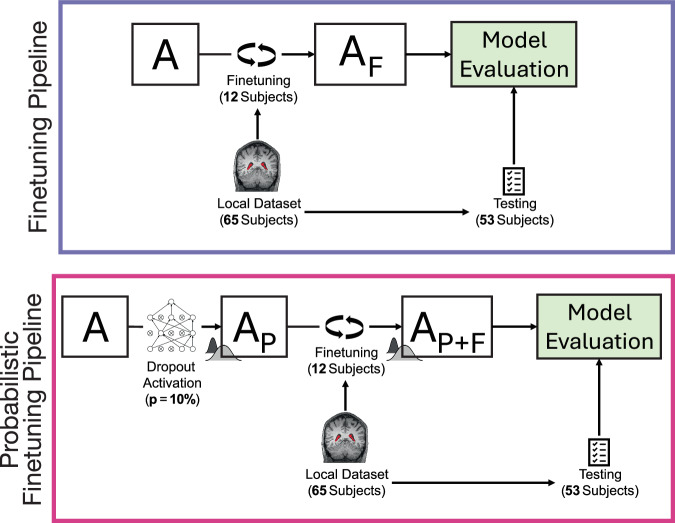 Figure 1
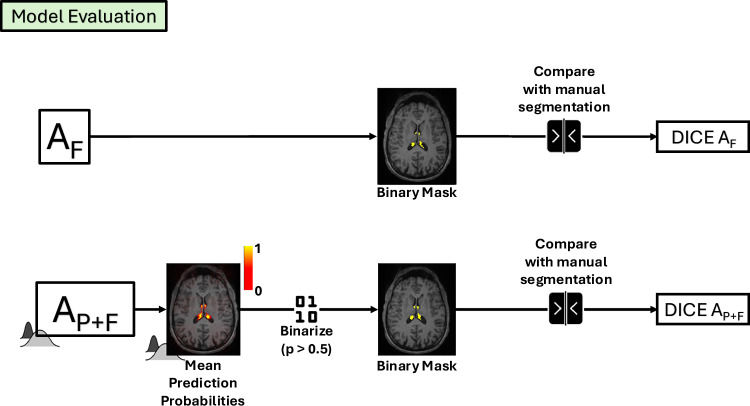 Figure 2
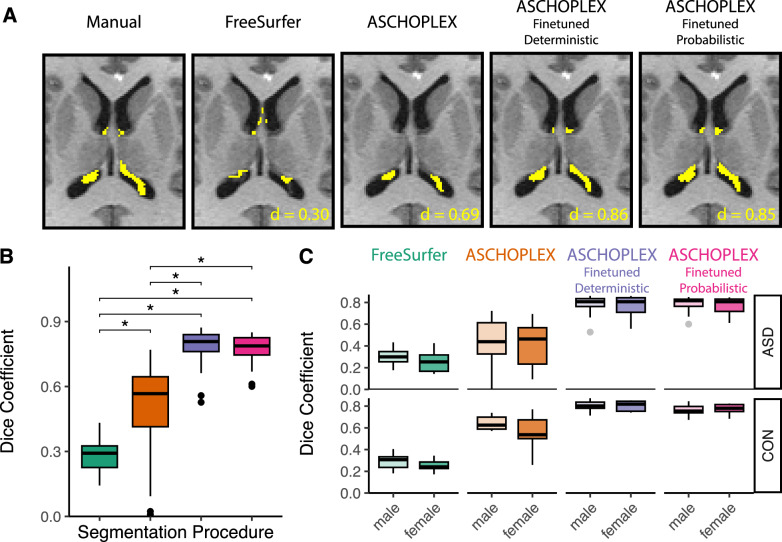 Figure 3
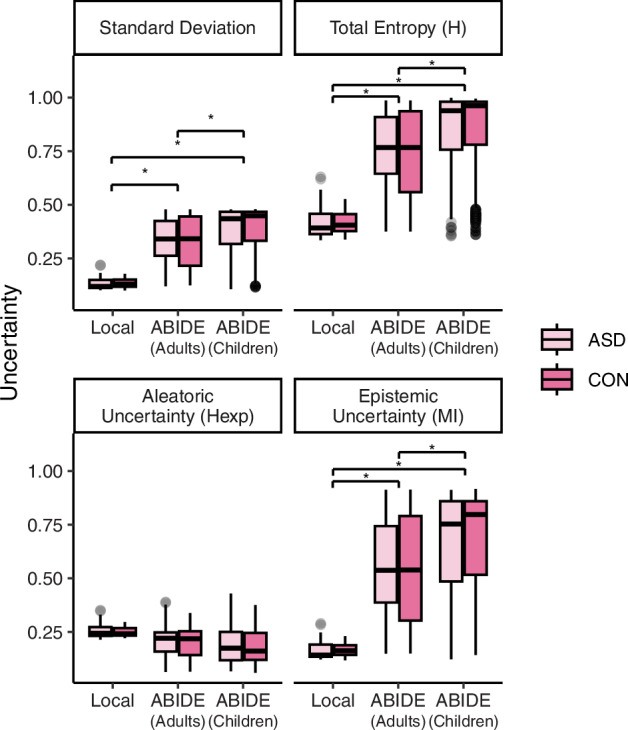 Figure 4
Peer Reviews
No public reviews on file for this paper yet. If you reviewed it on a platform where reviews are public (OpenReview, ICLR, NeurIPS, ICML), you can paste yours below so the community can read it here.
Videos
No videos yet. Explain this paper in a talk, walkthrough, or lecture? Add one.
Taxonomy
TopicsAutism Spectrum Disorder Research · Fetal and Pediatric Neurological Disorders · Functional Brain Connectivity Studies