Testing a General Theory for Optimal Flowering Time in Deciduous Perennial Plants as a Function of Growing Season Length
John S. Park, John Jackson, Anna Bergsten, Jon Ågren

TL;DR
This study shows that the best time for plants to flower depends not just on when spring starts but also on how long the growing season is, with implications for how plants respond to climate change.
Contribution
The study introduces a nonlinear relationship between growing season length and optimal flowering time, extending energy allocation theory for perennial plants.
Findings
Experiments with purple loosestrife and European goldenrod confirmed a nonlinear relationship between growing season length and optimal flowering time.
Optimal flowering time may stall before advancing in response to climate warming at high-latitude range margins.
The mathematical framework can be used to predict phenological limits for other species based on their life history.
Abstract
Effects of climate change on phenological timing, like flowering onset, are crucial for population fitness and community dynamics. Recent research has focused on plastic responses to earlier springs, but the optimal phenological timing should depend also on the growing season duration, within which entire annual life cycles must unfold. Optimal energy allocation theory can address life‐history scheduling when this critical time window expands. Extending Iwasa and Cohen's (1989) framework, we predict a nonlinear relationship between growing season length and optimal flowering time of deciduous perennial plants measured from spring onset. Common‐garden experiments with purple loosestrife ( Lythrum salicaria ) and European goldenrod (Solidago virgaurea) along Swedish latitudinal gradients strongly supported this a priori prediction. As climate change alters both start and duration of…
Genes, proteins, chemicals, diseases, species, mutations and cell lines named across the full text — each resolved to its canonical identifier and authoritative record.
Click any figure to enlarge with its caption.
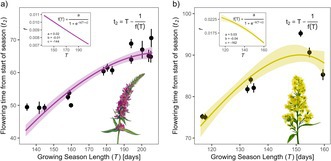 Figure 1
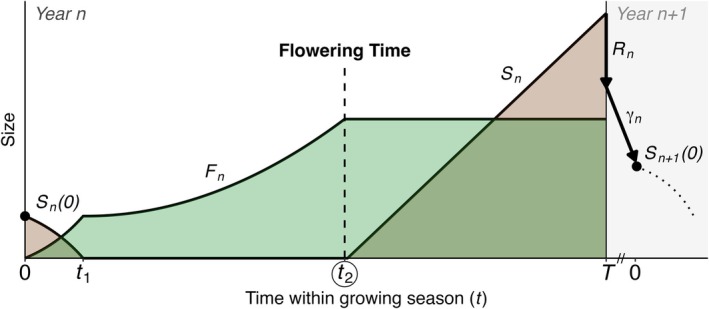 Figure 2
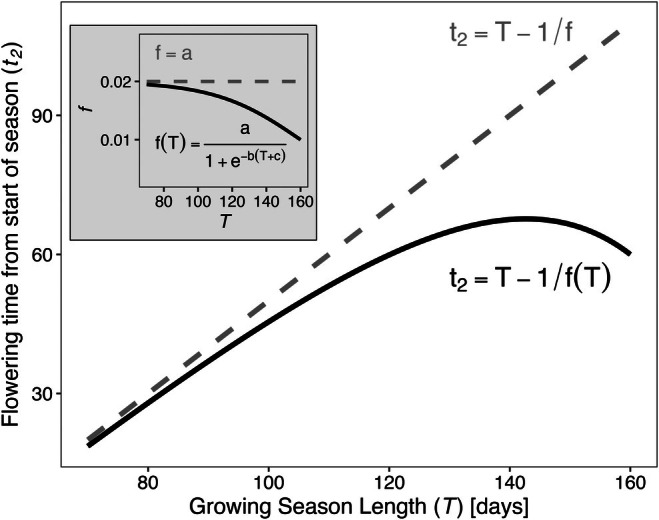 Figure 3
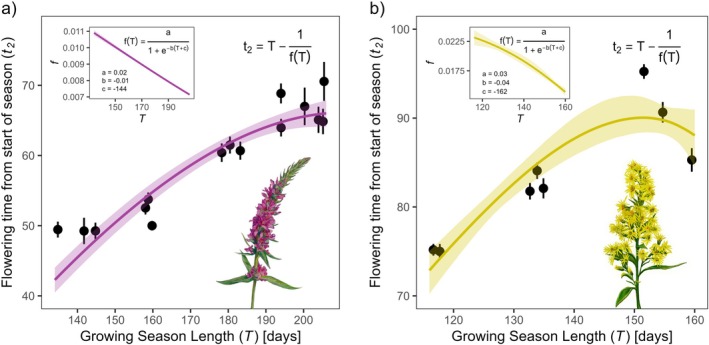 Figure 4
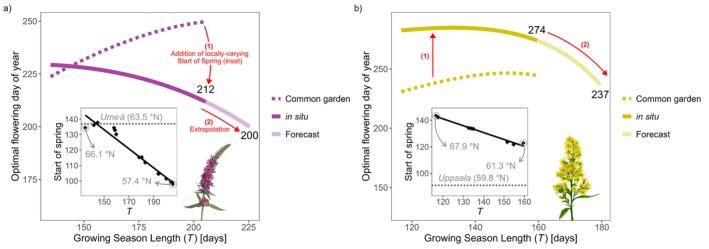 Figure 5
Peer Reviews
No public reviews on file for this paper yet. If you reviewed it on a platform where reviews are public (OpenReview, ICLR, NeurIPS, ICML), you can paste yours below so the community can read it here.
Videos
No videos yet. Explain this paper in a talk, walkthrough, or lecture? Add one.
Taxonomy
TopicsPlant and animal studies · Plant Water Relations and Carbon Dynamics · Ecology and Vegetation Dynamics Studies