Rejected sickness cash benefit claims after 180 days of sick leave in the Swedish rehabilitation chain: A nationwide register-based study
Ulrik Lidwall

TL;DR
This study examines why sickness benefit claims are rejected after 180 days of sick leave in Sweden, finding higher rejection rates for certain health conditions and vulnerable groups.
Contribution
The study identifies specific health and demographic factors associated with rejected sickness benefit claims in Sweden after 180 days of sick leave.
Findings
Musculoskeletal diseases had the highest rejection rates (RR=1.84) followed by injuries and symptoms.
Immigrants and those with primary education had higher rejection rates compared to other groups.
Pregnancy-related diagnoses and neoplasms had the lowest rejection rates.
Abstract
Since a lack of financial security among vulnerable groups could further hamper health and well-being, this study scrutinises factors predicting rejected prolonged sickness cash benefit claims among people on compensated sick leave of more than 180 days with a rejection between days 181 and 365. All 246,872 claims for employed people on sick leave recorded in the Swedish official statistics register between January 2018 and June 2021 were analysed. Claim outcome was evaluated using logistic regression with odds ratios recalculated to relative risks (RR) with 95% confidence intervals (CI), mutually adjusted for sociodemographic, work and health-related factors. Overall, 46,611 (19%) of the claims were rejected, with slightly lower rates among women (RR=0.97; 95% CI 0.95–0.99). Musculoskeletal diseases had the highest rejection rates (RR=1.84; 95% CI 1.75–1.94) followed by injuries…
Genes, proteins, chemicals, diseases, species, mutations and cell lines named across the full text — each resolved to its canonical identifier and authoritative record.
Click any figure to enlarge with its caption.
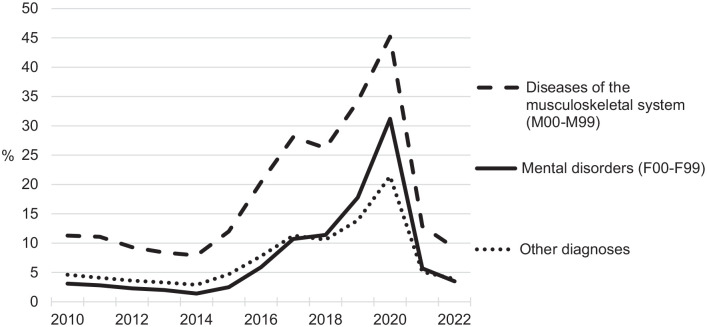 Figure 1
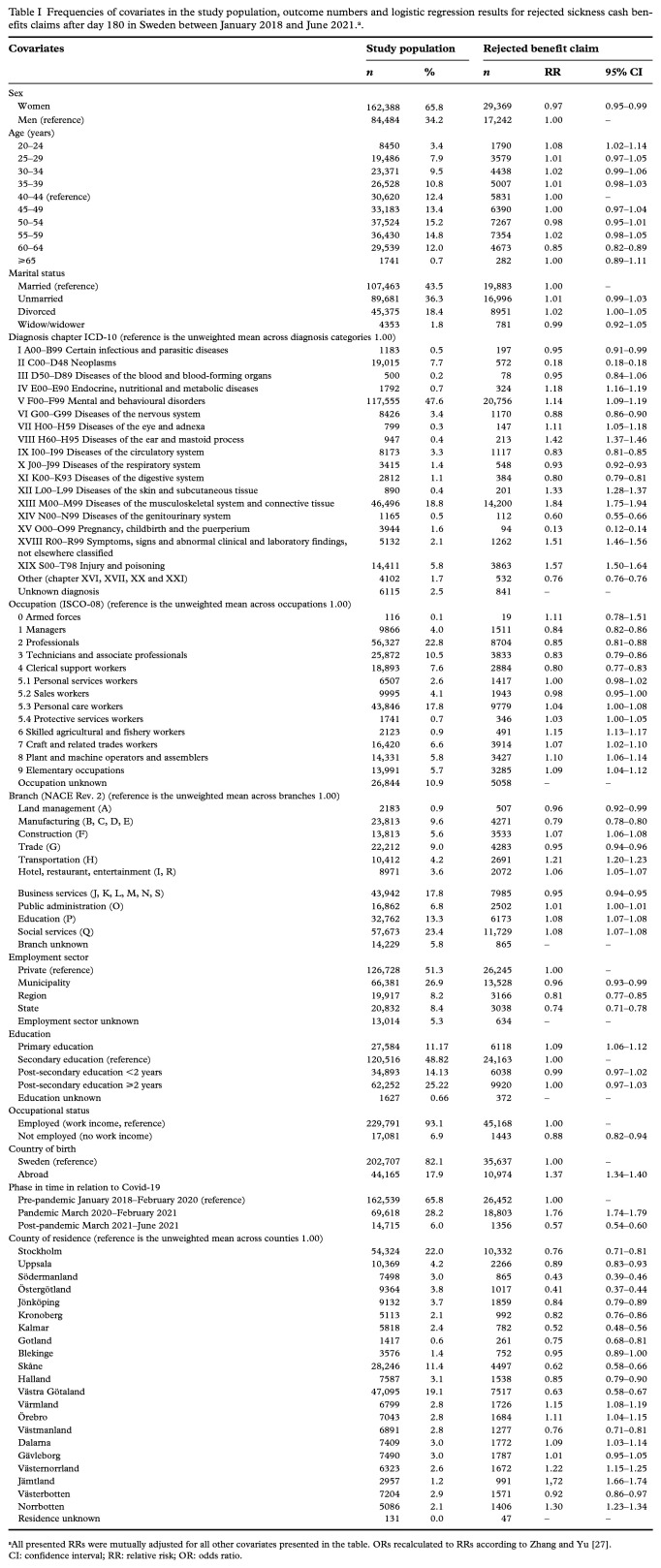 Figure 2
Peer Reviews
No public reviews on file for this paper yet. If you reviewed it on a platform where reviews are public (OpenReview, ICLR, NeurIPS, ICML), you can paste yours below so the community can read it here.
Videos
No videos yet. Explain this paper in a talk, walkthrough, or lecture? Add one.
Taxonomy
TopicsWorkplace Health and Well-being · Employment and Welfare Studies · Occupational Health and Safety Research