Myelin Lipid Reserves as a Conditional Metabolic Buffer: Implications for Alzheimer’s Disease and Ischemic Stroke
Peibin Zou, Zhihai Huang, Yulan Zhang, Xuemei Zong, Quanguang Zhang

TL;DR
Myelin lipid reserves in the brain may act as a backup energy source during metabolic stress, offering new insights for treating Alzheimer’s and stroke.
Contribution
The paper introduces myelin lipid stores as a conditional metabolic buffer in the brain, linking them to disease contexts like Alzheimer’s and ischemic stroke.
Findings
Myelin and oligodendrocytes actively stabilize brain metabolism by mobilizing lipid reserves when glycolytic supply declines.
Alzheimer’s disease and ischemic stroke may both benefit from or be worsened by the mobilization of myelin lipid-derived fuels.
Regulating lipid metabolism in myelin requires careful control to avoid harmful byproducts like reactive oxygen species and acidosis.
Abstract
Brain energetics rely on a distributed partnership among cell types and fuel sources. Beyond astrocytic glycogen, the brain has limited conventional energy reserves. Emerging evidence broadens this view by positioning myelin and oligodendrocytes as active stabilizers of metabolic homeostasis. They align substrate delivery with demand and directly sustain axonal ATP production. This review highlights current understanding that myelin lipid stores function as a conditional metabolic buffer that can be mobilized when glycolytic supply wanes. Firstly, we outline the protective repertoire of myelin (e.g., adaptive myelination, antioxidant defense, and metabolic coupling) and then summarize myelin lipid metabolism, spanning de novo synthesis and β-oxidation. We next demonstrate disease contexts marked by energetic failure. Specifically, Alzheimer’s disease exhibits a chronic metabolic…
Genes, proteins, chemicals, diseases, species, mutations and cell lines named across the full text — each resolved to its canonical identifier and authoritative record.
Click any figure to enlarge with its caption.
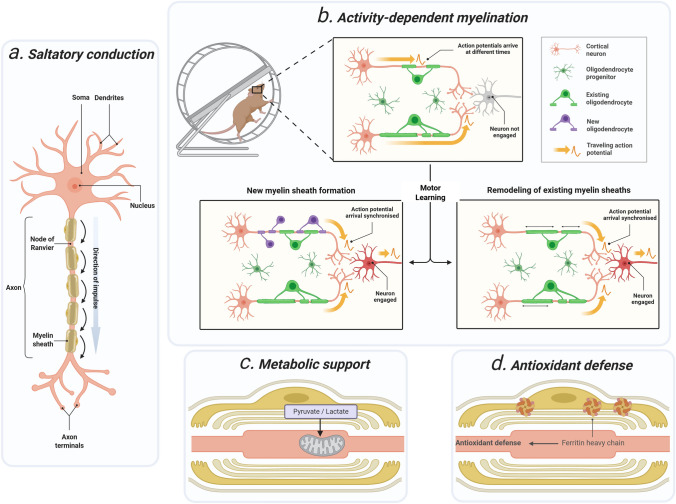 Figure 1
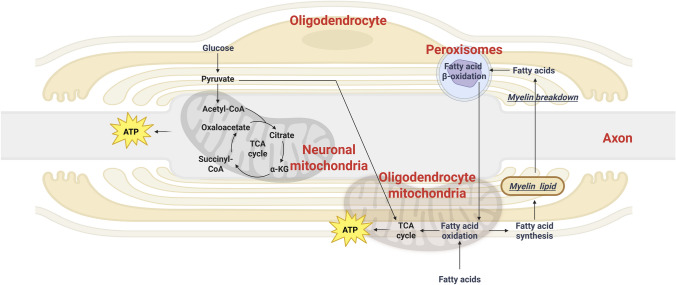 Figure 2
Peer Reviews
No public reviews on file for this paper yet. If you reviewed it on a platform where reviews are public (OpenReview, ICLR, NeurIPS, ICML), you can paste yours below so the community can read it here.
Videos
No videos yet. Explain this paper in a talk, walkthrough, or lecture? Add one.
Taxonomy
TopicsNeurogenesis and neuroplasticity mechanisms · Alzheimer's disease research and treatments · Nerve injury and regeneration