Artificial intelligence versus classical scoring systems: a comparative analysis of stone-free prediction after percutaneous nephrolithotomy
Burak Elmaağaç, Ali Yasin Özercan, Abdullah Gölbaşı, Hüseyin Biçer, Ercan Arslan, Mert Ali Karadağ

TL;DR
This study compares traditional stone scoring systems with a ChatGPT-based model in predicting stone-free outcomes after kidney stone surgery.
Contribution
The study evaluates ChatGPT's predictive performance against established scoring systems for the first time in endourology.
Findings
Traditional scoring systems like Guy’s Stone Score and S.T.O.N.E. outperformed ChatGPT in predicting stone-free rates.
ChatGPT-based models showed limited predictive accuracy and failed to provide reliable estimates.
Guy’s Stone Score and S.T.O.N.E. were identified as independent predictors of surgical success.
Abstract
This study aimed to compare the predictive performance of traditional stone scoring systems with a large language model based on ChatGPT in estimating stone-free rates following percutaneous nephrolithotomy. A total of 340 patients who underwent the procedure between 2019 and 2025 were retrospectively analyzed. Preoperative stone complexity was evaluated using four established scoring systems—Guy’s Stone Score, the CROES nomogram, the S.T.O.N.E. nephrolithometry score, and the Seoul National University Renal Stone Complexity score—and each case was additionally processed through a ChatGPT-based prediction model. The predicted outcomes of each method were compared with actual postoperative results using correlation analysis and multivariate regression. The overall stone-free rate was 60.9%. Patients who achieved stone-free status had significantly lower Guy’s Stone Score, S.T.O.N.E., and…
Genes, proteins, chemicals, diseases, species, mutations and cell lines named across the full text — each resolved to its canonical identifier and authoritative record.
Click any figure to enlarge with its caption.
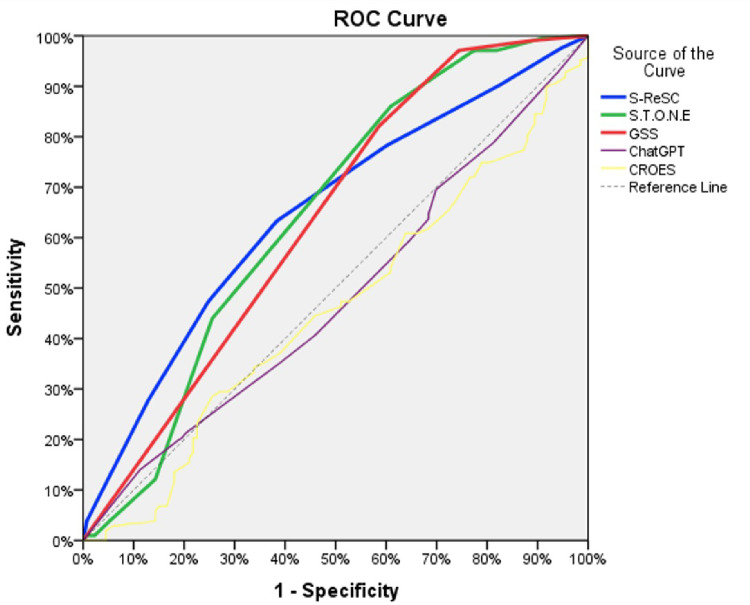 Figure 1
Peer Reviews
No public reviews on file for this paper yet. If you reviewed it on a platform where reviews are public (OpenReview, ICLR, NeurIPS, ICML), you can paste yours below so the community can read it here.
Videos
No videos yet. Explain this paper in a talk, walkthrough, or lecture? Add one.
Taxonomy
TopicsKidney Stones and Urolithiasis Treatments · Dialysis and Renal Disease Management · Paleopathology and ancient diseases