Prevalence and risk factors of difficult-to-treat axial spondyloarthritis: Real-life evidence from the BioSTaR database
Hatice Bodur, Şebnem Ataman, Fatma Gül Yurdakul, Gülcan Gürer, Kenan Akgün, Lale Altan İnceoğlu, İsmihan Sunar, Özgür Akgül, İlhan Sezer, Erhan Çapkın, Aylin Rezvani, İlker Yağcı, Mehmet Tuncay Duruöz, Hasan Fatih Çay, Remzi Çevik, Feride Göğüş, Ayhan Kamanlı, Hilal Ecesoy

TL;DR
The study finds that 11.3% of axial spondyloarthritis patients are difficult to treat, with factors like longer disease duration and comorbidities playing a key role.
Contribution
The study identifies specific risk factors and prevalence of difficult-to-treat axial spondyloarthritis using real-world clinical data.
Findings
11.3% of axial spondyloarthritis patients were classified as difficult-to-treat.
Difficult-to-treat patients had longer disease duration, higher MASES and ASDAS-CRP scores, and more comorbidities like hypertension and psoriasis.
Abstract
This study was aimed at determining the prevalence of difficult-to-treat (D2T) axial spondyloarthritis (axSpA) and identifying main associated factors for D2T axSpA. This multicenter observational cross-sectional study included axSpA patients from the BioSTaR (Biological and Targeted Synthetic Disease-Modifying Antirheumatic Drugs Registry) from February 1, 2019, to January 1, 2025. Data from 1800 axSpA patients who have previously used or are currently using at least one biologic/targeted synthetic disease-modifying antirheumatic drug were analyzed. Patient data included demographic characteristics, body mass index (BMI), marital status, smoking and alcohol use, family history of SpA, and presence of comorbidities. The parameters related to SpA such as disease duration, type of axSpA (radiographic/non-radiographic), HLA-B27 status, the presence of extra-musculoskeletal manifestations…
Genes, proteins, chemicals, diseases, species, mutations and cell lines named across the full text — each resolved to its canonical identifier and authoritative record.
Click any figure to enlarge with its caption.
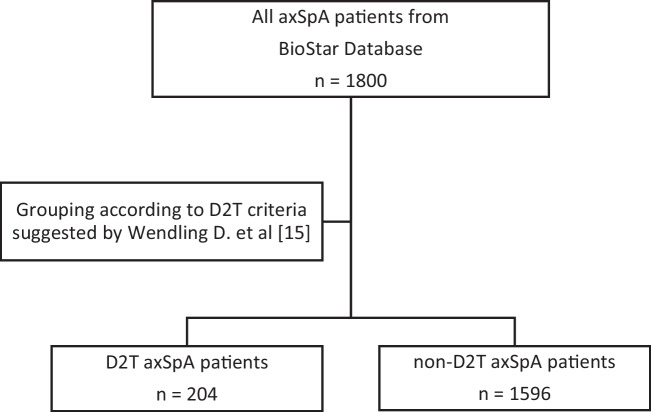 Figure 1
 Figure 2
 Figure 3
Peer Reviews
No public reviews on file for this paper yet. If you reviewed it on a platform where reviews are public (OpenReview, ICLR, NeurIPS, ICML), you can paste yours below so the community can read it here.
Videos
No videos yet. Explain this paper in a talk, walkthrough, or lecture? Add one.
Taxonomy
TopicsSpondyloarthritis Studies and Treatments · Rheumatoid Arthritis Research and Therapies · Spine and Intervertebral Disc Pathology