Peroral cholangiopancreatoscopy-guided diagnosis and treatment of an intramural bile duct stone complicated with immunoglobulin G4-related cholangitis: a case report with video
Sichao Wen, Haiyong Long, Ping Wang, Wenguang Yang, Yuhong Ren, Bin Yang, Mingwen Guo

Abstract
Genes, proteins, chemicals, diseases, species, mutations and cell lines named across the full text — each resolved to its canonical identifier and authoritative record.
Click any figure to enlarge with its caption.
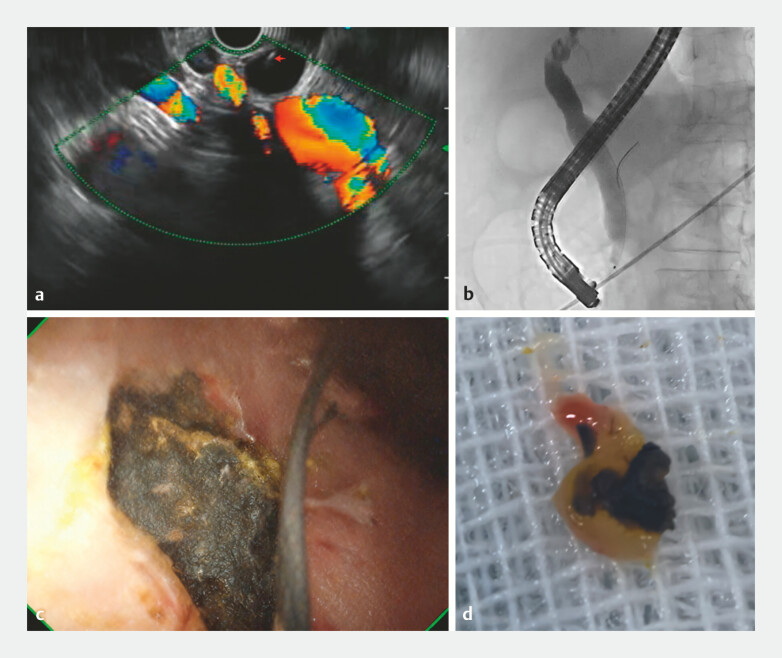 Fig. 1
Peer Reviews
No public reviews on file for this paper yet. If you reviewed it on a platform where reviews are public (OpenReview, ICLR, NeurIPS, ICML), you can paste yours below so the community can read it here.
Videos
No videos yet. Explain this paper in a talk, walkthrough, or lecture? Add one.
Taxonomy
TopicsIgG4-Related and Inflammatory Diseases · Gallbladder and Bile Duct Disorders · Pediatric Hepatobiliary Diseases and Treatments
The development of peroral cholangiopancreatoscopy (POCPS) has enabled the super-minimally invasive direct visualization diagnosis and treatment of biliopancreatic diseases. Over the past half-century, continuous advancements in related equipment and accessories have promoted the evolution of POCPS-guided super-minimally invasive therapies 1 . For diagnosis, direct endoscopic visualization of unexplained biliopancreatic abnormalities combined with targeted biopsy has become an effective approach. In terms of treatment, POCPS-guided laser or electrohydraulic lithotripsy provides a safe and effective option for refractory bile duct and pancreatic stones 2 . Herein, we report a rare case of an intramural bile duct stone successfully managed by POCPS, with subsequent pathological confirmation of immunoglobulin G4-related cholangitis (IgG4-RC) from the resected bile duct wall tissue.
A 58-year-old woman presented to our department with recurrent abdominal pain and abnormal liver function for 3 years. Serum biochemistry showed mild elevations in transaminases, bilirubin, alkaline phosphatase, and gamma-glutamyl transferase. Computed tomography (CT) and magnetic resonance imaging (MRI) revealed a post-cholecystectomy status, with irregular morphology of the common hepatic duct and intrahepatic bile ducts but no evidence of stones. Subsequent endoscopic ultrasound (EUS) demonstrated a tiny hyperechoic lesion in the bile duct, suggestive of a small stone ( Fig. 1 a ). After obtaining informed consent, endoscopic retrograde cholangiopancreatography (ERCP) was performed, but cholangiography showed no filling defects ( Fig. 1 b ). Further POCPS examination identified a 4-mm intramural stone in the distal bile duct ( Fig. 1 c ). The stone and a portion of the surrounding bile duct wall tissue were successfully retrieved under POCPS guidance ( Fig. 1 d , Video 1 ). Postoperative pathology confirmed IgG4-RC, which was further supported by a marked elevation in serum IgG4 levels.
Peroral cholangiopancreatoscopy (POCPS)-guided visualization and retrieval of an intramural bile duct stone in a patient with immunoglobulin G4-related cholangitis. a EUS showing a tiny hyperechoic lesion in the bile duct, suggestive of a small stone. b ERCP was performed, and cholangiography showed no filling defects. c Further POCPS identified a 4-mm intramural stone in the distal bile duct. d POCPS-guided the successful retrieval of the stone and adjacent bile duct wall tissue. ERCP, endoscopic retrograde cholangiopancreatography; EUS, endoscopic ultrasound.
This video demonstrates the peroral cholangiopancreatoscopy (POCPS)-guided diagnosis and treatment of a 58-year-old woman with an intramural bile duct stone complicated by immunoglobulin G4-related cholangitis.Video 1
Intramural bile duct stones are extremely rare. EUS exhibits higher sensitivity than CT or MRI for their detection, but definitive diagnosis relies on direct POCPS visualization, which also allows simultaneous stone removal. IgG4-RC may be the underlying cause of intramural stone formation in this case. POCPS provides a safe and effective diagnostic and therapeutic modality for biliopancreatic diseases.
Endoscopy_UCTN_Code_CCL_1AZ_2AN
The reference list from the paper itself. Each links out to its DOI / PubMed record.
- 1Subhash A Buxbaum JL Tabibian JH Peroral cholangioscopy: Update on the state-of-the-art World J Gastrointest Endosc 202214637610.4253/wjge.v 14.i 2.6335316979 PMC 8908329 · doi ↗ · pubmed ↗
- 2Galetti F Moura DTH Ribeiro IB Cholangioscopy-guided lithotripsy vs. conventional therapy for complex bile duct stones: a systematic review and meta-analysis Arq Bras Cir Dig 202033 e 149110.1590/0102-672020190001 e 149132609255 PMC 7325696 · doi ↗ · pubmed ↗