Physiology of the subconscious: Autonomic activation during sexual dreaming
Emmanuel Eroumé A Egom, Bernadette Sandrine Lema, Elijah-Bill Christopher Nguem Nguem

TL;DR
This study explores how sexual dreams are linked to self-reported physical sensations like increased heart rate and sweating in female-identifying adults.
Contribution
The study isolates and analyzes self-reported autonomic-like symptoms following sexual dreams, not previously examined in the SLEEP Study dataset.
Findings
Increased heart rate was the most commonly reported symptom (57.4%).
A minority (20.8%) reported no symptoms, showing variability in perceived arousal.
Symptoms often co-occurred, reflecting cardiovascular and emotional experiences.
Abstract
To evaluate self-reported autonomic-like symptoms following sexual dreams in the SLEEP Study and characterize their perceived physiological patterns. In a cross-sectional online study, 301 female-identifying adults reported physical and emotional sensations experienced immediately after sexual dreams. We summarized symptom prevalence using descriptive statistics. Increased heart rate (57.4 %) and sweating (35.0 %) were most frequently reported, followed by anxiety (33.9 %) and muscle tension (23.0 %). A minority (20.8 %) reported no symptoms, indicating variability in perceived arousal or recall. Symptom patterns reflected common co-occurrence of self-reported cardiovascular-like and affective experiences. These findings suggest that sexual dreams are often accompanied by self-reported autonomic-like experiences, although these reports do not represent objective physiological…
Genes, proteins, chemicals, diseases, species, mutations and cell lines named across the full text — each resolved to its canonical identifier and authoritative record.
Click any figure to enlarge with its caption.
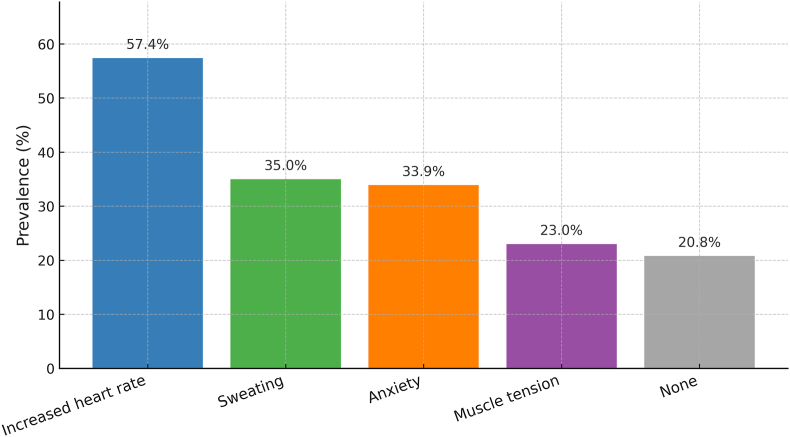 Figure 1
Peer Reviews
No public reviews on file for this paper yet. If you reviewed it on a platform where reviews are public (OpenReview, ICLR, NeurIPS, ICML), you can paste yours below so the community can read it here.
Videos
No videos yet. Explain this paper in a talk, walkthrough, or lecture? Add one.
Taxonomy
TopicsSleep and Wakefulness Research · Sleep and related disorders · Music Therapy and Health
Introduction
1
Dreams are a window into emotion–autonomic coupling during sleep [1,2]. While sexual dreams are common, their physiological signatures are rarely quantified outside laboratory settings. In this study, a ‘sexual dream’ refers to any dream involving erotic activity, romantic-sensual interaction, or emotionally intimate content with a sexual component. Building on our Sleep Research article [3], we summarize autonomic-like symptoms reported immediately after sexual dreams in a community cohort.
Methods
2
Study design and participants
2.1
This brief report represents a focused secondary analysis of autonomic-like symptoms within the SLEEP Study dataset. The broader psychological findings were previously published in Sleep Research [3]; those analyses did not examine autonomic-like symptoms as independent physiological outcomes. The SLEEP Study is a cross-sectional, survey-based investigation conducted by Heaven Foundation/Fondation CIEL with anonymized data handling and electronic consent. Adults (N = 301) residing in the United States completed an online questionnaire on dream experiences and post-dream symptoms. The analytic sample included 301 female-identifying adults (90 % identifying as women, 10 % nonbinary), with a mean age of 39.5 years (SD = 12.3; range 19–104). Control comparisons (e.g., nightmares or neutral dreams) were not included because the approved survey focused exclusively on sexual-dream experiences. This brief report therefore describes autonomic-like symptoms within this specific dream category only.
Measures
2.2
Participants indicated post-dream increased heart rate, sweating, muscle tension, anxiety, none, or other (single/multiple selections allowed).
Post-dream symptoms were assessed with the item:
After this dream, did you experience any of the following?
- •Increased heart rate
- •Sweating
- •Anxiety
- •Muscle tension
- •None
- •Other (free text)
Participants could select multiple responses.
Analytic approach
2.3
We summarized symptom prevalence using descriptive statistics (proportions with 95 % confidence intervals). Analyses focused on descriptive characterization and co-occurrence patterns of reported cardiovascular-like and affective symptoms. No inferential or correlational analyses were performed, consistent with the hypothesis-generating and self-reported nature of the dataset.
Results
3
Increased heart rate was most frequent (57.4 %), followed by sweating (35.0 %) and anxiety (33.9 %). Muscle tension occurred in 22.95 % of respondents, while 20.8 % reported no symptoms. These distributions are illustrated in Fig. 1 and detailed with 95 % confidence intervals in Table 1. These distributions describe the prevalence and co-occurrence of self-reported post-dream physical and emotional symptoms, as summarized in Table 1 and Fig. 1.Fig. 1**Prevalence of post-dream symptoms following sexual dreams (N=301).**Bars show % of participants endorsing each symptom: increased heart rate (57.4 %), sweating (35.0 %), anxiety (33.9 %), muscle tension (23.0 %), and none (20.8 %). Labels denote percentages.Fig. 1. Table 1Prevalence of post-dream symptoms with 95 % Wilson confidence intervals (N = 301).Table 1. SymptomnPrevalence (%)95 % CI lower (%)95 % CI upper (%)Increased heart rate17357.451.862.9Sweating10535.029.740.4Anxiety10233.928.839.4Muscle tension6923.018.528.0None6320.816.725.9Values are prevalence (%) with 95 % Wilson confidence intervals, computed from counts rounded from study percentages (N = 301).
Discussion
4
Self-reported post-dream symptoms indicate that sexual dreams are commonly associated with perceived autonomic-like experiences, reflecting subjective emotional and bodily arousal reported by participants. The co-occurrence of cardiovascular-like (heart rate, sweating) and affective (anxiety) symptoms is consistent with parallel subjective arousal experiences. The ∼21 % asymptomatic subgroup may reflect lower perceived arousal, variability in recall, or differences in reporting style.
These self-reported autonomic-like experiences reflect perceived arousal states and do not constitute objective evidence of autonomic or sleep-stage–specific physiological activation. The asymptomatic subgroup may reflect lower perceived arousal, variability in recall, or differences in reporting style.
Clinically, dream-elicited self-reports may complement PSG-based markers by offering an ecologically valid, low-burden subjective index of emotional arousal during sleep, without implying specific sleep-stage mechanisms. Future work should integrate ambulatory physiology (e.g., PPG-derived pulse, EDA) with experience sampling to validate these patterns against objective signals.
This brief report is limited by its female-only sample, reliance on subjective recall, lack of dream-type control conditions, and absence of objective physiological recordings. These constraints reflect the structure of the original SLEEP Study instrument.
Conclusion
5
Sexual dreaming is frequently accompanied by self-reported autonomic-like experiences and may serve as a non-invasive, hypothesis-generating probe of subjective emotion–bodily coupling during sleep.
CRediT authorship contribution statement
Emmanuel Eroumé A Egom: Writing – review & editing, Writing – original draft, Visualization, Supervision, Methodology, Investigation, Formal analysis, Data curation, Conceptualization. Bernadette Sandrine Lema: Writing – review & editing, Writing – original draft, Supervision, Methodology, Investigation, Formal analysis, Data curation, Conceptualization. Elijah-Bill Christopher Nguem Nguem: Writing – review & editing, Writing – original draft, Formal analysis, Data curation, Conceptualization.
Ethics statement
All participants provided electronic informed consent; the study was non-interventional and conducted in accordance with the Declaration of Helsinki.
Declaration of generative AI use
No generative AI tools were used to generate scientific content or images. Language polishing tools were limited to grammar and style checks; authors take full responsibility for the content.
Funding
No external funding was received.
Declaration of competing interest
The authors declare that they have no known competing financial interests or personal relationships that could have appeared to influence the work reported in this paper.
The reference list from the paper itself. Each links out to its DOI / PubMed record.
- 1Billiard M.Sleep: physiology, investigations, and medicine 2003 Springer 10.1007/978-1-4615-0217-3 · doi ↗
- 2Eiser A.S.Physiology and psychology of dreams Semin Neurol 251200531010.1055/s-2005-86707815798942 · doi ↗ · pubmed ↗
- 3Egom E.E.A.Mbah T.B.Ebango S.A.S.Lema B.S.Unveiling the subconscious: how sexual dreams reflect and intensify mental problems Sleep Res 220251322