ATDD: Multi-lingual dataset for auto-tune detection in music recordings
Mahyar Gohari, Paolo Bestagini, Sergio Benini, Nicola Adami

TL;DR
This paper introduces a multilingual dataset to help detect auto-tuned music in recordings across English, Mandarin, and Japanese.
Contribution
The paper presents a novel multilingual dataset with auto-tuned and authentic music segments, annotated for pitch correction.
Findings
The dataset includes 10-second audio segments in English, Mandarin, and Japanese with pitch correction applied.
Time-domain labels are provided to indicate exact pitch correction locations for training detection models.
The dataset is structured for robust analysis and supports research in music analysis and audio signal processing.
Abstract
This study introduces a novel multilingual dataset designed to distinguish auto-tuned musical compositions from authentic recordings, addressing a significant gap in existing resources. The dataset encompasses songs in English, Mandarin, and Japanese, ensuring a diverse representation of linguistic contexts. The data collection process began with aggregating diverse datasets from the Music Information Retrieval domain, incorporating tracks from the three specified languages to capture a wide range of musical styles and recording qualities. Each audio file was subsequently standardized into 10-second intervals with the sample rate of 16 kHz to facilitate manageable analysis. For the creation of auto-tuned samples, pitch correction was implemented using the probabilistic YIN (PYIN) algorithm for accurate pitch detection, followed by transposition via the pitch-synchronized overlap and add…
Click any figure to enlarge with its caption.
 Figure 1
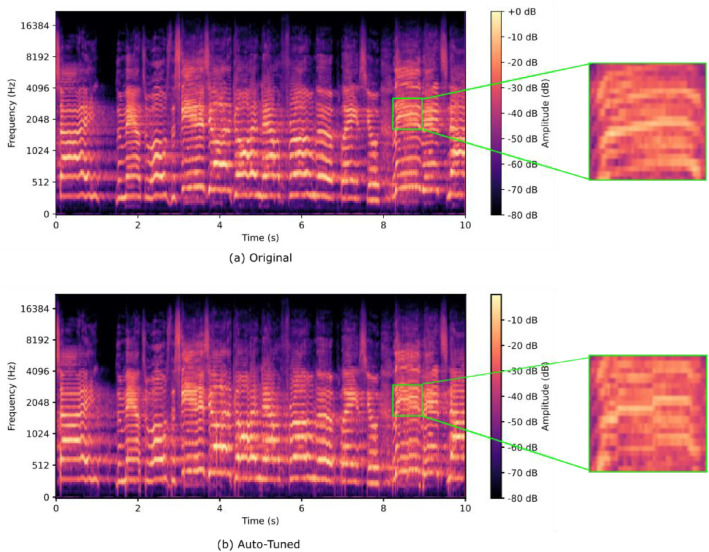 Figure 2
Peer Reviews
No public reviews on file for this paper yet. If you reviewed it on a platform where reviews are public (OpenReview, ICLR, NeurIPS, ICML), you can paste yours below so the community can read it here.
Videos
No videos yet. Explain this paper in a talk, walkthrough, or lecture? Add one.
Taxonomy
TopicsMusic and Audio Processing · Speech and Audio Processing · Speech Recognition and Synthesis
Specifications TableSubjectComputer Science / Signal ProcessingSpecific subject areaDetection and Localization of auto-tuned singing voices in music recordingsType of data(.wav) Raw, Processed(.json) Ground truthData collectionThe dataset is curated by applying auto-tuning on eight open-source datasets in the literature. All the audio tracks are normalized to have an equal length of 10 seconds and resampled to 16 KHz.Data source locationDepartment of Information Engineering, University of Brescia, Via Branze, 38, 25133, Brescia, ItalyData accessibilityRepository name: ZenodoData identification number: 10.5281/zenodo.14621005Direct URL to data: https://doi.org/10.5281/zenodo.14621005Direct URL to software: https://github.com/mahyargm/Auto-Tune-DetectionRelated research articleM. Gohari, P. Bestagini, S. Benini and N. Adami, ``Spectrogram-Based Detection of Auto-Tuned Vocals in Music Recordings,'' 2024 IEEE International Workshop on Information Forensics and Security (WIFS), Rome, Italy, 2024, pp. 1-6, doi:10.1109/WIFS61860.2024.10810675.
Value of the Data
1
- •This dataset serves as a valuable resource for developing and testing models to detect and locate auto-tuned vocals within song tracks. It provides researchers with the opportunity to create, assess, and benchmark new approaches for identifying and analyzing auto-tuning effects in musical recordings.
- •This dataset represents an enhanced version of the dataset initially introduced in [1], now featuring a larger collection of multi-lingual songs along with strong labels that precisely mark the time stamps where auto-tuning is applied. Notably, auto-tuning is applied partially within tracks rather than uniformly across entire segments, thereby reflecting real-world practice and providing a stronger, more varied ground truth for learning-based methods. This extension provides a more comprehensive resource for training and validating auto-tune detection models.
- •The code used to create this dataset has been published, enabling researchers to recreate the dataset and extend it using their own collection of songs, thereby facilitating the development of larger and more comprehensive datasets.
Background
2
As auto-tuning continues to play a significant role in contemporary music production, there is a necessary need to develop algorithms capable of identifying instances of auto-tuning in musical recordings. The motivation behind compiling this dataset stemmed from the need within the music information retrieval (MIR) community for standardized datasets to facilitate research on auto-tune detection methods.
This work extends the dataset we employed in our previous study [1], significantly enhancing its scope by increasing the number of songs, diversifying the languages represented, and incorporating strong labels that mark precise time stamps where auto-tuning is applied. The original dataset laid the groundwork for research in this area, but its scope was limited in terms of language diversity and label precision. In response, we expanded and enriched the dataset to provide a more comprehensive resource for researchers and developers.
This dataset aims to serve as a valuable resource for building, training, and evaluating machine learning models and algorithms for Auto-Tune detection. Additionally, to promote transparency and reproducibility, we provide the code used to create the dataset, allowing other researchers to extend it with their own music collections.
Data Description
3
The proposed dataset contains 21,249 isolated songs and singing voice segments sourced from various datasets in the MIR field to ensure diversity in styles, genres, and languages. Each song or singing voice in our dataset contains an auto-tuned version of themselves. Table 1 summarizes the overview of the proposed dataset. For practical use, we recommend further splitting the training set into training and validation subsets with a proportion of 90% to 10%, respectively.Table 1. Overview of the dataset.Table 1. Source datasetNumber of 10s segmentsNameLanguageTraining partitionTest PartitionTotalMusDB18English1,7559532,708VocalSetEnglish (vowels)3,613-3,613OpencpopMandarin1,881-1,881M4SingerMandarin5,6455,03410,679Ofuton-PJapanse324-324Oniku KurumiJapanse417-417KiritanJapanse381-381JVS-MuSiCJapanse1,246-1,246
The ground truth, relative paths, and additional details of the audio files are recorded in two separate JSON files, one for the training partition and one for the test partition. Each audio file in the dataset has an associated JSON metadata entry with the fields shown in Table 2.Table 2. The structure of audio files' metadata.Table 2. FieldDescriptionAudio_pathRelative path to the audio file.Source_datasetPrimary dataset of the original song or singing voice.PartitionThe partition that the segment belongs to. (Training or Test).Auto-tuning_labelIncludes the start time, end time, and duration of auto-tuning.Song_nameIdentifier for the song.Singer(VocalSet)Identifier of the singer if the song belongs to VocalSet.
Experimental Design, Materials and Methods
4
In this section, we initially present the primary datasets employed in this study. Subsequently, we explain the auto-tuning procedure utilized for the generation of Auto-Tuned songs and vocal tracks within the dataset. Finally, we provide a detailed, step-by-step procedure of the dataset creation process.
Primary datasets
4.1
In this study, we utilize 8 primary datasets to create the final dataset:
VocalSet [2]: The VocalSet comprises 10.1 hours of monophonic audio recordings, with durations ranging from 1.56 to 81.21 seconds and an average duration of 8.76 seconds. The recordings feature performances by professional singers and were chosen specifically for their diverse range of vocal techniques, demonstrated by 20 different singers. The application of auto-tuning to these vocals facilitates a comprehensive exploration and analysis of its effects.
MusDB18 [3]: MusDB18, also referred to as the Music Source Separation Dataset, comprises 150 full-length music tracks representing various genres such as pop, rock, electronic, jazz, and more. It is divided into a training set containing 100 tracks and a testing set containing 50 tracks. Musdb18 is widely recognized as a benchmark dataset in the field of music source separation.
Opencpop [4]: A publicly available high-quality Mandarin singing corpus designed for singing voice synthesis (SVS) systems. It comprises 100 unique Mandarin songs recorded by a professional female singer in a studio environment, totaling approximately 5.2 hours of audio.
M4Singer [5]: A comprehensive Mandarin singing corpus featuring recordings from 20 professional singers, covering various styles and all four SATB (soprano, alto, tenor, bass) voice types. It encompasses 700 Chinese pop songs.
Ofuton-P [6]: A Japanese singing voice database featuring recordings from a single male singer, utilized in research and development of singing voice synthesis systems.
Oniku Kurumi [7]: Another Japanese singing voice database comprising recordings from a single female singer.
Kiritan [8]: Also known as the Tohoku Kiritan Singing Database, this Japanese singing voice corpus features recordings from a single female singer. It includes 50 Japanese pop songs totaling approximately 57 minutes of studio-recorded vocals.
JVS-MuSiC [9]: This dataset features recordings from 100 Japanese singers, each performing ``Katatsumuri,'' a traditional children's song, along with an additional unique song per singer.
Pre-processing process
4.2
To create a uniform dataset for analysis, we standardized all audio files from the primary datasets into 10-second segments with a sampling rate of 16 kHz. For every dataset except VocalSet, we divided each song into consecutive 10-second clips and discarded any remaining audio shorter than 10 seconds. This approach ensured consistent segment lengths and simplified subsequent data processing.
In contrast, VocalSet features a variety of standard and extended vocal techniques demonstrated on all five vowels, with most recordings lasting less than 10 seconds. These recordings are not typical singing voices but rather specialized vocal performances. Therefore, when standardizing the dataset into 10-second segments, we employed a different processing strategy for VocalSet: trimming longer recordings and applying zero-padding to shorter ones. This approach preserves the unique characteristics of VocalSet’s specialized vocal techniques while ensuring uniform segment lengths across the entire dataset.
Finally, we filtered out segments with low energy content to discard segments devoid of vocal elements. To do so, we defined
which represents the energy of a -samples floating-point discrete-time signal , normalized between -1 and +1. We filtered out all segments with energy below 10, which corresponds to approximately less than 0.002 % of the maximum energy. This step effectively removes segments that do not contain any vocals from the dataset.
Auto-tuning process
4.3
We first randomly selected a portion of each audio segment, ranging from 20 % to 80 % of its total length, and applied auto-tuning, specifically to this portion, following the methodology described in [1]. The process begins with pitch tracking, which involves determining the pitch at each time stamp—a fundamental task in Digital Signal Processing (DSP) for audio signals. Among the available methods, the probabilistic YIN (PYIN) algorithm [10] is particularly notable and widely recognized. PYIN builds upon the YIN algorithm [11], which estimates pitch by analyzing the autocorrelation function of the time-domain signal and refining these estimates. PYIN enhances YIN by incorporating a Hidden Markov Model, thereby improving the accuracy of pitch tracking.
After identifying the pitches, we adjusted them to the nearest MIDI note using the pitch-synchronized overlap and add (PSOLA) technique [12]. By leveraging PSOLA, the pitch modification process maintains synchronization and coherence across audio segments, ensuring smooth transitions between notes.
Dataset creation process
4.4
The dataset creation pipeline is illustrated in Fig. 1 using the three main building blocks: Pre-processing (P), Auto-tuning (A), and **Mixing (M).**Fig. 1. Dataset creation pipeline.Fig 1
Initially, each isolated singing voice from the primary datasets undergoes segmentation in the pre-processing block (P), where each isolated singing voice X is divided into uniform 10-second clips, producing the pre-processed outputs . These segments are then processed in the auto-tuning block (A), where pitch correction is applied to generate auto-tuned versions . The Pre-processing and Auto-tuning processes are described in detail in 4.2, 4.3, respectively.
For tracks originating from the MusDB18 dataset, an additional mixing step is performed where the auto-tuned singing voices are recombined with their corresponding instrumental accompaniments to create auto-tuned mixed songs . This final mixing ensures that the dataset includes auto-tuned mixed songs, which are more challenging for detection algorithms due to the complexity introduced by the background music. As a result, the final dataset comprises both isolated auto-tuned vocal segments and mixed auto-tuned songs, providing a versatile and demanding resource for advancing research in audio processing and auto-tune detection.
Fig. 2 compares a 10-second mel-spectrogram of an original audio file in our dataset with its corresponding Auto-Tuned version, illustrating the effectiveness of the pitch correction process.Fig. 2. Mel-spectrogram representation of an audio segment and its corresponding auto-tuned version [1].Fig 2
Limitations
While our study marks a significant step, it is essential to acknowledge certain limitations. Notably, the absence of manually and professionally Auto-Tuned songs in our dataset represents a constraint. Although we successfully replicated auto-tuning behavior using the employed method, the inclusion of manually and professionally Auto-Tuned samples would have provided a more comprehensive evaluation of models trained on this dataset.
Ethics Statement
The authors have read and follow the ethical requirements for publication in Data in Brief and confirming that the current work does not involve human subjects, animal experiments, or any data collected from social media platforms.
CRediT Author Statement
Mahyar Gohari: Writing – original draft, Software, Data curation, Visualization, Formal analysis, Investigation. Paolo Bestagini, Sergio Benini, Nicola Adami: Conceptualization, Methodology, Supervision, Project administration, Formal analysis, Investigation, Writing – review & editing.
The reference list from the paper itself. Each links out to its DOI / PubMed record.
- 1Gohari M.Bestagini P.Benini e S.Adami N.«Spectrogram-based detection of auto-tuned vocals in music recordings,»2024 IEEE International Workshop on Information Forensics and Security (WIFS)2024
- 2Wilkins J.Seetharaman P.Wahland e B. Pardo A.Vocal Set: Sing. Voice Dataset 2018
- 3Rafii Z.Liutkus A.Stöter F.-R.Mimilakis S.I.Bittner R.MUSDB 18 Corpus Music Sep.2017
- 4Y. Wang, X. Wang, P. Zhu, J. Wu, H. Li, H. Xue, Y. Zhang, L. Xie e M. Bi, «Opencpop: A high-quality open source chinese popular song corpus for singing voice synthesis,» ar Xiv preprint ar Xiv:2201.07429, 2022.
- 5Zhang L.Li R.Wang S.Deng L.Liu J.Ren Y.He J.Huang R.Zhu J.Chen e others X.«M 4singer: A multi-style, multi-singer and musical score provided mandarin singing corpus,»Adv. Neural Inf. Process. Syst.35202269146926
- 6«Ofuton-P,» [Online]. Available: https://sites.google.com/view/oftn-utagoedb/. [Consultato il giorno 26 February 2025].
- 7«Oniku Kurumi,» [Online]. Available: https://onikuru.info/db-download/. [Consultato il giorno 26 February 2025].
- 8Ogawa I.Morisee M.«Tohoku kiritan singing database: A singing database for statistical parametric singing synthesis using japanese pop songs,»Acoust. Sci. Technol.422021140145