Viral transduction for T cell engineering in immunotherapy
Yikhyeon Seo, Jimin Pak, Jiyun Han, Joonbeom Bae, Soo Seok Hwang

TL;DR
This paper explains how to genetically modify T cells using viruses for immunotherapy research.
Contribution
The paper offers practical guidance for T cell engineering, tailored for researchers familiar with mammalian cell culture.
Findings
Viral transduction allows stable genetic modification of T cells for immunotherapy.
T cell culture requires special considerations due to activation and proliferation nuances.
The article provides a workflow for those new to T cell engineering.
Abstract
Viral transduction of primary T cells enables stable genetic engineering for research and immunotherapy, supporting both transgene overexpression and gene deletion. Although the overall workflow can be similar to transduction in other mammalian cell lines, primary T cell culture imposes distinct requirements such as cell-state-dependent nuances shaped by T cell activation and proliferation, which can make it challenging to obtain a sufficient number of genetically engineered T cells. This article provides practical guidance for researchers new to T cells but familiar with basic mammalian cell culture.
Genes, proteins, chemicals, diseases, species, mutations and cell lines named across the full text — each resolved to its canonical identifier and authoritative record.
Click any figure to enlarge with its caption.
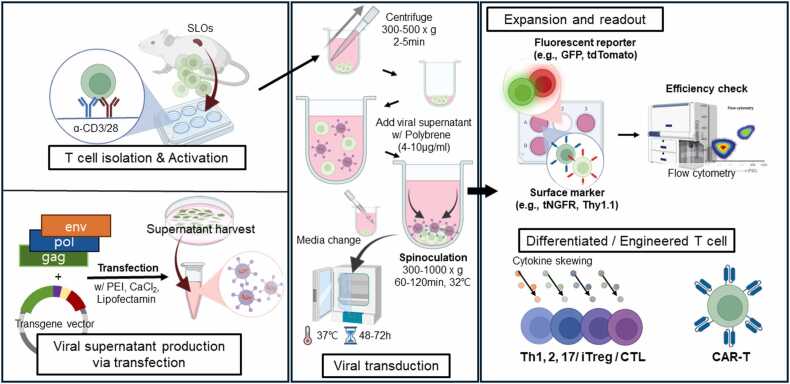 Figure 1
Peer Reviews
No public reviews on file for this paper yet. If you reviewed it on a platform where reviews are public (OpenReview, ICLR, NeurIPS, ICML), you can paste yours below so the community can read it here.
Videos
No videos yet. Explain this paper in a talk, walkthrough, or lecture? Add one.
Taxonomy
TopicsCAR-T cell therapy research · Virus-based gene therapy research · CRISPR and Genetic Engineering