ReticularNet: Automated Pixel-Level Segmentation of Reticular Pseudodrusen on Near-Infrared Reflectance Images by Deep Learning
Souvick Mukherjee, Dylan Wu, Leon von der Emde, Emily Vance, Marco Ji, Mehdi Emamverdi, Tharindu De Silva, Alisa T. Thavikulwat, Jayashree Kalpathy-Cramer, Amitha Domalpally, Catherine A. Cukras, Tiarnán D.L. Keenan

TL;DR
This paper introduces ReticularNet, a deep learning model that automatically segments reticular pseudodrusen in near-infrared images, outperforming human experts in accuracy and consistency.
Contribution
A novel deep learning model for automated, pixel-level segmentation of reticular pseudodrusen in clinical near-infrared images.
Findings
ReticularNet achieved a mean Dice similarity coefficient of 0.36, significantly higher than human experts.
The model showed higher consistency in lesion number, pixel area, and contour area compared to ophthalmologists.
ReticularNet's performance was validated across a diverse dataset of 508 images from 117 eyes.
Abstract
Reticular pseudodrusen (RPD) represent an important biomarker in age-related macular degeneration (AMD) but are difficult to grade and often assessed only for presence or absence, without quantitative or spatial analysis of RPD burden. The objective was to develop and validate a deep learning model for pixel-level RPD grading on near-infrared reflectance (NIR) images, which are commonly acquired in clinical practice and the most accurate en face detection modality. Deep learning model development study. Five hundred eight images of 117 eyes (70 participants) with or without RPD, over a wide range of AMD severities. The ground truth grading pipeline comprised reading center multimodal grading for RPD presence and NIR annotation with RPD contours, followed by pixel-level NIR annotation of all individual RPD lesions. The data set was split 80:20 into training and test sets. A…
Genes, proteins, chemicals, diseases, species, mutations and cell lines named across the full text — each resolved to its canonical identifier and authoritative record.
Click any figure to enlarge with its caption.
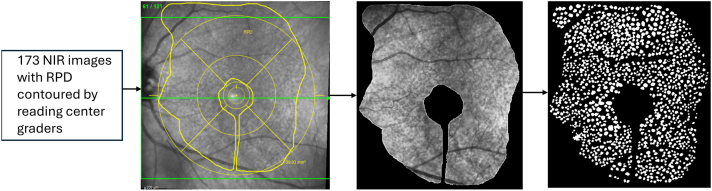 Figure 1
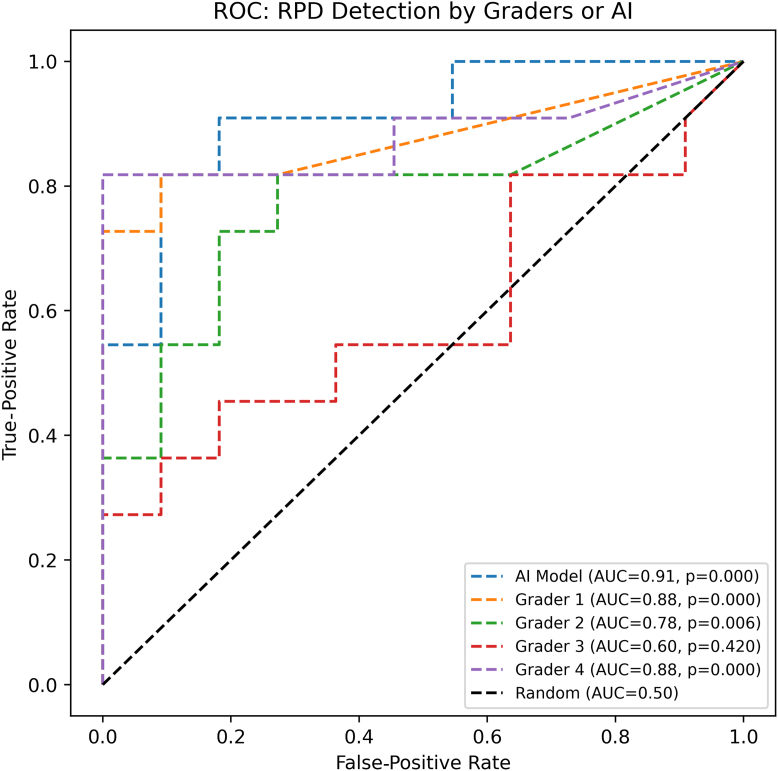 Figure 2
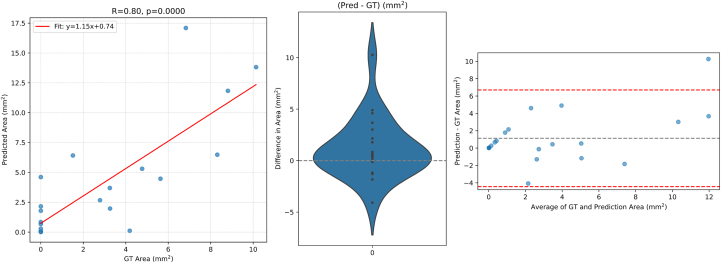 Figure 3
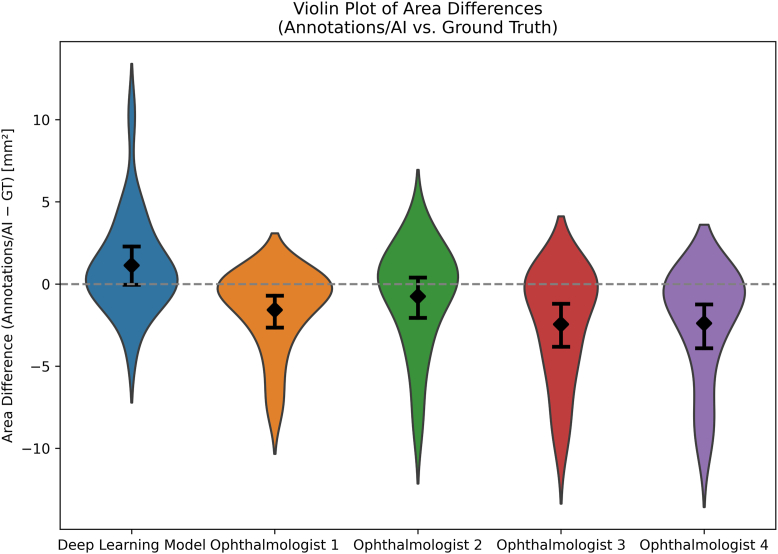 Figure 4
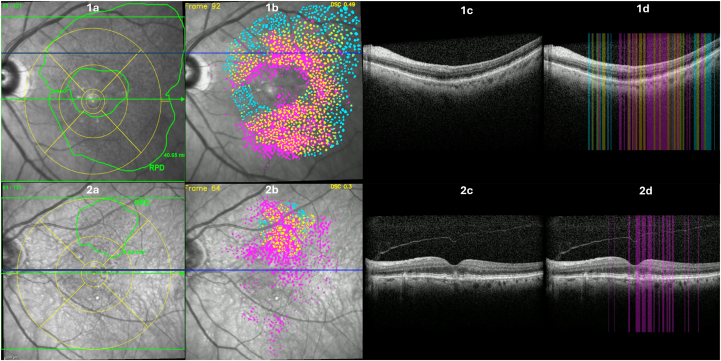 Figure 5
Peer Reviews
No public reviews on file for this paper yet. If you reviewed it on a platform where reviews are public (OpenReview, ICLR, NeurIPS, ICML), you can paste yours below so the community can read it here.
Videos
No videos yet. Explain this paper in a talk, walkthrough, or lecture? Add one.
Taxonomy
TopicsCell Image Analysis Techniques · AI in cancer detection · Cutaneous Melanoma Detection and Management