Prompting and Fine-Tuning Large Language Models for Parkinson Disease Diagnosis: Comparative Evaluation Study Using the PPMI Structured Dataset
Hyun-Ji Shin, Young Jin Jeong, Sungmin Jun, Do-Young Kang

TL;DR
This study compares large language models and traditional machine learning for diagnosing Parkinson's disease using structured clinical data, finding that LLMs can perform well but require careful tuning.
Contribution
The study evaluates LLMs using natural language prompts from structured clinical data for Parkinson's diagnosis, comparing them to traditional ML models.
Findings
LLMs achieved high diagnostic performance comparable to logistic regression on the test set.
LLMs outperformed SVM in the temporal validation set, showing better generalization.
Supervised fine-tuning improved LLM stability and performance on small validation sets.
Abstract
Parkinson disease (PD) presents diagnostic challenges due to its heterogeneous motor and nonmotor manifestations. Traditional machine learning (ML) approaches have been evaluated on structured clinical variables. However, the diagnostic utility of large language models (LLMs) using natural language representations of structured clinical data remains underexplored. This study aimed to evaluate the diagnostic classification performance of multiple LLMs using natural language prompts derived from structured clinical data and to compare their performance with traditional ML baselines. We reformatted structured clinical variables from the Parkinson’s Progression Markers Initiative (PPMI) dataset into natural language prompts and used them as inputs for several LLMs. Variables with high multicollinearity were removed, and the top 10 features were selected using Shapley additive explanations…
Genes, proteins, chemicals, diseases, species, mutations and cell lines named across the full text — each resolved to its canonical identifier and authoritative record.
Click any figure to enlarge with its caption.
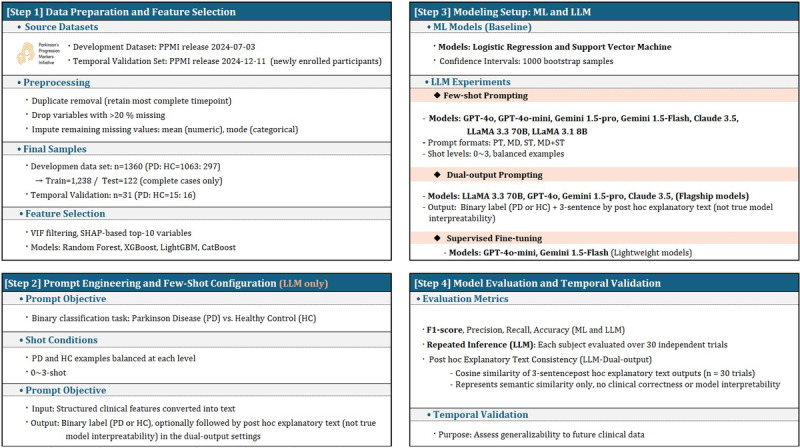 Figure 1
 Figure 10
 Figure 11
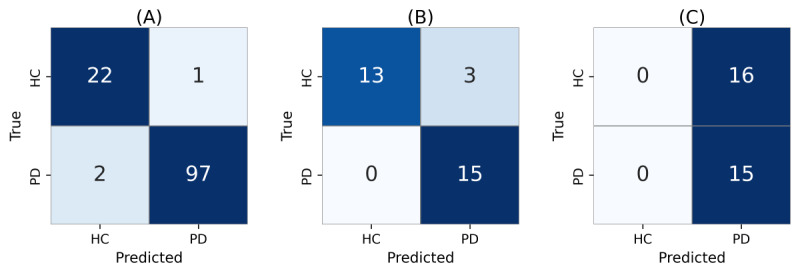 Figure 2
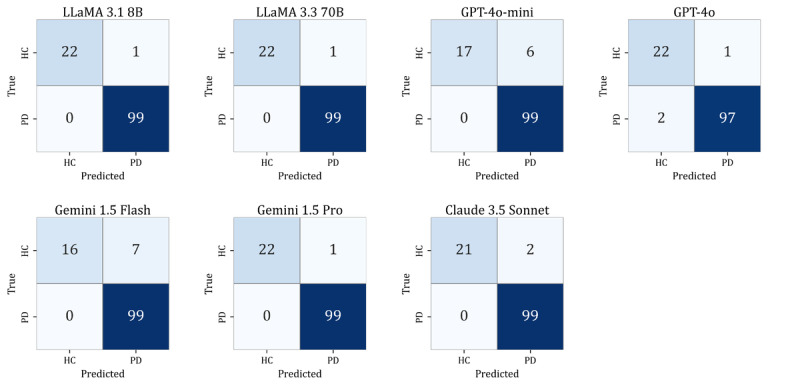 Figure 3
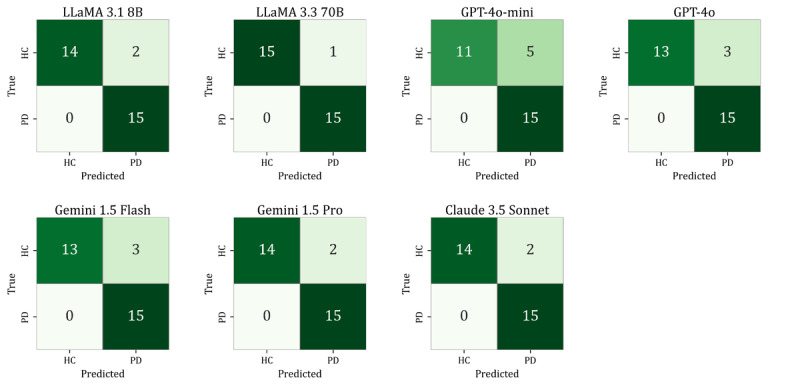 Figure 4
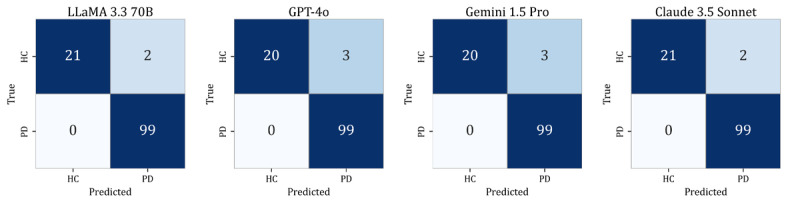 Figure 5
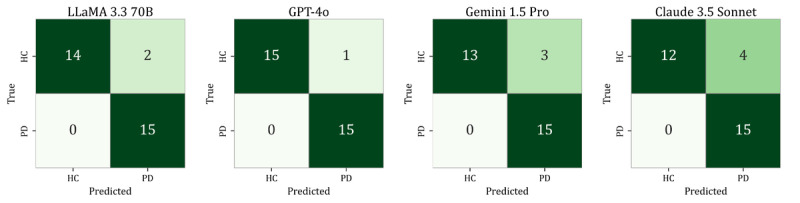 Figure 6
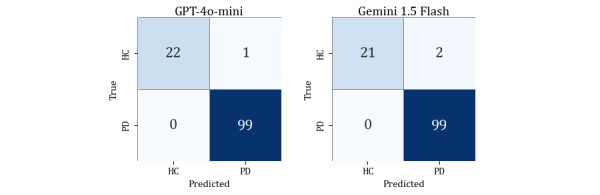 Figure 7
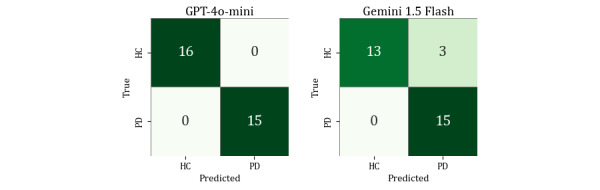 Figure 8
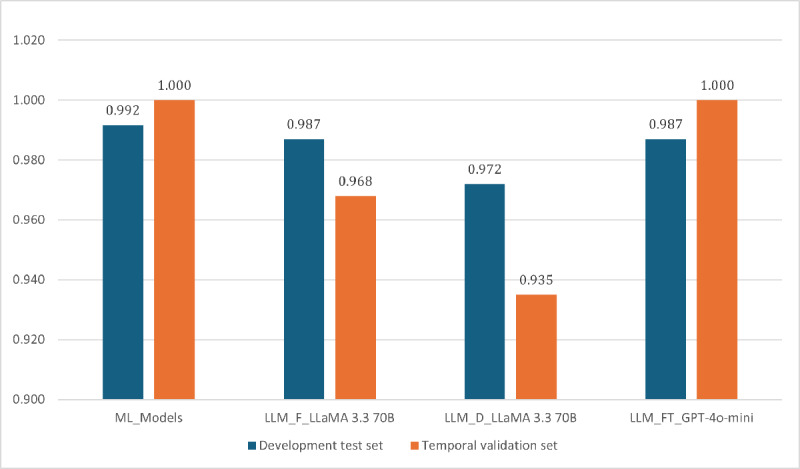 Figure 9
Peer Reviews
No public reviews on file for this paper yet. If you reviewed it on a platform where reviews are public (OpenReview, ICLR, NeurIPS, ICML), you can paste yours below so the community can read it here.
Videos
No videos yet. Explain this paper in a talk, walkthrough, or lecture? Add one.
Taxonomy
TopicsVoice and Speech Disorders · Parkinson's Disease Mechanisms and Treatments · Neurological disorders and treatments