Opioid Prescribing Patterns of Board-Certified Emergency Physicians Compared With Other Physicians Practicing Emergency Medicine Among Medicare Part-D Beneficiaries Between 2018 and 2020 in the United States
Yachana Bhakta, Michael Gottlieb, Susan E. Farrell, Suzanne R. White, Kevin B. Joldersma, Melissa A. Barton, Chadd K. Kraus, Lyndsay Tyler, Bradley Chappell, Jonah Geddes, Diane L. Gorgas

TL;DR
Board-certified emergency medicine physicians prescribed fewer opioids than non-certified physicians in U.S. emergency departments from 2018 to 2020.
Contribution
This study is the first to analyze opioid prescribing patterns of board-certified emergency physicians compared to non-certified ones using Medicare data.
Findings
Board-certified emergency physicians prescribed significantly lower average opioid doses than non-certified physicians.
Non-certified physicians prescribed up to 4 times more opioids per beneficiary for common medications like hydrocodone/acetaminophen.
The study found consistent lower prescribing rates across multiple opioid types for board-certified physicians.
Abstract
There is limited knowledge regarding whether board-certified emergency medicine (EM) physicians have different opioid prescribing rates compared to other physicians working in emergency departments (EDs). This study aims to determine if opioid prescribing rates differ based on board-certification status compared with other physicians practicing in an ED setting. An IRB-approved, cross-sectional analysis was performed on the Medicare Part D Prescribers by Provider and Drug datasets from 2018 to 2020 to determine prescribing rates of EM physicians by board-certification status with the American Board of Emergency Medicine or the American Osteopathic Board of Emergency Medicine. EM physicians prescribing opioids to 11 or more Medicare beneficiaries per calendar year in EDs were included. The average total day supply (TDS) of opioids per beneficiary for the 4 most common opioids…
Genes, proteins, chemicals, diseases, species, mutations and cell lines named across the full text — each resolved to its canonical identifier and authoritative record.
Click any figure to enlarge with its caption.
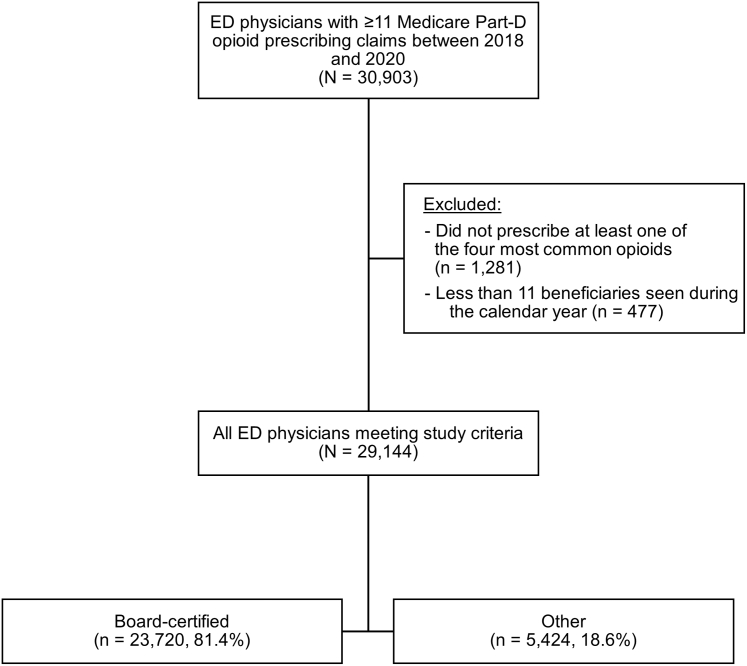 Figure 1
Peer Reviews
No public reviews on file for this paper yet. If you reviewed it on a platform where reviews are public (OpenReview, ICLR, NeurIPS, ICML), you can paste yours below so the community can read it here.
Videos
No videos yet. Explain this paper in a talk, walkthrough, or lecture? Add one.
Taxonomy
TopicsOpioid Use Disorder Treatment · Healthcare professionals’ stress and burnout · Patient Safety and Medication Errors