Theory of Mind Development in Children With Congenital Visual Impairment: Role of Visual Impairment and Verbal Ability
Yong Yang, Boyao Zhao, Linli Xie, Buxin Han

TL;DR
This study examines how children with congenital visual impairment develop theory of mind, finding that verbal ability and age are key factors influencing their social understanding.
Contribution
The study identifies verbal ability and age as key predictors of theory of mind development in children with congenital visual impairment.
Findings
Children with total blindness had significantly lower false-belief scores than sighted children.
Verbal ability moderated differences in theory of mind tasks between children with visual impairments and sighted children.
Age and verbal ability, but not residual vision, significantly predict theory of mind development in children with congenital visual impairment.
Abstract
This study aims to explore the theory of mind (ToM) status in individuals with congenital visual impairment (CVI) and identify key predictive factors. For Study 1, the false‐belief task was used to assess ToM ability in children aged 7–10 years (60 with normal sight, 33 with legal blindness, and 23 with total blindness). The results showed that children with total blindness had significantly lower false‐belief scores than sighted children, with those with legal blindness performing in between. In the first‐order false‐belief task, verbal ability only moderated differences between children with total blindness and sighted children. Meanwhile, in the second‐order false‐belief task, verbal ability moderated differences between children with total blindness and sighted children and between children with legal blindness and sighted children. For Study 2, the faux pas task was used to examine…
Genes, proteins, chemicals, diseases, species, mutations and cell lines named across the full text — each resolved to its canonical identifier and authoritative record.
Click any figure to enlarge with its caption.
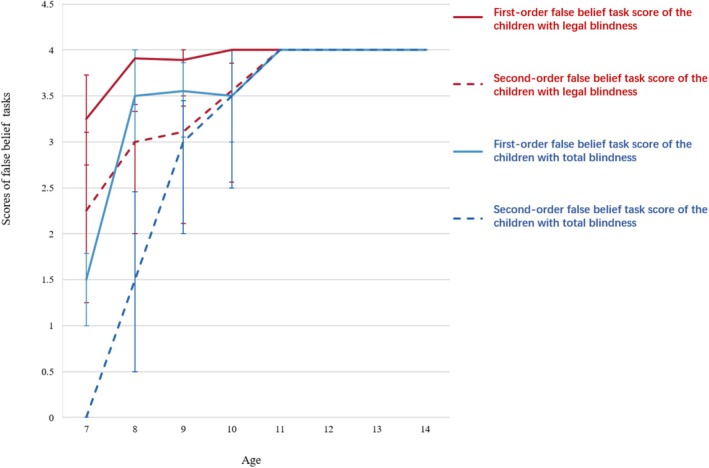 Figure 1
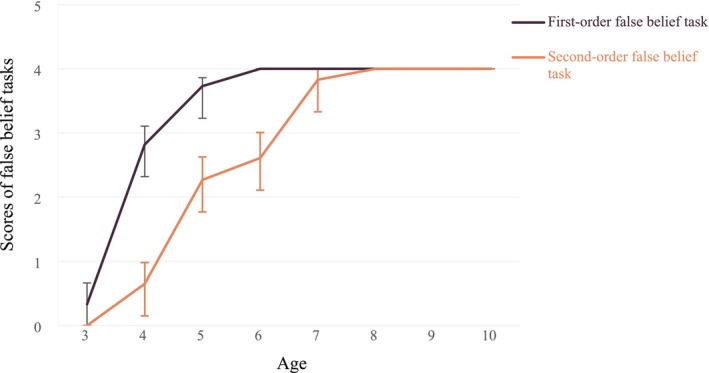 Figure 2
Peer Reviews
No public reviews on file for this paper yet. If you reviewed it on a platform where reviews are public (OpenReview, ICLR, NeurIPS, ICML), you can paste yours below so the community can read it here.
Videos
No videos yet. Explain this paper in a talk, walkthrough, or lecture? Add one.
Taxonomy
TopicsChild and Animal Learning Development · Ophthalmology and Visual Impairment Studies · Tactile and Sensory Interactions