Age and Language Effects on Temporal Cognition in Chinese and English
Rong Bao

TL;DR
The study shows how Chinese and English speakers differ in their mental representations of time, with Chinese speakers focusing more on the future and English speakers on the past.
Contribution
It reveals that native Chinese speakers use a future-oriented S-Time reference frame, while English speakers use a D-Time frame, highlighting cultural influences on temporal cognition.
Findings
Younger and older L1 Chinese speakers differ in temporal focus but consistently use a future-facing S-Time reference.
L1 English speakers prefer a D-Time frame, mapping 'front' to the future and 'back' to the past.
Cultural background shapes dominant temporal reference frames, overriding age-related shifts in focus.
Abstract
Younger and older L1 Chinese speakers differ in where they place their focus—young adults look more to the future, while older adults value the past—yet neither group faces toward the past. Instead, all L1 Chinese participants consistently adopt a future‐facing perspective. When interpreting ambiguous temporal expressions, they rely on S‐Time: “前” (“qian”, front) refers to earlier (past) moments and “后” (“hou”, back) to later (future) moments. This reflects a reference frame of S‐Time rather than a backward orientation toward the past. In contrast, L1 English speakers prefer D‐Time, mapping “front” onto the future and “back” onto the past. Together, these findings show that although age shifts temporal focus among L1 Chinese speakers, cultural and values background determines the dominant reference frames of temporal representations and cognition—S‐Time for L1 Chinese speakers and…
Genes, proteins, chemicals, diseases, species, mutations and cell lines named across the full text — each resolved to its canonical identifier and authoritative record.
Click any figure to enlarge with its caption.
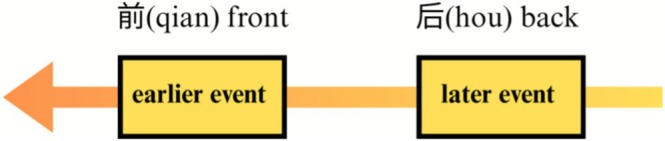 Figure 1
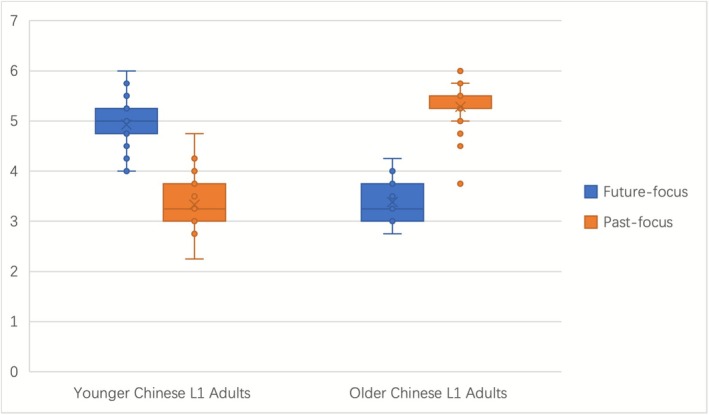 Figure 2
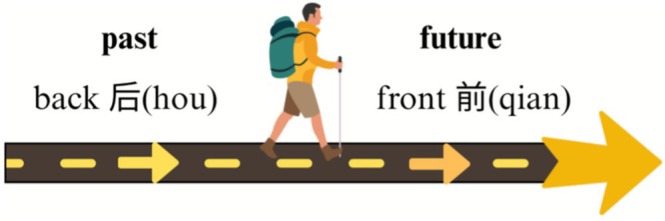 Figure 3
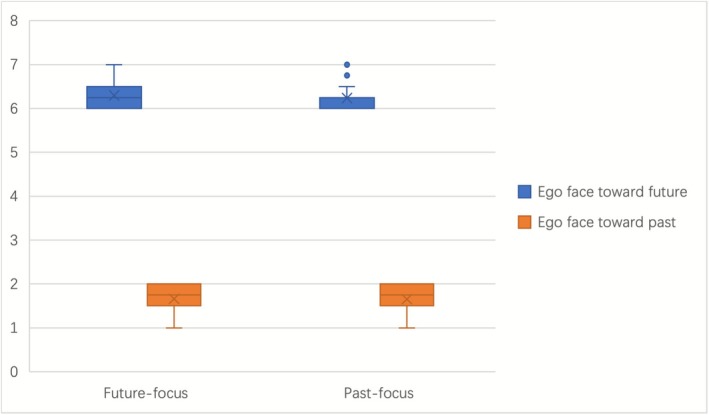 Figure 4
Peer Reviews
No public reviews on file for this paper yet. If you reviewed it on a platform where reviews are public (OpenReview, ICLR, NeurIPS, ICML), you can paste yours below so the community can read it here.
Videos
No videos yet. Explain this paper in a talk, walkthrough, or lecture? Add one.
Taxonomy
TopicsCategorization, perception, and language · Neurobiology of Language and Bilingualism · Identity, Memory, and Therapy