A Participatory Artificial Intelligence Driven Shift‐Scheduling Application for Improving Sleep Among Shift‐Working Caregivers: A 4‐Month Non‐Randomised Controlled Study With Cross‐Over Design
Tomohide Kubo, Shun Matsumoto, Yuki Nishimura, Hiroki Ikeda, Shuhei Izawa, Fumihiko Sato

Abstract
Here, we examine the effectiveness of a participatory artificial intelligence (AI)‐driven shift‐scheduling mobile application (which reflects the local improvement needs in shift scheduling) in improving the sleep quality of shift‐working geriatric caregivers. Thirty‐five shift‐working geriatric caregivers participated in this 4‐month cross‐over interventional study. Half of the participants in the first 2 months followed the intervention schedule created by the AI‐driven shift‐scheduling mobile application, while the remaining participants followed the manually created control schedule. The improvement needs in shift scheduling, derived from occupational‐fatigue counselling, were as follows: avoiding backward rotating shifts, reducing consecutive shifts, extending shift intervals and ensuring a day‐off after a night shift. Sleep phases were evaluated using a ring‐type sleep tracker.…
Genes, proteins, chemicals, diseases, species, mutations and cell lines named across the full text — each resolved to its canonical identifier and authoritative record.
Click any figure to enlarge with its caption.
 Figure 1
 Figure 2
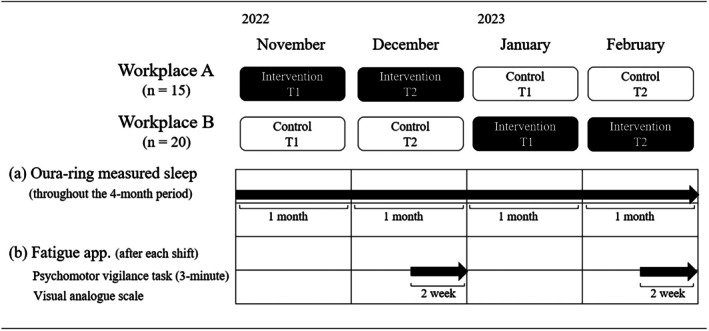 Figure 3
Peer Reviews
No public reviews on file for this paper yet. If you reviewed it on a platform where reviews are public (OpenReview, ICLR, NeurIPS, ICML), you can paste yours below so the community can read it here.
Videos
No videos yet. Explain this paper in a talk, walkthrough, or lecture? Add one.
Taxonomy
TopicsSleep and Work-Related Fatigue · Sleep and related disorders · Workplace Health and Well-being