Switching Metazoan Fatty Acid Synthase Between Reducing and Nonreducing Elongation Mode via Programming of the Ketoreductase Domain
Damian L. Ludig, André Herber, Martin Grininger

TL;DR
Researchers modified fatty acid synthase to switch between fully reducing and nonreducing modes, enabling the production of complex pyrone compounds.
Contribution
A helix motif from PKS ketoreductase domains was introduced into fatty acid synthase to control elongation mode and produce pyrones.
Findings
Modified FAS variants produced intermediates that cyclized into pyrone products.
A new amino acid involved in intermediate protonation was identified in the KR domain.
The study provides insights into programming FASs for iterative biosynthesis.
Abstract
Polyketides constitute a large class of natural products with important biological activities and applications such as antibiotics, antitumor agents, pesticides, and pigments. Their biosynthesis is catalyzed by polyketide synthases (PKSs) which are multidomain enzymes evolutionarily related to fatty acid synthases (FASs). Despite their close homology in structure and the chemistry they perform, FASs and PKSs differ fundamentally in their catalytic programming: FASs run fully reducing elongation reactions to yield saturated fatty acids, while iterative PKSs execute reductions just in selected cycles, generating complex oxidized compounds. In this study, we aimed at engineering the metazoan FAS in its ketoreduction (KR) domain to switch from fully reducing to a nonreducing mode during chain elongation. Guided by recent insights into KR programming, we incorporated a helix into metazoan…
Genes, proteins, chemicals, diseases, species, mutations and cell lines named across the full text — each resolved to its canonical identifier and authoritative record.
Click any figure to enlarge with its caption.
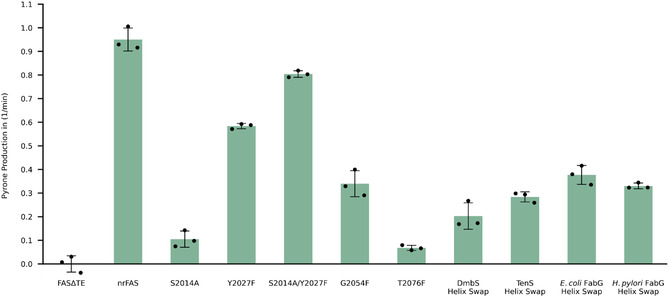 Figure 1
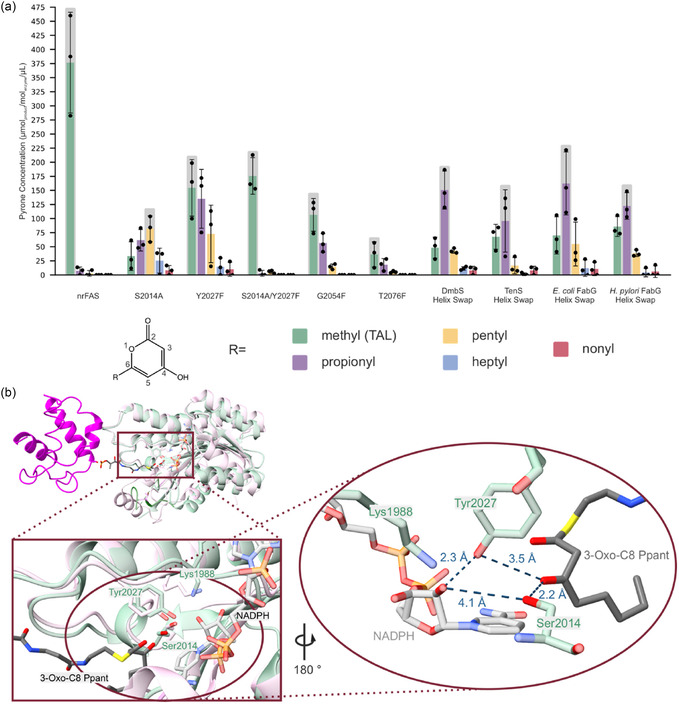 Figure 2
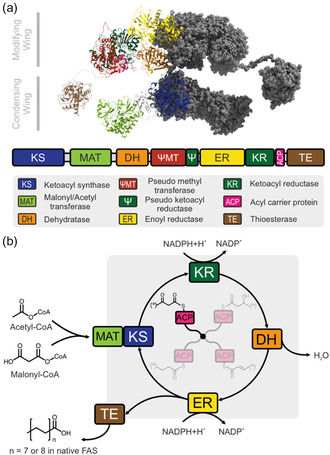 Figure 3
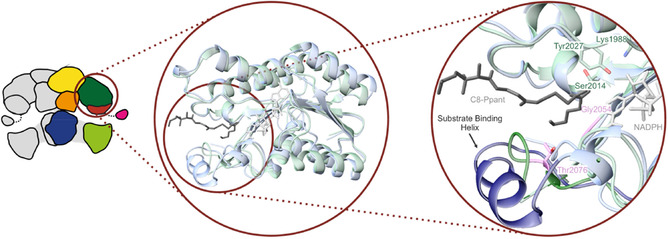 Figure 4
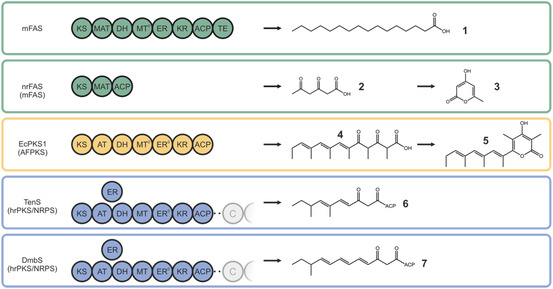 Figure 5
 Figure 6
Peer Reviews
No public reviews on file for this paper yet. If you reviewed it on a platform where reviews are public (OpenReview, ICLR, NeurIPS, ICML), you can paste yours below so the community can read it here.
Videos
No videos yet. Explain this paper in a talk, walkthrough, or lecture? Add one.
Taxonomy
TopicsMicrobial Natural Products and Biosynthesis · Synthetic Organic Chemistry Methods · Microbial Metabolic Engineering and Bioproduction