Submicroscopic 16q24.2–q24.3 deletion in a family with nonsyndromic short stature
Chisato Narita, Hidekazu Utsunomiya, Junpei Hamada, Ikuko Kageyama, Maki Fukami, Akie Nakamura

TL;DR
A family with unexplained short stature was found to have a rare genetic deletion on chromosome 16, suggesting a possible link to growth-related genes.
Contribution
The study reports a novel ~1.5-Mb deletion at 16q24.2–q24.3 associated with nonsyndromic short stature.
Findings
Array-based comparative genomic hybridization identified a heterozygous deletion in the 16q24.2–q24.3 region.
Whole-exome sequencing found no pathogenic variants, pointing to the deletion as a likely cause.
The deletion region may contain genes or regulatory elements important for skeletal growth.
Abstract
Array-based comparative genomic hybridization for a boy, his mother and his half-sister with etiology-unknown nonsyndromic short stature identified a hitherto unreported heterozygous ~1.5-Mb deletion at 16q24.2–q24.3. Whole-exome sequencing detected no pathogenic variants. Our results, in conjunction with previous reports of cases with similar deletions, indicate that the 16q24.2–q24.3 region provides a platform for submicroscopic deletions and possibly contains a gene(s) or regulatory elements involved in skeletal growth.
Genes, proteins, chemicals, diseases, species, mutations and cell lines named across the full text — each resolved to its canonical identifier and authoritative record.
Click any figure to enlarge with its caption.
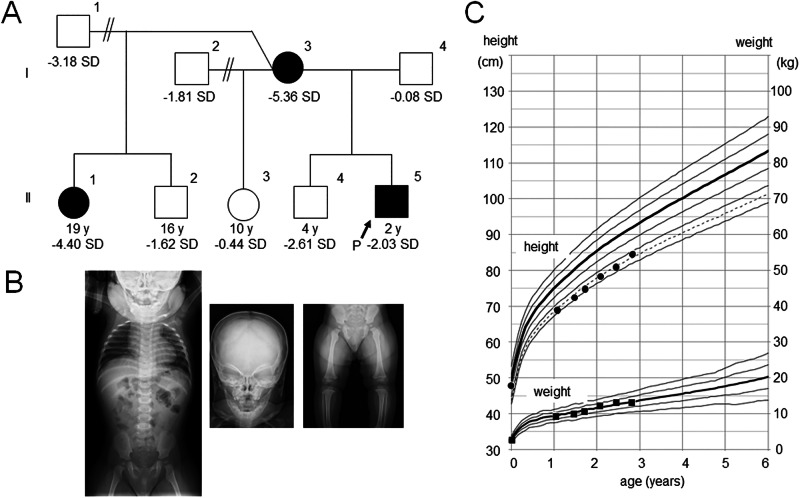 Figure 1
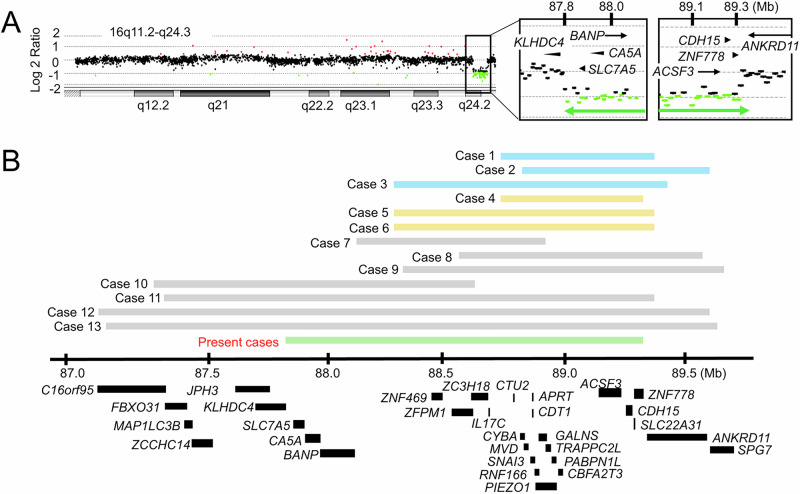 Figure 2
Peer Reviews
No public reviews on file for this paper yet. If you reviewed it on a platform where reviews are public (OpenReview, ICLR, NeurIPS, ICML), you can paste yours below so the community can read it here.
Videos
No videos yet. Explain this paper in a talk, walkthrough, or lecture? Add one.
Taxonomy
TopicsGenomic variations and chromosomal abnormalities · Congenital limb and hand anomalies · Growth Hormone and Insulin-like Growth Factors