Collection of fluorescence from an ion using trap-integrated photonics
Felix W. Knollmann, Sabrina M. Corsetti, Ethan R. Clements, Reuel Swint, Aaron D. Leu, May E. Kim, Patrick T. Callahan, Dave Kharas, Thomas Mahony, Cheryl Sorace-Agaskar, Robert McConnell, Colin D. Bruzewicz, Isaac L. Chuang, Jelena Notaros, John Chiaverini

TL;DR
Researchers developed a chip-integrated method to collect photons from a trapped ion, improving stability and scalability for quantum information processing.
Contribution
A new grating design technique enables efficient photon collection from a trapped ion into a single-mode waveguide.
Findings
The integrated optic collects 0.043% of spontaneously emitted light into a single-mode waveguide.
The method enables imaging and quantum state detection of the ion with high reproducibility.
The grating design extends the effective aperture for improved photon collection.
Abstract
Spontaneously emitted photons are entangled with the electronic and nuclear degrees of freedom of the emitting atom, so interference and measurement of these photons can entangle separate matter-based quantum systems as a resource for quantum information processing. Since confinement in a single-mode facilitates the photon interference needed for generating entanglement, the dipole emission patterns relevant in spontaneous emission present a mode-matching challenge. Current demonstrations rely on bulk photon-collection and manipulation optics that suffer from large component size and system-to-system variability—factors that impede scaling to the large numbers of entangled pairs needed for quantum information processing. To address these limitations, we demonstrate a collection method that enables passive phase stability, straightforward photonic manipulation, and intrinsic…
Genes, proteins, chemicals, diseases, species, mutations and cell lines named across the full text — each resolved to its canonical identifier and authoritative record.
Click any figure to enlarge with its caption.
 Figure 1
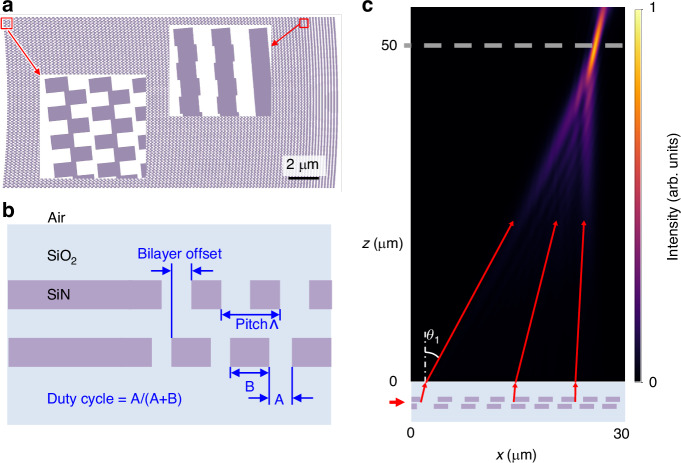 Figure 2
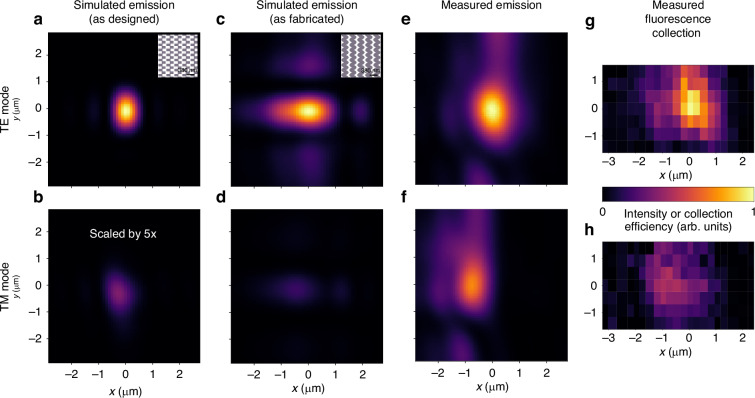 Figure 3
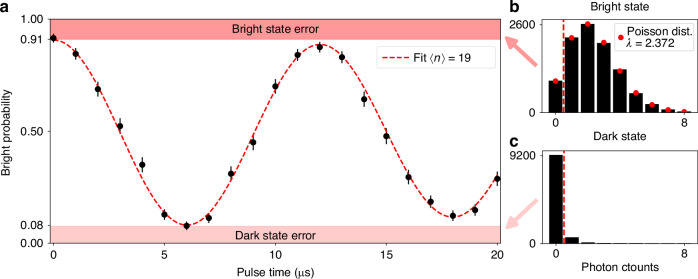 Figure 4
 Figure 5
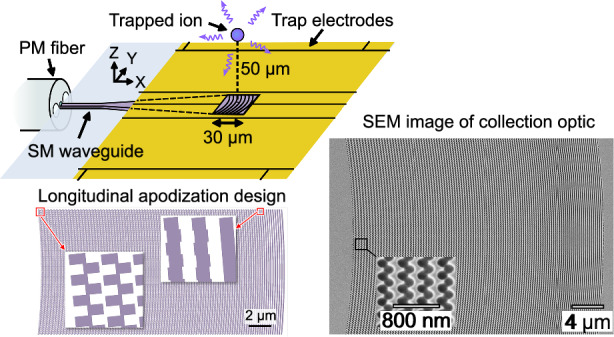 Figure 6
Peer Reviews
No public reviews on file for this paper yet. If you reviewed it on a platform where reviews are public (OpenReview, ICLR, NeurIPS, ICML), you can paste yours below so the community can read it here.
Videos
No videos yet. Explain this paper in a talk, walkthrough, or lecture? Add one.
Taxonomy
TopicsQuantum Information and Cryptography · Mechanical and Optical Resonators · Quantum optics and atomic interactions