Axillary surgery in patients with sentinel node macrometastases: secondary results of the randomized INSEMA trial
Toralf Reimer, Angrit Stachs, Kristina Veselinovic, Thorsten Kuehn, Joerg Heil, Silke Polata, Frederik Marme, Elisabeth Trapp, Guido Hildebrandt, David Krug, Beyhan Ataseven, Roland Reitsamer, Sylvia Ruth, Carsten Denkert, Inga Bekes, Nicole Stahl, Marc Thill

TL;DR
This study compares two surgical approaches for breast cancer patients with macrometastases in sentinel nodes and finds no significant difference in survival outcomes.
Contribution
The study provides new evidence on the non-inferiority of sentinel lymph node biopsy alone compared to full lymph node dissection in specific breast cancer patients.
Findings
No significant difference in invasive disease-free survival between the two surgical approaches.
Low locoregional recurrence rates in both treatment arms.
Overall survival rates were similar between the groups.
Abstract
The sub-study of the INSEMA trial (randomization-2) compares completion axillary lymph node dissection (cALND) with sentinel lymph node biopsy (SLNB) alone in cN0 patients with T1/T2 invasive breast cancer and one to three sentinel node macrometastases undergoing upfront breast-conserving surgery. The key secondary objective is to assess whether the SLNB-alone arm is non-inferior to cALND in terms of invasive disease-free survival (iDFS). Finally, 485 patients were recruited, and 386 patients (cALND: N = 169, SLNB alone: N = 217) were included in the per-protocol set. The median follow-up is 74.2 months. The 5-year iDFS analysis in the per-protocol set demonstrates a non-significant difference between study arms, with a hazard ratio (HR) of 1.69 (95% CI: 0.98-2.94) for SLNB alone compared to cALND. The 5-year iDFS rates are 86.6% (81.0%-90.7%) in the SLNB-alone arm and 93.8%…
Genes, proteins, chemicals, diseases, species, mutations and cell lines named across the full text — each resolved to its canonical identifier and authoritative record.
Click any figure to enlarge with its caption.
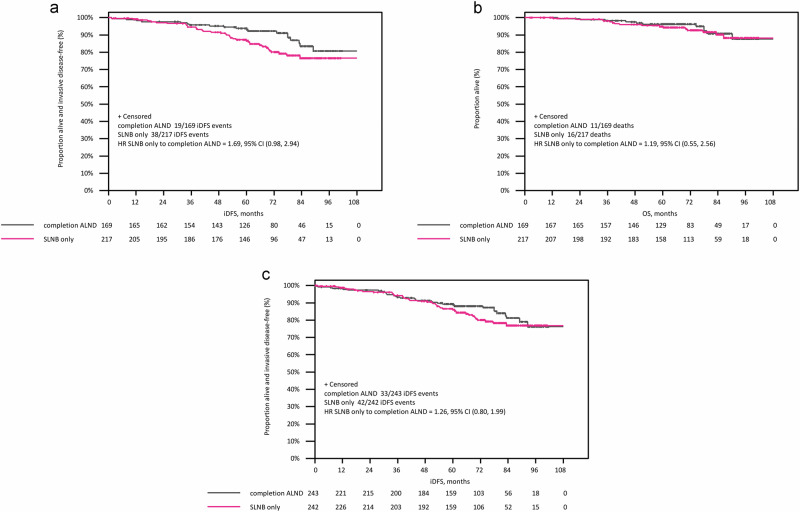 Figure 1
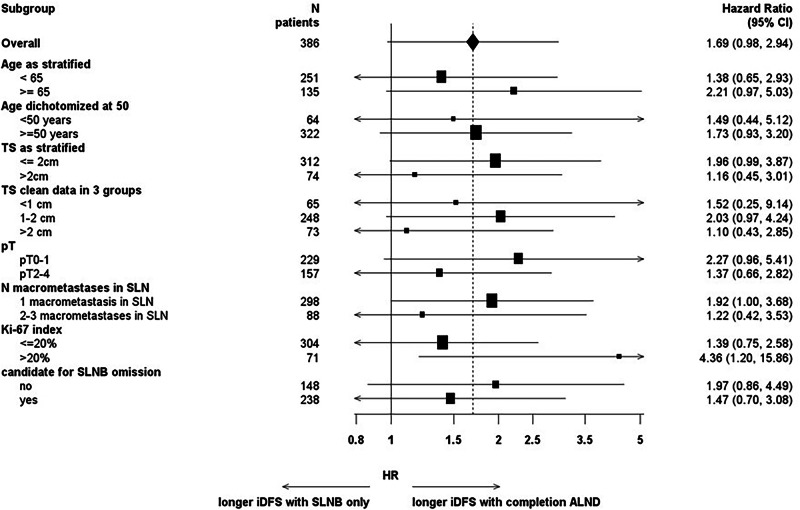 Figure 2
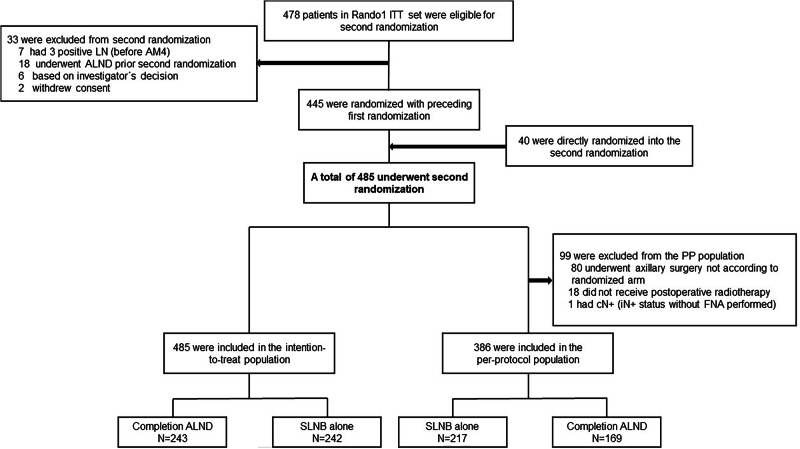 Figure 3
Peer Reviews
No public reviews on file for this paper yet. If you reviewed it on a platform where reviews are public (OpenReview, ICLR, NeurIPS, ICML), you can paste yours below so the community can read it here.
Videos
No videos yet. Explain this paper in a talk, walkthrough, or lecture? Add one.
Taxonomy
TopicsBreast Cancer Treatment Studies · Breast Implant and Reconstruction · Breast Lesions and Carcinomas