Auxin accumulation in cereals after infection by Fusarium graminearum: putative biosynthetic pathways and preferences
Huanzhang Shang, Bo Ji, Thérèse Ouellet, Guangwei Li, Boliao Li, Xiulin Chen, Kun Luo

TL;DR
This paper reviews how the fungus Fusarium graminearum causes increased accumulation of the plant hormone auxin in cereals, and explores possible biosynthetic pathways and strategies for controlling the resulting disease.
Contribution
The paper provides a comprehensive review of the molecular mechanisms and pathways involved in auxin accumulation in cereals infected by Fusarium graminearum.
Findings
Fusarium graminearum infection increases auxin (IAA) levels in cereals through L-tryptophan-dependent pathways.
Infection may also trigger serotonin and phytomelatonin production in wheat, which can stimulate IAA accumulation.
Identifying fungal effectors involved in IAA accumulation could aid in developing scab-resistant wheat cultivars.
Abstract
Indole-3-acetic acid (IAA) is a major naturally occurring auxin that shows extensive accumulation in cereal plants during the first few days of infection by the phytopathogen Fusarium graminearum. Apart from its positive effects on plant growth, empirical studies have suggested that it is a virulence factor that alters the host’s nutritional level and fine-tunes the plant’s immune responses, especially salicylic acid-mediated defenses. Plant and fungus genomic studies have predicted that their genomes carry the required genes for L-tryptophan-dependent IAA biosynthetic pathways. In recent decades, genetic and genomic studies have facilitated the description of L-tryptophan (L-TRP)-dependent IAA biosynthetic pathways in F. graminearum and its host plants. The present review illustrates and summarizes the putative and preference molecular networks related to extensive IAA accumulation in…
Genes, proteins, chemicals, diseases, species, mutations and cell lines named across the full text — each resolved to its canonical identifier and authoritative record.
Click any figure to enlarge with its caption.
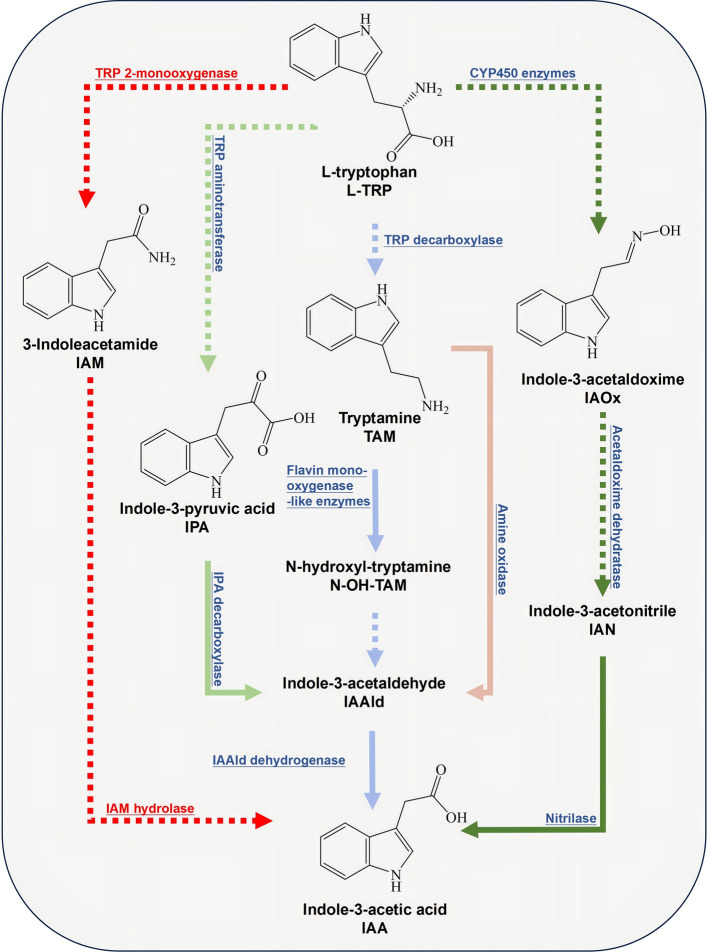 Figure 1
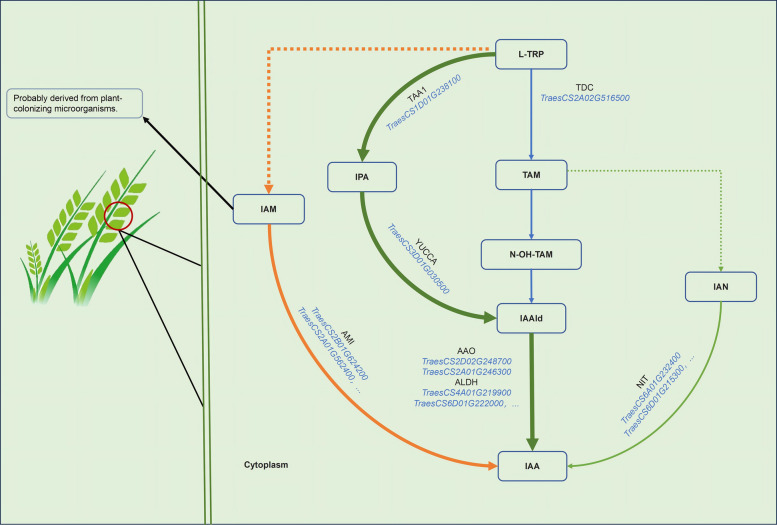 Figure 2
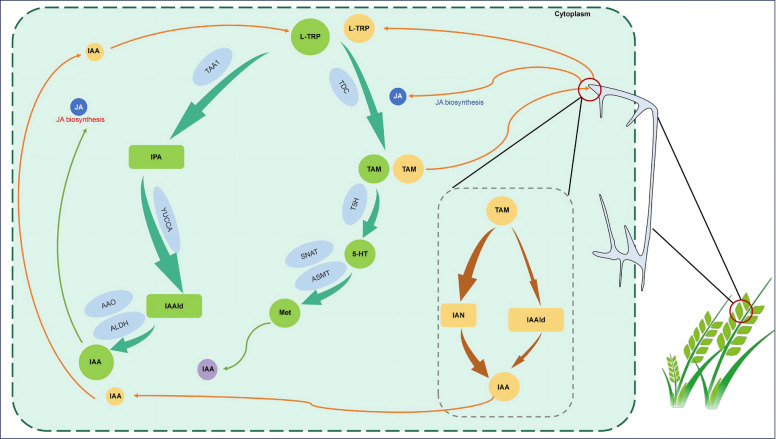 Figure 3
Peer Reviews
No public reviews on file for this paper yet. If you reviewed it on a platform where reviews are public (OpenReview, ICLR, NeurIPS, ICML), you can paste yours below so the community can read it here.
Videos
No videos yet. Explain this paper in a talk, walkthrough, or lecture? Add one.
Taxonomy
TopicsPlant-Microbe Interactions and Immunity · Plant Disease Resistance and Genetics · Mycotoxins in Agriculture and Food